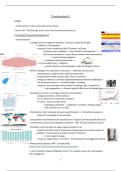
Biological Molecules
Monomers and Polymers
Monomers are the smaller units from which larger molecules are made
Polymers are made from a large number of monomers joined together
Condensation reactions join two molecules together. A molecule of water is released
and a chemical bond is formed
Hydrolysis reactions breaks a chemical bond between two molecules using a molecule
of water
Carbohydrates
Monomers: monosaccharides
Form glycosidic bonds
Disaccharides are formed by the condensation of two monosaccharides:
o Glucose + glucose maltose
o Glucose + fructose sucrose
o Glucose + galactose lactose
Glucose has two isomers, alpha glucose and beta glucose:
,Polysaccharides
STARCH (alpha glucose)
Function: store excess glucose for plants
Structure: amylose and amylopectin:
o Amylose
o Long, unbranched chain compact SO good for storage
o Angles of glycosidic bonds coiled SO good for storage
o Amylopectin
o Long, branched chain more access points for enzymes SO glucose can
be released quickly
o Insoluble in water so doesn’t affect water potential SO no influx of
water by osmosis
GLYCOGEN (alpha glucose)
Function: store excess glucose for animals
Structure:
o Long, branched chain SO more access points for enzymes so glucose can be
released quickly
o Compact SO good for storage
CELLULOSE (beta glucose)
Function: forms cells walls in plants
Structure:
o Long, unbranched chains of beta glucose
o Straight chains linked together by hydrogen bonds form strong fibres called
microfibrils SO provide structural support for cell walls
Biochemical tests
BENEDICT’S TEST
JUST FOR NON-REDUCING SUGARS:
1. Add dilute HCl to sample
2. Heat sample
3. Add NaHCO3 to neutralise sample
FOR REDUCING AND NON-REDUCING SUGARS:
1. Heat sample with Benedict’s reagent (blue)
2. Forms coloured precipitate (intensity of colour change dependent on concentration of
reducing sugar, goes as far as brick-red)
IODINE TEST FOR STARCH
1. Add iodine dissolved in potassium iodide solution to sample
2. Sample changes from browny-orange to dark blue/black
,Lipids
TRIGLYCERIDES
One glycerol (-OH) attached to three fatty acids (-OOH)
Fatty acids have carboxylic acid functional group attached to hydrocarbon tail, which can
be saturated or unsaturated
Ester bonds form by condensation reactions between glycerol and fatty acids
Function: energy storage
o Hydrocarbon tails contain lots of chemical energy which is released when they
are broken down
o Insoluble in water so do not affect water potential and cause influx of water by
osmosis
o Bundle together as insoluble droplets because hydrocarbon tails are
hydrophobic so face inwards
PHOSHOLIPIDS
One glycerol (-OH) attached to two fatty acids (-OOH) and one phosphate group
Phosphate group is hydrophilic
Fatty acid tails are hydrophobic
Function: make up cell membrane phospholipid bilayer
o Heads face out towards water and tails face inwards acts as barrier to water-
soluble substances
EMULSION TEST FOR LIPIDS
1. Shake test sample with ethanol for one minute
2. Pour solution into water
3. Formation of milky emulsion
, Proteins
Monomers: amino acids
Form peptide bonds by condensation reactions
Two amino acids: dipeptide
More than two amino acids: polypeptide
One or more polypeptides: protein
General structure (shared by all twenty amino acids):
Primary structure: Sequence of amino acids in polypeptide chain
Secondary structure: Hydrogen bonds form coils/folds into alpha-helixes/beta-
pleated sheets
Tertiary structure: Coils/folds further formation of hydrogen bonds/ionic
bonds/disulfide bridges
Quaternary structure: Several different polypeptide chains
Proteins have a variety of functions: eg enzymes, antibodies, transport proteins,
structural proteins
Biuret test for proteins
Add a few drops of NaOH
Add some CuSO4 solution
Solution will turn purple
Enzymes
Enzymes are proteins that act as biological catalysts by providing an alternative route of
reaction with a lower activation energy
They have an active site with a unique tertiary structure which allows it to bind with a
complementary substrate to form an enzyme-substrate complex
Induced fit model: as the substrate binds, the active site changes shape slightly to fit
around it the right way
Nucleic Acids
Monomers and Polymers
Monomers are the smaller units from which larger molecules are made
Polymers are made from a large number of monomers joined together
Condensation reactions join two molecules together. A molecule of water is released
and a chemical bond is formed
Hydrolysis reactions breaks a chemical bond between two molecules using a molecule
of water
Carbohydrates
Monomers: monosaccharides
Form glycosidic bonds
Disaccharides are formed by the condensation of two monosaccharides:
o Glucose + glucose maltose
o Glucose + fructose sucrose
o Glucose + galactose lactose
Glucose has two isomers, alpha glucose and beta glucose:
,Polysaccharides
STARCH (alpha glucose)
Function: store excess glucose for plants
Structure: amylose and amylopectin:
o Amylose
o Long, unbranched chain compact SO good for storage
o Angles of glycosidic bonds coiled SO good for storage
o Amylopectin
o Long, branched chain more access points for enzymes SO glucose can
be released quickly
o Insoluble in water so doesn’t affect water potential SO no influx of
water by osmosis
GLYCOGEN (alpha glucose)
Function: store excess glucose for animals
Structure:
o Long, branched chain SO more access points for enzymes so glucose can be
released quickly
o Compact SO good for storage
CELLULOSE (beta glucose)
Function: forms cells walls in plants
Structure:
o Long, unbranched chains of beta glucose
o Straight chains linked together by hydrogen bonds form strong fibres called
microfibrils SO provide structural support for cell walls
Biochemical tests
BENEDICT’S TEST
JUST FOR NON-REDUCING SUGARS:
1. Add dilute HCl to sample
2. Heat sample
3. Add NaHCO3 to neutralise sample
FOR REDUCING AND NON-REDUCING SUGARS:
1. Heat sample with Benedict’s reagent (blue)
2. Forms coloured precipitate (intensity of colour change dependent on concentration of
reducing sugar, goes as far as brick-red)
IODINE TEST FOR STARCH
1. Add iodine dissolved in potassium iodide solution to sample
2. Sample changes from browny-orange to dark blue/black
,Lipids
TRIGLYCERIDES
One glycerol (-OH) attached to three fatty acids (-OOH)
Fatty acids have carboxylic acid functional group attached to hydrocarbon tail, which can
be saturated or unsaturated
Ester bonds form by condensation reactions between glycerol and fatty acids
Function: energy storage
o Hydrocarbon tails contain lots of chemical energy which is released when they
are broken down
o Insoluble in water so do not affect water potential and cause influx of water by
osmosis
o Bundle together as insoluble droplets because hydrocarbon tails are
hydrophobic so face inwards
PHOSHOLIPIDS
One glycerol (-OH) attached to two fatty acids (-OOH) and one phosphate group
Phosphate group is hydrophilic
Fatty acid tails are hydrophobic
Function: make up cell membrane phospholipid bilayer
o Heads face out towards water and tails face inwards acts as barrier to water-
soluble substances
EMULSION TEST FOR LIPIDS
1. Shake test sample with ethanol for one minute
2. Pour solution into water
3. Formation of milky emulsion
, Proteins
Monomers: amino acids
Form peptide bonds by condensation reactions
Two amino acids: dipeptide
More than two amino acids: polypeptide
One or more polypeptides: protein
General structure (shared by all twenty amino acids):
Primary structure: Sequence of amino acids in polypeptide chain
Secondary structure: Hydrogen bonds form coils/folds into alpha-helixes/beta-
pleated sheets
Tertiary structure: Coils/folds further formation of hydrogen bonds/ionic
bonds/disulfide bridges
Quaternary structure: Several different polypeptide chains
Proteins have a variety of functions: eg enzymes, antibodies, transport proteins,
structural proteins
Biuret test for proteins
Add a few drops of NaOH
Add some CuSO4 solution
Solution will turn purple
Enzymes
Enzymes are proteins that act as biological catalysts by providing an alternative route of
reaction with a lower activation energy
They have an active site with a unique tertiary structure which allows it to bind with a
complementary substrate to form an enzyme-substrate complex
Induced fit model: as the substrate binds, the active site changes shape slightly to fit
around it the right way
Nucleic Acids