Meiosis and Variation
Why is meiosis required and why do we need to halve the chromosome number ?
During sexual reproduction fuse during fertilisation offspring (
zygote )
two
gametes to
give rise to
•
a new .
Hence in order maintain constant number of in adults of of
to chromosomes the species the
-
a a
,
number
chromosomes must be halved at some stage -
this occurs as a result of meiosis .
Definitions
→ A is length of DNA that codes for
polypeptide
gene a a .
→ Locus is the position of a chromosome DNA molecule
gene on a or .
→ An allele is of the different forms of
one a particular gene .
Homologous
→
chromosomes are a pair of chromosomes , one maternal
and have the
one
paternal ,
that same
gene loci .
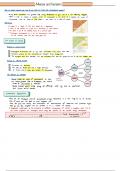
The process of meiosis
%
÷ ÷÷.÷
Meiosis 1 ( First Division )
1
Homologous chromosomes pair up and their chromatids
wrap around each other .
2
Equivalent portions of the chromatids are
exchanged during crossing over .
3 The
homologous pairs have separated ,
with one chromosome from each pair going into one of the two daughter cells .
23
Meiosis 2 ( second division )
_•-
1-
46 *
Chromatids are separated .
paternal 23
2 Four cells are formed each with a
single chromatid .
chromosome
€•§
•
92 * _•-
3 In humans ,
each of these cells contains 23 chromosomes .
=•-_ meiosis 1 meiosis 2
The £-70 46
function of meiosis 23
A
of maternal
•
•
Meiosis halves the number chromosomes so when
chromosome
two haploid gametes fuse at fertilisation ,
the diploid a
23
number of chromosomes is restored . -•-
•
Meiosis produces genetic variation among
the offspring ,
which
may
lead to adaptations
that
improve survival chances .
"
Independent
--------------%
segregation
¥4
-
when the 23 homologous pairs of chromosomes themselves in a line
they do so at random
arrange
, .
One of each will to
daughter cell
-
pair pass each .
since the random combination of chromosomes of maternal and paternal
the
origin
'
are
pairs ,
1 matter of
that
go into the daughter cell at meiosis is a chance .
different of
→
Independent assortment is the production of combinations alleles in daughter cells due to
the random
alignment of homologous pairs along the equator of the
spindle during metaphase .
"
- - -
- - - - - - - - - -
- - - - - - - - - -
Total combinations =2
Lt
£ ¥{§ .
. . . .
.
- n . .
. .
M P .
. .
. .
1in humans )
Why is meiosis required and why do we need to halve the chromosome number ?
During sexual reproduction fuse during fertilisation offspring (
zygote )
two
gametes to
give rise to
•
a new .
Hence in order maintain constant number of in adults of of
to chromosomes the species the
-
a a
,
number
chromosomes must be halved at some stage -
this occurs as a result of meiosis .
Definitions
→ A is length of DNA that codes for
polypeptide
gene a a .
→ Locus is the position of a chromosome DNA molecule
gene on a or .
→ An allele is of the different forms of
one a particular gene .
Homologous
→
chromosomes are a pair of chromosomes , one maternal
and have the
one
paternal ,
that same
gene loci .
The process of meiosis
%
÷ ÷÷.÷
Meiosis 1 ( First Division )
1
Homologous chromosomes pair up and their chromatids
wrap around each other .
2
Equivalent portions of the chromatids are
exchanged during crossing over .
3 The
homologous pairs have separated ,
with one chromosome from each pair going into one of the two daughter cells .
23
Meiosis 2 ( second division )
_•-
1-
46 *
Chromatids are separated .
paternal 23
2 Four cells are formed each with a
single chromatid .
chromosome
€•§
•
92 * _•-
3 In humans ,
each of these cells contains 23 chromosomes .
=•-_ meiosis 1 meiosis 2
The £-70 46
function of meiosis 23
A
of maternal
•
•
Meiosis halves the number chromosomes so when
chromosome
two haploid gametes fuse at fertilisation ,
the diploid a
23
number of chromosomes is restored . -•-
•
Meiosis produces genetic variation among
the offspring ,
which
may
lead to adaptations
that
improve survival chances .
"
Independent
--------------%
segregation
¥4
-
when the 23 homologous pairs of chromosomes themselves in a line
they do so at random
arrange
, .
One of each will to
daughter cell
-
pair pass each .
since the random combination of chromosomes of maternal and paternal
the
origin
'
are
pairs ,
1 matter of
that
go into the daughter cell at meiosis is a chance .
different of
→
Independent assortment is the production of combinations alleles in daughter cells due to
the random
alignment of homologous pairs along the equator of the
spindle during metaphase .
"
- - -
- - - - - - - - - -
- - - - - - - - - -
Total combinations =2
Lt
£ ¥{§ .
. . . .
.
- n . .
. .
M P .
. .
. .
1in humans )