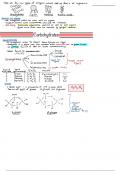
There four main
types of biological molecule which found all
are are in
organisms :
0-0--00
i¥¥I¥¥÷
Monomersandym
Most
carbohydrates proteins and nucleic acids are
polymers
•
, .
of include monosaccharides and nucleotides
•
Examples monomers , amino acids .
used make
•
GCSE Chemistry
:
Condensation polymerisation reactions are to polymers .
Polymers can be broken down into monomers
by hydrolysis reactions .
Carbohydrates
Monosaccharides
carbohydates contain the elements Carbon , Hydrogen and
Oxygen .
•
Carbohydrate is a polymer made from monomers called monosaccharides , like
glucose fructose
,
and galactose ③ Call of them are
.
hexose monosaccharides)
•
General formula for monosaccharides : Glucose
1- Fructose
-
( CH20)n
{
monosaccharides \
]6a%g%
Galactose
Carbohydrates / "
\
:
-
simple carbs'
-
Disaccharides
J sugars
carbs
Polysaccharides ⇐ complex
Type of
garimonosacchan.de#H0nExameTriose
/ / / JJ
Glyceraldehyde ↳ He 03
4 Tetrose C4 HG04
5
6
Pentose
HEXOSE
↳ Hoo,
( 6 Hiz Of
TII%[%e
GIuco→
CgH
Therese monosacchar.de with 6 carbon atoms
sugar
-
a
There
types of glucose glucose and
p-glucose.CH
•
are two : -
OH
CHZOH
,
Jaggers
I
1 O
I
-
H
/! to ✓
O
\
-
,
I rH not
µ
Iii Eliott to
'
It ,
"
1 1 I
H
I
OH
H
OH
glucose
( different
structural form)
a-
glucose
=
B-glucose
=
, Carbon Carbon
#
tactosein.io/eran&
"
¥
/'
"
'
o ,
•
Person lacks the lactase
enzyme
to
ibnreakm.IO
lactose hence
allergic to lactose
Ho c.
OH
OH
Glucose beta Glucose
alpha
-
-
makingandbreakingpolysacharri.de#
Monomers
-
Polymers
-
condensation
-
0+0
-
0-0 + Hao
-
hydrolysis
synanymtorememberbiomole-esee.me
• CHO CHO CHON CHONP
t t t t
Carbon Carbon Carbon Carbon
Hydrogen Hydrogen Hydrogen Hydrogen
oxygen oxygen oxygen oxygen
Nitrogen Nitrogen
Phosphorus
Reducingsugars-wnataretheyl.TT hence could form glycosidic
bond
µ
The ( from if
H
Hydrogen ) could dissociate the carbon
ring
it IS a
reducing sugar
•
.
Maltose ✓
Reducing sugar
.
Lactose V
Reducing sugar
.
sucrose X Sucrose and cannot form
Non
reducing polysaccharide
sucrose
'
→ a
sugar
-
Reducing sugar turns Benedict's the
hydrogen could not dissociate and old
'
as ↳
solution ( positive
red test ) not form a
glycosidic bond .
types of biological molecule which found all
are are in
organisms :
0-0--00
i¥¥I¥¥÷
Monomersandym
Most
carbohydrates proteins and nucleic acids are
polymers
•
, .
of include monosaccharides and nucleotides
•
Examples monomers , amino acids .
used make
•
GCSE Chemistry
:
Condensation polymerisation reactions are to polymers .
Polymers can be broken down into monomers
by hydrolysis reactions .
Carbohydrates
Monosaccharides
carbohydates contain the elements Carbon , Hydrogen and
Oxygen .
•
Carbohydrate is a polymer made from monomers called monosaccharides , like
glucose fructose
,
and galactose ③ Call of them are
.
hexose monosaccharides)
•
General formula for monosaccharides : Glucose
1- Fructose
-
( CH20)n
{
monosaccharides \
]6a%g%
Galactose
Carbohydrates / "
\
:
-
simple carbs'
-
Disaccharides
J sugars
carbs
Polysaccharides ⇐ complex
Type of
garimonosacchan.de#H0nExameTriose
/ / / JJ
Glyceraldehyde ↳ He 03
4 Tetrose C4 HG04
5
6
Pentose
HEXOSE
↳ Hoo,
( 6 Hiz Of
TII%[%e
GIuco→
CgH
Therese monosacchar.de with 6 carbon atoms
sugar
-
a
There
types of glucose glucose and
p-glucose.CH
•
are two : -
OH
CHZOH
,
Jaggers
I
1 O
I
-
H
/! to ✓
O
\
-
,
I rH not
µ
Iii Eliott to
'
It ,
"
1 1 I
H
I
OH
H
OH
glucose
( different
structural form)
a-
glucose
=
B-glucose
=
, Carbon Carbon
#
tactosein.io/eran&
"
¥
/'
"
'
o ,
•
Person lacks the lactase
enzyme
to
ibnreakm.IO
lactose hence
allergic to lactose
Ho c.
OH
OH
Glucose beta Glucose
alpha
-
-
makingandbreakingpolysacharri.de#
Monomers
-
Polymers
-
condensation
-
0+0
-
0-0 + Hao
-
hydrolysis
synanymtorememberbiomole-esee.me
• CHO CHO CHON CHONP
t t t t
Carbon Carbon Carbon Carbon
Hydrogen Hydrogen Hydrogen Hydrogen
oxygen oxygen oxygen oxygen
Nitrogen Nitrogen
Phosphorus
Reducingsugars-wnataretheyl.TT hence could form glycosidic
bond
µ
The ( from if
H
Hydrogen ) could dissociate the carbon
ring
it IS a
reducing sugar
•
.
Maltose ✓
Reducing sugar
.
Lactose V
Reducing sugar
.
sucrose X Sucrose and cannot form
Non
reducing polysaccharide
sucrose
'
→ a
sugar
-
Reducing sugar turns Benedict's the
hydrogen could not dissociate and old
'
as ↳
solution ( positive
red test ) not form a
glycosidic bond .