Section 3 : Organic Chemistry
Optical Isomerism
• Optical isomerism is a form of stereoisomerism + occurs as a result of chirality in molecules.
- Stereoisomerism: same structural + displayed formulae but different arrangement of bonds in
space.
• Optical isomerism occurs in molecules which contain a carbon atom w/ 4 different atoms or groups
attached to it tetrahedrally. Such molecules exhibit optical isomerism as they are described as
asymmetric (i.e. they have no centre, plane or axis of symmetry).
• An asymmetric carbon atom is chiral + gives rise to optical isomers (enantiomers), which exist as
non super-imposable mirror images.
- This carbon atom is called a chiral or asymmetric centre.
Drawing optical isomers (enantiomers)
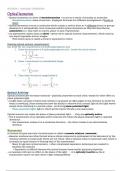
E.g. draw the two enantiomers of 2-hydroxypropanoic acid.
1. Draw the structure of 2-hydroxypropanoic acid + locate the chiral centre.
2. Draw 1 enantiomer in a tetrahedral shape.
3. Then draw its mirror image beside it.
Optical Activity
Optical isomers have the same chemical + physical properties as each other, except for their effect on
plane polarised light.
• A light beam consists of waves that vibrate in all planes at right angles to the direction in which the
beam is travelling. Some substances have the ability to remove from normal light all the light waves
except those vibrating in a certain plane - producing plane polarised light.
- Plane polarised light: light in which all the waves vibrate in the same plane.
Optical isomers can rotate the plane of plane polarised light - ∴ they are optically active.
• The 2 enantiomers of an optically active molecule will rotate the plane polarised light in opposite
directions.
- One enantiomer rotates it in a clockwise direction, + the other rotates in an anticlockwise
direction.
Racemates
A mixture of equal amounts of enantiomers is called a racemic mixture (racemate).
• Racemic mixtures are often formed when a chiral compound is synthesised in the laboratory by the
reaction between 2 compounds which are not chiral. This is because when 2 molecules react, there is
normally an equal chance of forming each of the enantiomers.
- Many drugs have optical isomers, + often complicated separation techniques are needed to
separate the mixture.
• Separation is dif cult because the optical isomers have similar physical properties.
• A racemate will have no effect on the plane of the light - ∴ it is optically inactive as the 2
enantiomers cancel out each other’s light-rotating effects.
fi
Optical Isomerism
• Optical isomerism is a form of stereoisomerism + occurs as a result of chirality in molecules.
- Stereoisomerism: same structural + displayed formulae but different arrangement of bonds in
space.
• Optical isomerism occurs in molecules which contain a carbon atom w/ 4 different atoms or groups
attached to it tetrahedrally. Such molecules exhibit optical isomerism as they are described as
asymmetric (i.e. they have no centre, plane or axis of symmetry).
• An asymmetric carbon atom is chiral + gives rise to optical isomers (enantiomers), which exist as
non super-imposable mirror images.
- This carbon atom is called a chiral or asymmetric centre.
Drawing optical isomers (enantiomers)
E.g. draw the two enantiomers of 2-hydroxypropanoic acid.
1. Draw the structure of 2-hydroxypropanoic acid + locate the chiral centre.
2. Draw 1 enantiomer in a tetrahedral shape.
3. Then draw its mirror image beside it.
Optical Activity
Optical isomers have the same chemical + physical properties as each other, except for their effect on
plane polarised light.
• A light beam consists of waves that vibrate in all planes at right angles to the direction in which the
beam is travelling. Some substances have the ability to remove from normal light all the light waves
except those vibrating in a certain plane - producing plane polarised light.
- Plane polarised light: light in which all the waves vibrate in the same plane.
Optical isomers can rotate the plane of plane polarised light - ∴ they are optically active.
• The 2 enantiomers of an optically active molecule will rotate the plane polarised light in opposite
directions.
- One enantiomer rotates it in a clockwise direction, + the other rotates in an anticlockwise
direction.
Racemates
A mixture of equal amounts of enantiomers is called a racemic mixture (racemate).
• Racemic mixtures are often formed when a chiral compound is synthesised in the laboratory by the
reaction between 2 compounds which are not chiral. This is because when 2 molecules react, there is
normally an equal chance of forming each of the enantiomers.
- Many drugs have optical isomers, + often complicated separation techniques are needed to
separate the mixture.
• Separation is dif cult because the optical isomers have similar physical properties.
• A racemate will have no effect on the plane of the light - ∴ it is optically inactive as the 2
enantiomers cancel out each other’s light-rotating effects.
fi