Section 3: Organic Chemistry
Alkanes
Alkanes: saturated hydrocarbons - contain single C-C bonds.
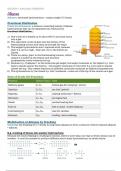
Fractional Distillation
Crude Oil/Petroleum: a mixture consisting mainly of alkane
hydrocarbons that can be separated into fractions by
fractional distillation…
1) The crude oil is heated up to about 350°C and most turns
into a gas.
2) The vaporised crude oil goes into the bottom of the
fractionating column and rises up through the trays.
3) The largest hydrocarbons don’t vaporise at all, because
their b.p. are too high - they just run to the bottom as
liquids.
4) There is a temp. grad. in the fractionating column, which
means it is hotter at the bottom and becomes
progressively cooler towards the top.
5) Because b.p. of alkanes ↑ as the molecules get larger, the larger molecules w/ the higher b.p. turn
back to liquids nearer the bottom, + the smaller molecules w/ the lower b.p. turn back to liquids
nearer the top. This creates fractions as different molecules condense at different temperatures.
6) The hydrocarbons w/ the lowest b.p. don’t condense + come out of the top of the column as a gas.
Uses of Crude Oil Fractions
Fraction Carbon Chain Uses
Re nery gases C1-C4 bottles gas for camping + stoves
Gasoline C5-C12 car fuel (petrol)
Naphtha C7-C14 making medicines + fabrics
Kerosene C11-C15 jet engine fuel
Diesel C15-C30 central heating fuel
Fuel oil C30-C50 fuel in ships + power stations
Lubricating oil C40-C50 wax for candles
Bitumen C50+ roo ng, road surfacing
Modi cation of Alkanes by Cracking
Cracking: the breaking of C–C bonds in long-chain alkanes to form a mixture of short-chained alkanes
+ alkenes.
E.g. cracking of decane into smaller hydrocarbons
Because the bond breaking in cracking is random, there is more than one way in which decane can be
cracked - it could be cracked to produce different short chain hydrocarbons, as shown below:
OR
fifi fi
Alkanes
Alkanes: saturated hydrocarbons - contain single C-C bonds.
Fractional Distillation
Crude Oil/Petroleum: a mixture consisting mainly of alkane
hydrocarbons that can be separated into fractions by
fractional distillation…
1) The crude oil is heated up to about 350°C and most turns
into a gas.
2) The vaporised crude oil goes into the bottom of the
fractionating column and rises up through the trays.
3) The largest hydrocarbons don’t vaporise at all, because
their b.p. are too high - they just run to the bottom as
liquids.
4) There is a temp. grad. in the fractionating column, which
means it is hotter at the bottom and becomes
progressively cooler towards the top.
5) Because b.p. of alkanes ↑ as the molecules get larger, the larger molecules w/ the higher b.p. turn
back to liquids nearer the bottom, + the smaller molecules w/ the lower b.p. turn back to liquids
nearer the top. This creates fractions as different molecules condense at different temperatures.
6) The hydrocarbons w/ the lowest b.p. don’t condense + come out of the top of the column as a gas.
Uses of Crude Oil Fractions
Fraction Carbon Chain Uses
Re nery gases C1-C4 bottles gas for camping + stoves
Gasoline C5-C12 car fuel (petrol)
Naphtha C7-C14 making medicines + fabrics
Kerosene C11-C15 jet engine fuel
Diesel C15-C30 central heating fuel
Fuel oil C30-C50 fuel in ships + power stations
Lubricating oil C40-C50 wax for candles
Bitumen C50+ roo ng, road surfacing
Modi cation of Alkanes by Cracking
Cracking: the breaking of C–C bonds in long-chain alkanes to form a mixture of short-chained alkanes
+ alkenes.
E.g. cracking of decane into smaller hydrocarbons
Because the bond breaking in cracking is random, there is more than one way in which decane can be
cracked - it could be cracked to produce different short chain hydrocarbons, as shown below:
OR
fifi fi