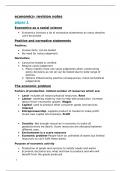
economics- revision notes
paper 1
Economics as a social science
Economics involves a lot of normative statements as many theories
can't be proved
Positive and normative statements
Positive;
Involve facts, can be tested
No need for value judgement
Normative;
Cannot be tested or verified
Require value judgement
1. Policy makers must use value judgments when constructing
policy decisions as not all can be tested due to wide range of
policies.
2. Options influenced by positive consequences, moral and pollical
judgements
The economic problem
Factors of production- limited number of resources which are;
Land- includes all natural physical resources. Rent
Labour- anything made by man to help with production. Increase
labour force->economic growth. Wages
Capital- used to produce other consumer goods and services.
Interest
Entrepreneurship- supplies product to market to make profit.
Invest own capital into business. Profit
Scarcity- Not enough resources in economy to make all
goods/services we desire. Scare resources are allocated between
different uses.
Environment is a scare resource
Economic problem-People have an unlimited of wants but limited
resources so can't fulfil these wants
Purpose of economic activity
Production of goods and services to satisfy needs and wants
Economic decisions are: what and how to produce and who will
benefit from the goods produced
1
,Opportunity cost
The cost of giving up the next best alternative
Governments only have certain tax revenue- NHS or defence
Firms have certain amount of finance to invest- new factory or
product research
Consumer have certain amount of income- TV or holiday
Allocation of resources
Scarcity results from limited resources and unlimited wants
Choices must be made about how scare resources are used in-
between use
Production possibility frontier
Shows max output combinations of two good/services that economy
can achieve when all resources are fully and efficiently employed
-inside= insufficient usage
-Middle outside= productive efficient; optimized production output with
fixed amount of resourced
-Allocatively efficient= consumer needs best met
C- consumer goods
K- productive goods
A- efficient allocation but producing only consumption goods
B- efficient allocation but producing only capital goods
C- different efficient allocation
D- inefficient allocation with unemployed resources
E- unfeasible allocation
F- allocation that will benefit living standards in the long run
PPF and Opportunity cost
Allocation is inside PPF= no opportunity cost as unemployed
resources where previously not in use
Economy operating efficiently on the frontier= there are opportunity
costs
2
, PPF straight line= opportunity cost same along the length of the
line
Concave PPF line= Opportunity cost will vary. Nearer to extremes,
higher opportunity cost
Shifts in PPF and economic growth
Shift outward= increase in productive potential (economic growth)
or increase in FOP. Increase standard of living
Economic growth= economy grow in terms of what it can produce.
Occurs if there is increase in quantity or quality of FOP
Shift inward= reduction in quantity or quality of economy's FOP or
resources depleted. E.G natural disasters
All causes by short/long run economic growth
Cause of growth Impact on FOP downsides
Spending on education Quality and quantity of Opportunity cosy
labour force (healthcare)
Spending on More training of staff Taxes may increase to
healthcare pay for increase
spending on
healthcare
Investment in capital
Higher productivity-> Less dividends for
goods by firms better quality shareholders
Population increasesIncrease in labour and Not enough land
enterprise in economy
meaning it has larger
productive capacity
Movement along the PPF
No need for a change in number of resources or FOP
Reallocation of resources from governments or policymakers to try
increase welfare of citizens by meeting needs better
OC associated with movement
Specialisation and division of labour
Specialisation- individual, firm or country produces narrow range
of goods/services
Division of labour- dividing the production process into different
stages enables workers to focus on specific tasks
Labour productivity- measure of output per worker per hour
Specialisation has been used to increase efficiency of production
process called division of labour by increasing productivity.
Advantages of DOL Disadvantages of DOL
Efficient mastery Monotony of work
Higher productivity Lack of craftsman ship
3
, Cheaper products Dumping of mass products as
many masses produced
Better productive efficiency= goods produced at lower cost
01- demand and supply
Type of economies- unlimited wants and limited resources cause
scarcity, so resources need to be allocated
Free market economy- scarce resources allocated entirely by
price mechanism (demand and supply)
Mixed economy- scarce resources allocated partly by price
mechanism (consumers and producers or supply and demand)
Planned economy- scare resources allocated entirely by
government
Uk has mixed economy
Private sector- organisations owned by individuals and
shareholder driven by profit. TVs, fridges, laptops.
Public sector- produced, sold or provided by organisations owned
and run by government, funding raised via taxes. Education.
Emergency services, medical care.
Demand
Quantity of a good or service consumers are willing to pay at a given price and time
Links with utility
P-population
A-advertisement
S-substitute
I-income
F-fashion
I-interest rate
C-complement
W-weather
Joint demand- increase in demand for good x increased demand for good Y
Composite- good has more than one use so decreases the supply for another good
Derived- goods demanded as their needed for production of other goods
Competitive- increase in demand for one good decrease the demand for another
Supply
Quantity of good/service suppliers are willing to sell at given price and time PASIFIFC
4
paper 1
Economics as a social science
Economics involves a lot of normative statements as many theories
can't be proved
Positive and normative statements
Positive;
Involve facts, can be tested
No need for value judgement
Normative;
Cannot be tested or verified
Require value judgement
1. Policy makers must use value judgments when constructing
policy decisions as not all can be tested due to wide range of
policies.
2. Options influenced by positive consequences, moral and pollical
judgements
The economic problem
Factors of production- limited number of resources which are;
Land- includes all natural physical resources. Rent
Labour- anything made by man to help with production. Increase
labour force->economic growth. Wages
Capital- used to produce other consumer goods and services.
Interest
Entrepreneurship- supplies product to market to make profit.
Invest own capital into business. Profit
Scarcity- Not enough resources in economy to make all
goods/services we desire. Scare resources are allocated between
different uses.
Environment is a scare resource
Economic problem-People have an unlimited of wants but limited
resources so can't fulfil these wants
Purpose of economic activity
Production of goods and services to satisfy needs and wants
Economic decisions are: what and how to produce and who will
benefit from the goods produced
1
,Opportunity cost
The cost of giving up the next best alternative
Governments only have certain tax revenue- NHS or defence
Firms have certain amount of finance to invest- new factory or
product research
Consumer have certain amount of income- TV or holiday
Allocation of resources
Scarcity results from limited resources and unlimited wants
Choices must be made about how scare resources are used in-
between use
Production possibility frontier
Shows max output combinations of two good/services that economy
can achieve when all resources are fully and efficiently employed
-inside= insufficient usage
-Middle outside= productive efficient; optimized production output with
fixed amount of resourced
-Allocatively efficient= consumer needs best met
C- consumer goods
K- productive goods
A- efficient allocation but producing only consumption goods
B- efficient allocation but producing only capital goods
C- different efficient allocation
D- inefficient allocation with unemployed resources
E- unfeasible allocation
F- allocation that will benefit living standards in the long run
PPF and Opportunity cost
Allocation is inside PPF= no opportunity cost as unemployed
resources where previously not in use
Economy operating efficiently on the frontier= there are opportunity
costs
2
, PPF straight line= opportunity cost same along the length of the
line
Concave PPF line= Opportunity cost will vary. Nearer to extremes,
higher opportunity cost
Shifts in PPF and economic growth
Shift outward= increase in productive potential (economic growth)
or increase in FOP. Increase standard of living
Economic growth= economy grow in terms of what it can produce.
Occurs if there is increase in quantity or quality of FOP
Shift inward= reduction in quantity or quality of economy's FOP or
resources depleted. E.G natural disasters
All causes by short/long run economic growth
Cause of growth Impact on FOP downsides
Spending on education Quality and quantity of Opportunity cosy
labour force (healthcare)
Spending on More training of staff Taxes may increase to
healthcare pay for increase
spending on
healthcare
Investment in capital
Higher productivity-> Less dividends for
goods by firms better quality shareholders
Population increasesIncrease in labour and Not enough land
enterprise in economy
meaning it has larger
productive capacity
Movement along the PPF
No need for a change in number of resources or FOP
Reallocation of resources from governments or policymakers to try
increase welfare of citizens by meeting needs better
OC associated with movement
Specialisation and division of labour
Specialisation- individual, firm or country produces narrow range
of goods/services
Division of labour- dividing the production process into different
stages enables workers to focus on specific tasks
Labour productivity- measure of output per worker per hour
Specialisation has been used to increase efficiency of production
process called division of labour by increasing productivity.
Advantages of DOL Disadvantages of DOL
Efficient mastery Monotony of work
Higher productivity Lack of craftsman ship
3
, Cheaper products Dumping of mass products as
many masses produced
Better productive efficiency= goods produced at lower cost
01- demand and supply
Type of economies- unlimited wants and limited resources cause
scarcity, so resources need to be allocated
Free market economy- scarce resources allocated entirely by
price mechanism (demand and supply)
Mixed economy- scarce resources allocated partly by price
mechanism (consumers and producers or supply and demand)
Planned economy- scare resources allocated entirely by
government
Uk has mixed economy
Private sector- organisations owned by individuals and
shareholder driven by profit. TVs, fridges, laptops.
Public sector- produced, sold or provided by organisations owned
and run by government, funding raised via taxes. Education.
Emergency services, medical care.
Demand
Quantity of a good or service consumers are willing to pay at a given price and time
Links with utility
P-population
A-advertisement
S-substitute
I-income
F-fashion
I-interest rate
C-complement
W-weather
Joint demand- increase in demand for good x increased demand for good Y
Composite- good has more than one use so decreases the supply for another good
Derived- goods demanded as their needed for production of other goods
Competitive- increase in demand for one good decrease the demand for another
Supply
Quantity of good/service suppliers are willing to sell at given price and time PASIFIFC
4