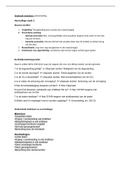
Types of Observation
Research Methods
Naturalistic – high external validity, low internal
Review validity
Controlled – high internal validity, low external
validity
Experimental Designs
Covert – low demand characteristics, consent
Independent Groups – participant variables not issues
controlled but no order effects
Overt – no consent issues, demand
Repeated Measures – order effects (overcome by characteristics
counterbalancing), demand characteristics but
Participant – high internal validity, less objectivity
participant variables controlled and more
(internal validity)
economical
Non-participant – objectivity (internal validity),
Matched Pairs – cannot match exactly, time
less insight
consuming but no order effects
Types of Experiment Dealing with Ethical Issues
Informed Consent – signed consent form,
Lab – internal validity (control and cause/effect),
presumptive, retrospective
replicable but lacks generalisability and realism,
demand characteristics Deception – debriefing, counselling, right to
withdraw data
Field – external validity (generalisable, realistic)
but less internal validity (lacks control), lac of Protection from Harm – psychological and
consent physical risk should be normal, counselling
Natural – external validity (generalisable, Privacy/Confidentiality – numbers not names,
realistic) but limited opportunity, lack of control data not shared
and no cause/effect (internal validity)
Quasi – same as lab study but lack of
manipulation of IV means no cause/effect Case Studies
Qualitative and longitudinal
Sampling Strengths
Random – unbiased but time-consuming, - Insight into unusual cases
unrepresentative - Generate hypotheses for future studies
Systematic – objective, representative but time- Weaknesses
consuming - Lacks generalisability
Stratified – representative - Subjective
Opportunity – convenient but unrepresentative
Volunteer – easy but volunteer bias, Peer Review
unrepresentative
- Allocate funding, assess quality/relevance
of research, suggest
amendments/improvements
- Anonymity – unjustified criticism
- Publication bias – false impression
- Burying ground-breaking research
Research Methods
Naturalistic – high external validity, low internal
Review validity
Controlled – high internal validity, low external
validity
Experimental Designs
Covert – low demand characteristics, consent
Independent Groups – participant variables not issues
controlled but no order effects
Overt – no consent issues, demand
Repeated Measures – order effects (overcome by characteristics
counterbalancing), demand characteristics but
Participant – high internal validity, less objectivity
participant variables controlled and more
(internal validity)
economical
Non-participant – objectivity (internal validity),
Matched Pairs – cannot match exactly, time
less insight
consuming but no order effects
Types of Experiment Dealing with Ethical Issues
Informed Consent – signed consent form,
Lab – internal validity (control and cause/effect),
presumptive, retrospective
replicable but lacks generalisability and realism,
demand characteristics Deception – debriefing, counselling, right to
withdraw data
Field – external validity (generalisable, realistic)
but less internal validity (lacks control), lac of Protection from Harm – psychological and
consent physical risk should be normal, counselling
Natural – external validity (generalisable, Privacy/Confidentiality – numbers not names,
realistic) but limited opportunity, lack of control data not shared
and no cause/effect (internal validity)
Quasi – same as lab study but lack of
manipulation of IV means no cause/effect Case Studies
Qualitative and longitudinal
Sampling Strengths
Random – unbiased but time-consuming, - Insight into unusual cases
unrepresentative - Generate hypotheses for future studies
Systematic – objective, representative but time- Weaknesses
consuming - Lacks generalisability
Stratified – representative - Subjective
Opportunity – convenient but unrepresentative
Volunteer – easy but volunteer bias, Peer Review
unrepresentative
- Allocate funding, assess quality/relevance
of research, suggest
amendments/improvements
- Anonymity – unjustified criticism
- Publication bias – false impression
- Burying ground-breaking research