Cell Membrane
Divides the cell into a barrier between the cytoplasm and the organelle
Regulates transport of materials in and out of cells
Has receptors to detect hormones/chemicals - cell recognition
Holds the components of some materials (chlorophyll)
Provides an internal transport system
Provides surfaces where reactions can occur
Isolates enzymes which may cause damage to cells (lysosomes)
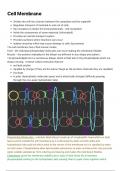
The cell membrane has a fluid mosaic model.
Fluid - the individual phospholipid molecules can move making the membrane flexible.
Mosaic - the proteins imbedded in the bilayer are different in size shape and pattern.
The phospholipids form a continuous bilayer which is fluid due to the phospholipids which are
always moving. It doesn't allow molecules that are:
not lipid soluble
repelled by charge (if they are the same charge as the proteins channels they are repelled)
too large
is polar (hydrophobic molecules pass) and is electrically charged (difficulty passing
through the non-polar hydrophobic tails)
Phospholipid Molecules: a double (lipid bilayer) made up of a hydrophilic head which on both
layers points outside the cell membrane as it is attracted by water on both sides and
hydrophobic fatty acid tail which point to the centre of the membrane as it is repelled by water
on both sides. Phospholipids allow lipid soluble substances to enter and leave the cell, prevents
water soluble substances from entering and leaving and makes the membrane flexible.
Cholesterol: gives the membrane stability and a type of lipid which fits in between
phospholipids binding to the hydrophobic tails causing them to pack close together which
Divides the cell into a barrier between the cytoplasm and the organelle
Regulates transport of materials in and out of cells
Has receptors to detect hormones/chemicals - cell recognition
Holds the components of some materials (chlorophyll)
Provides an internal transport system
Provides surfaces where reactions can occur
Isolates enzymes which may cause damage to cells (lysosomes)
The cell membrane has a fluid mosaic model.
Fluid - the individual phospholipid molecules can move making the membrane flexible.
Mosaic - the proteins imbedded in the bilayer are different in size shape and pattern.
The phospholipids form a continuous bilayer which is fluid due to the phospholipids which are
always moving. It doesn't allow molecules that are:
not lipid soluble
repelled by charge (if they are the same charge as the proteins channels they are repelled)
too large
is polar (hydrophobic molecules pass) and is electrically charged (difficulty passing
through the non-polar hydrophobic tails)
Phospholipid Molecules: a double (lipid bilayer) made up of a hydrophilic head which on both
layers points outside the cell membrane as it is attracted by water on both sides and
hydrophobic fatty acid tail which point to the centre of the membrane as it is repelled by water
on both sides. Phospholipids allow lipid soluble substances to enter and leave the cell, prevents
water soluble substances from entering and leaving and makes the membrane flexible.
Cholesterol: gives the membrane stability and a type of lipid which fits in between
phospholipids binding to the hydrophobic tails causing them to pack close together which