Diffusion
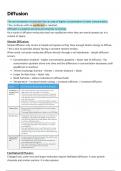
The net movement of particles from an area of higher concentration to lower concentration.
This continues until an equilibrium is reached.
Diffusion is a passive process and requires no energy.
As a result of diffusion molecules reach an equilibrium when they are evenly spread out in a
volume of space.
Simple Diffusion:
Simple diffusion only occurs in liquids and gases as they have enough kinetic energy to diffuse.
This is due to particles always having a constant random motion.
When small, non polar molecules diffuse directly through a cell membrane - simple diffusion
occurs.
Concentration Gradient - higher concentration gradient = faster rate of diffusion. The
concentration gradient slows over time and the difference in concentration decreases until
equilibrium is reached.
Thinner Exchange Surface - thinner = shorter distance = faster
Larger Surface Area = faster rate
Small Particles = allows molecules to diffuse faster
Temperature - increase kinetic energy = increase collisions = increased diffusion
Facilitated Diffusion:
Charged ions, polar ions and larger molecules require facilitated diffusion. It uses protein
channels and protein carriers. It is also passive.
The net movement of particles from an area of higher concentration to lower concentration.
This continues until an equilibrium is reached.
Diffusion is a passive process and requires no energy.
As a result of diffusion molecules reach an equilibrium when they are evenly spread out in a
volume of space.
Simple Diffusion:
Simple diffusion only occurs in liquids and gases as they have enough kinetic energy to diffuse.
This is due to particles always having a constant random motion.
When small, non polar molecules diffuse directly through a cell membrane - simple diffusion
occurs.
Concentration Gradient - higher concentration gradient = faster rate of diffusion. The
concentration gradient slows over time and the difference in concentration decreases until
equilibrium is reached.
Thinner Exchange Surface - thinner = shorter distance = faster
Larger Surface Area = faster rate
Small Particles = allows molecules to diffuse faster
Temperature - increase kinetic energy = increase collisions = increased diffusion
Facilitated Diffusion:
Charged ions, polar ions and larger molecules require facilitated diffusion. It uses protein
channels and protein carriers. It is also passive.