Inorganic Ions
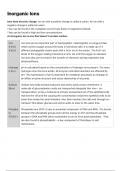
Ions have electric charge. An ion with a positive charge is called a cation. An ion with a
negative charge is called an anion.
They can be found in the cytoplasm and in body fluids of organisms (blood).
They can be found in high and low concentrations.
An inorganic ion is one that doesn't contain carbon.
Iron Iron ions are an important part of haemoglobin. Haemoglobin is a large protein
(Fe3+) which carries oxygen around the body in red blood cells. It is made up of 4
(Fe2+) different polypeptide chains each with a Fe2+ ion in the centre. The Fe2+ ion
binds to the oxygen making it become a Fe3+ ion until the oxygen is released.
Iron ions also are involved in the transfer of electrons during respiration and
photosynthesis.
Hydroge pH is calculated based on the concentration of hydrogen ions present. The more
n (H+) hydrogen ions the more acidic. All enzyme controlled reactions are affected by
pH. The maintenance of pH is important for metabolic processes as changes in
pH affect enzyme structure and cause denaturing of enzymes.
Sodium Sodium ions help transport glucose and amino acids across membrane. A
(Na+) molecule of glucose/amino acids are transported alongside Na+ ions - co-
transportation: an Na+ molecule is actively transported out of the epithelial cells
that line the villi and the causing the concentration inside the epithelial cells to be
lower than inside the small intestine. Na+ then reenters the cells and through co-
transport this allows glucose and amino acids to enter at the same time.
Phospha Phosphate ions (PO4 3-)are an essential component of DNA and RNA. The bonds
te between the phosphate groups store all the energy in ATP and the phosphate
(PO43-) groups in DNA and RNA allow nucleotides to join to form polynucleotides. They
are also found in phospholipids - a key component of the bilayer in cell
membranes.
Ions have electric charge. An ion with a positive charge is called a cation. An ion with a
negative charge is called an anion.
They can be found in the cytoplasm and in body fluids of organisms (blood).
They can be found in high and low concentrations.
An inorganic ion is one that doesn't contain carbon.
Iron Iron ions are an important part of haemoglobin. Haemoglobin is a large protein
(Fe3+) which carries oxygen around the body in red blood cells. It is made up of 4
(Fe2+) different polypeptide chains each with a Fe2+ ion in the centre. The Fe2+ ion
binds to the oxygen making it become a Fe3+ ion until the oxygen is released.
Iron ions also are involved in the transfer of electrons during respiration and
photosynthesis.
Hydroge pH is calculated based on the concentration of hydrogen ions present. The more
n (H+) hydrogen ions the more acidic. All enzyme controlled reactions are affected by
pH. The maintenance of pH is important for metabolic processes as changes in
pH affect enzyme structure and cause denaturing of enzymes.
Sodium Sodium ions help transport glucose and amino acids across membrane. A
(Na+) molecule of glucose/amino acids are transported alongside Na+ ions - co-
transportation: an Na+ molecule is actively transported out of the epithelial cells
that line the villi and the causing the concentration inside the epithelial cells to be
lower than inside the small intestine. Na+ then reenters the cells and through co-
transport this allows glucose and amino acids to enter at the same time.
Phospha Phosphate ions (PO4 3-)are an essential component of DNA and RNA. The bonds
te between the phosphate groups store all the energy in ATP and the phosphate
(PO43-) groups in DNA and RNA allow nucleotides to join to form polynucleotides. They
are also found in phospholipids - a key component of the bilayer in cell
membranes.