
KI1.2: There are theoretical frameworks that attempt to explain plate movements
a. The theory of plate tectonics and its key elements (the earth’s internal structure, mantle
convection, palaeomagnetism and sea floor spreading, subduction and slab pull)
b. The operation of these processes at different plate margins (destructive, constructive,
collision and transform) (2)
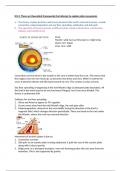
Crust
Mantle- solid, but can flow due to v high temp
Outer core- liquid
Inner core- solid
Convection currents form in the mantle as the core is hotter than the crust. This means that
the magma near the core heats up, so becomes less dense and rises. When it reaches the
crust, it becomes denser and falls back towards to core. This creates circular currents
Sea floor spreading is happening at the mid-Atlantic ridge (a divergent plate boundary). All
the land in the world used to be one land mass (Pangea), but it has since divided. This
theory is continental drift
Evidence for sea floor spreading:
1. Africa and America appear to ‘fit’ together
2. As you move away from the mid-Atlantic ridge, the rock gets older
3. Palaeomagnetism- minerals in the rock solidify facing the direction of the Earth’s
magnetic field, which changes direction periodically. There are bands in the rock under
the Atlantic, where the rock has reversed direction
Movement of tectonic plates is due to:
1. Convection currents
2. Slab pull- as an oceanic plate is being subducted, it pulls the rest of the oceanic plate
along with it due to gravity
3. Ridge push- at a divergent boundary, new rock forming pushes old rock away from the
boundary. This is also supported by gravity
a. The theory of plate tectonics and its key elements (the earth’s internal structure, mantle
convection, palaeomagnetism and sea floor spreading, subduction and slab pull)
b. The operation of these processes at different plate margins (destructive, constructive,
collision and transform) (2)
Crust
Mantle- solid, but can flow due to v high temp
Outer core- liquid
Inner core- solid
Convection currents form in the mantle as the core is hotter than the crust. This means that
the magma near the core heats up, so becomes less dense and rises. When it reaches the
crust, it becomes denser and falls back towards to core. This creates circular currents
Sea floor spreading is happening at the mid-Atlantic ridge (a divergent plate boundary). All
the land in the world used to be one land mass (Pangea), but it has since divided. This
theory is continental drift
Evidence for sea floor spreading:
1. Africa and America appear to ‘fit’ together
2. As you move away from the mid-Atlantic ridge, the rock gets older
3. Palaeomagnetism- minerals in the rock solidify facing the direction of the Earth’s
magnetic field, which changes direction periodically. There are bands in the rock under
the Atlantic, where the rock has reversed direction
Movement of tectonic plates is due to:
1. Convection currents
2. Slab pull- as an oceanic plate is being subducted, it pulls the rest of the oceanic plate
along with it due to gravity
3. Ridge push- at a divergent boundary, new rock forming pushes old rock away from the
boundary. This is also supported by gravity


