
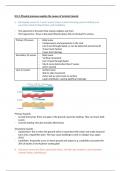
KI1.3: Physical processes explain the causes of tectonic hazards
a. Earthquake waves (P, S and L waves) cause crustal fracturing, ground shaking and
secondary hazards (liquefaction and landslides)
- The epicentre is the point that energy radiates out from
- The hypocentre / focus is the point directly above this on the Earth’s surface
Primary (P) waves - Body wave
- Compressions and expansions in the rock
- Can travel through liquid, so can be detected around world
- Travel much fastest
- Cause least damage
Secondary (S) waves - Body wave
- Vertical movement
- Can’t travel through liquid
- Much more destructive than P waves
- Arrive second
Love (L) waves - Surface wave
- Side to side movement
- Arrive last as only travel on surface
- Large amplitude, causing significant damage
Primary hazards
- Crustal fracturing- these are gaps in the ground caused by shaking. They can leave fault
scarps
- Ground shaking- this also includes aftershocks
Secondary hazards
- Liquefaction- this is when the ground which is saturated with water and made of gravel
turns into a liquid-like state. This may cause buildings to sink or collapse (e.g. Japan
2011)
- Landslides- frequently occur on loose ground and slopes (e.g. Landslides accounted for
30% of deaths in the Kashmir earthquake)
b. Volcanoes cause lava flows, pyroclastic flows, ash falls, gas eruptions, and secondary
hazards (lahars, jökulhlaups)
a. Earthquake waves (P, S and L waves) cause crustal fracturing, ground shaking and
secondary hazards (liquefaction and landslides)
- The epicentre is the point that energy radiates out from
- The hypocentre / focus is the point directly above this on the Earth’s surface
Primary (P) waves - Body wave
- Compressions and expansions in the rock
- Can travel through liquid, so can be detected around world
- Travel much fastest
- Cause least damage
Secondary (S) waves - Body wave
- Vertical movement
- Can’t travel through liquid
- Much more destructive than P waves
- Arrive second
Love (L) waves - Surface wave
- Side to side movement
- Arrive last as only travel on surface
- Large amplitude, causing significant damage
Primary hazards
- Crustal fracturing- these are gaps in the ground caused by shaking. They can leave fault
scarps
- Ground shaking- this also includes aftershocks
Secondary hazards
- Liquefaction- this is when the ground which is saturated with water and made of gravel
turns into a liquid-like state. This may cause buildings to sink or collapse (e.g. Japan
2011)
- Landslides- frequently occur on loose ground and slopes (e.g. Landslides accounted for
30% of deaths in the Kashmir earthquake)
b. Volcanoes cause lava flows, pyroclastic flows, ash falls, gas eruptions, and secondary
hazards (lahars, jökulhlaups)


