
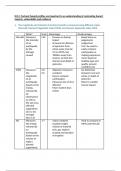
KI1.5: Tectonic hazard profiles are important to an understanding of contrasting hazard
impacts, vulnerability and resilience
a. The magnitude and intensity of tectonic hazards is measured using different scales
(Mercalli, Moment Magnitude Scale (MMS) and Volcanic Explosivity Index (VEI))
What? Scale Advantages Disadvantages
Mercalli Measures I-XII - Focuses on human - Based more on
the intensity impact judgements
of an - Accounts for distance (subjective)
earthquake of epicentre from - Can’t be used to
by the urban areas (may be easily compare
damage 9.0 on MMS, but earthquakes as
caused 1000km away from shaking experience
anyone, so feels less varies based on
intense) and depth of building type and
epicentre quality, ground
conditions etc
MMS Measures 3.0- - Objective (measures - No distinction
the 9.0 numbers) between rural and
magnitude - Easy to compare urban or depth of
of an earthquakes epicentre
earthquake - Measures size of area - Doesn’t consider
based on the affected human impact
energy - More modern than
released by richter
all
shockwaves
as well as
the size area
affected
Logarithmic
(6.0 is 10x
stronger
than 5.0)
VEI Measures 1-7 - Value combines - Hard to compare to
the energy eruption height, MMS and Mercalli
released by volume of material
an (ash, gas, tephra)
earthquake erupted and duration
based on the of eruption
volume of
tephra
ejected
Logarithmic
impacts, vulnerability and resilience
a. The magnitude and intensity of tectonic hazards is measured using different scales
(Mercalli, Moment Magnitude Scale (MMS) and Volcanic Explosivity Index (VEI))
What? Scale Advantages Disadvantages
Mercalli Measures I-XII - Focuses on human - Based more on
the intensity impact judgements
of an - Accounts for distance (subjective)
earthquake of epicentre from - Can’t be used to
by the urban areas (may be easily compare
damage 9.0 on MMS, but earthquakes as
caused 1000km away from shaking experience
anyone, so feels less varies based on
intense) and depth of building type and
epicentre quality, ground
conditions etc
MMS Measures 3.0- - Objective (measures - No distinction
the 9.0 numbers) between rural and
magnitude - Easy to compare urban or depth of
of an earthquakes epicentre
earthquake - Measures size of area - Doesn’t consider
based on the affected human impact
energy - More modern than
released by richter
all
shockwaves
as well as
the size area
affected
Logarithmic
(6.0 is 10x
stronger
than 5.0)
VEI Measures 1-7 - Value combines - Hard to compare to
the energy eruption height, MMS and Mercalli
released by volume of material
an (ash, gas, tephra)
earthquake erupted and duration
based on the of eruption
volume of
tephra
ejected
Logarithmic


