2.6 The international economy
2.6.1 Globalisation
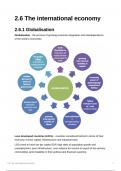
Globalisation - the process of growing economic integration and interdependence
of the world’s economies.
Less developed countries (LDCs) - countries considered behind in terms of their
economy, human capital, infrastructure and industrial base.
LDCs tend to have low per capita GDP, high rates of population growth and
unemployment, poor infrastructure, over-reliance for income in export of few primary
commodities (and instability in their political and financial systems).
2.6 The international economy 1
, More developed countries (MDCs) - countries with a high degree of economic
development, high average income per head, high standards of living, service
industries replacing manufacturing, well established infrastructure and investment in
human capital.
Anti-globalisation movements and anti-globalisation sentiments are commonplace in
MDCs. Brexit, Trump and the rise nationalist parties on the political left and right in
Europe, show that the former ‘globalisation is good’ consensus no longer holds.
Drivers of globalisation
1. Increase in trade and the number of transactions taking place
2. Increase in the movement of capital investment and MNCs
3. Increase in the movement of people across international borders, labour mobility
4. Improved technology - Increase in availability of knowledge, particularly through
the internet
5. Less protectionism - in many countries, borders have opened and average
import tariff levels have fallen
6. Fall in transport costs / containerisation - the costs of ocean shipping have come
down, due to containerisation, bulk shipping, and other production efficiencies
Gains from globalisation
1. Economies of scale, increased trade - It encourages producers and
consumers to reap the benefits from deeper division of labour and economies of
scale due to comparative advantage which enables higher exports and creates
jobs. For example, the UK has a comparative advantage in goods such as
financial services, video gaming and nuclear power components.
a. However, for countries like the UK it could lead to lower X-M as we have lost
our comparative advantage on many key manufacturing industries.
b. unemployment
2. Increased trade - Removal of tariffs (diagram) to promote and increase trade,
SRAS shifts to right, lower prices.
a. However, leads to higher inflation. Greater international trade will cause
countries like China and India to increase their export production. Demand
for commodities to produce those exports will increase (higher price of
2.6 The international economy 2
, copper, oil, commodities) as China is exploiting their comparative advantage
(derived demand) which causes cost push inflation for everyone else.
3. Greater choice of imports - Globalisation has significantly increased the choice
of consumer goods. For example, we have become accustomed to the year-
round availability of fruit and vegetables due to food imports.
a. However, some argue that goods have become more homogenised, mass
produced.
4. Increased competition and lower prices - Competitive markets reduce the
scale of monopoly profits and incentivise businesses to seek cost-reducing
innovations. Globalisation means that domestic monopolies will now face more
international competition. This leads to lower prices for consumers. This is
particularly noticeable in industries such as clothing, electronics and food –
where the UK is a net importer.
5. Lower costs for firms - Globalisation makes it easier to outsource parts of the
production process (e.g. call centres, web development) to countries with lower
labour costs. Firms can make use of technology to interact with people around
the world. This will help reduce costs and prices.
a. However, outsourcing can lead to domestic job-losses and lower quality of
service.
b. Dynamic efficiency gains flowing from the sharing/diffusion of new
ideas/skills/technologies across national borders
6. Migration - Globalisation makes it easier for migrants to enter and work in the
UK. This free movement of labour can help the UK to fill job vacancies. This is
important in industries such as fruit picking and the NHS where firms often find
labour shortages.
a. Greater mobility of labour - increased LRAS and AD (from consumption)
resulting in economic growth.
b. However, mass migration can also place greater stress on UK housing and
public services because of the net migration of people into the UK
c. However, labour drain: workers move to a country where they receive a
better wage. UK sector shifting away from manufacturing and moving
towards service sector, those structurally unemployed may move to where
their skills are useful.
2.6 The international economy 3
, For LDCs
foreign firms bring much-needed investment to LDCs: as well as jobs, there may
be improvements in infrastructure, provision of schools and healthcare due to
MNC involvement
though low by our standards, the wages paid by MNCs are often higher than
those paid by indigenous firms and act therefore to drive up wages (and
consequently living standards)
MNCs cannot afford the negative publicity that ill-treatment of workers can
attract, so exert pressure to improve workers’ conditions in LDCs.
far from ‘trampling over local culture’, smart MNCs adopt a strategy of
glocalisation (= globalisation + localisation), extracting higher profits by adapting
their products and practices to suit local tastes
For MDCs
Improved allocation of resources - modern technologies mean that most crops
can be grown and most goods can be made anywhere but this does not mean it
would be efficient to do so, e.g. why use lots of electricity to grow bananas in
greenhouses in Norway when they grow naturally in Ecuador with a lot less input
needed.
International competition = improved efficiency - when a country opens up their
borders to international firms, domestic firms are forced to up their game to
compete with the new rivals. This drives improvements in technology and
productivity, for reduction of abnormal profit which means lower prices for
consumers which means improved living standards, etc.
Better international relations - globalisation makes countries depend on each
other and so want to maintain good relations with each other. eg. the
government expects that more than 20% of the electricity used in the UK by
2025 will be imported (from Ireland, France, Belgium, the Netherlands, Denmark,
Norway and Germany). This being the case the UK would not want to fall out
with these nations and put our energy supply at risk.
Costs from globalisation
1. Global economic cycle - The UK is more affected by the global economic
cycle. For example, a deep recession in the EU/US will affect the UK, because
we rely on the EU and US to export many goods. The global credit crunch had a
2.6 The international economy 4
2.6.1 Globalisation
Globalisation - the process of growing economic integration and interdependence
of the world’s economies.
Less developed countries (LDCs) - countries considered behind in terms of their
economy, human capital, infrastructure and industrial base.
LDCs tend to have low per capita GDP, high rates of population growth and
unemployment, poor infrastructure, over-reliance for income in export of few primary
commodities (and instability in their political and financial systems).
2.6 The international economy 1
, More developed countries (MDCs) - countries with a high degree of economic
development, high average income per head, high standards of living, service
industries replacing manufacturing, well established infrastructure and investment in
human capital.
Anti-globalisation movements and anti-globalisation sentiments are commonplace in
MDCs. Brexit, Trump and the rise nationalist parties on the political left and right in
Europe, show that the former ‘globalisation is good’ consensus no longer holds.
Drivers of globalisation
1. Increase in trade and the number of transactions taking place
2. Increase in the movement of capital investment and MNCs
3. Increase in the movement of people across international borders, labour mobility
4. Improved technology - Increase in availability of knowledge, particularly through
the internet
5. Less protectionism - in many countries, borders have opened and average
import tariff levels have fallen
6. Fall in transport costs / containerisation - the costs of ocean shipping have come
down, due to containerisation, bulk shipping, and other production efficiencies
Gains from globalisation
1. Economies of scale, increased trade - It encourages producers and
consumers to reap the benefits from deeper division of labour and economies of
scale due to comparative advantage which enables higher exports and creates
jobs. For example, the UK has a comparative advantage in goods such as
financial services, video gaming and nuclear power components.
a. However, for countries like the UK it could lead to lower X-M as we have lost
our comparative advantage on many key manufacturing industries.
b. unemployment
2. Increased trade - Removal of tariffs (diagram) to promote and increase trade,
SRAS shifts to right, lower prices.
a. However, leads to higher inflation. Greater international trade will cause
countries like China and India to increase their export production. Demand
for commodities to produce those exports will increase (higher price of
2.6 The international economy 2
, copper, oil, commodities) as China is exploiting their comparative advantage
(derived demand) which causes cost push inflation for everyone else.
3. Greater choice of imports - Globalisation has significantly increased the choice
of consumer goods. For example, we have become accustomed to the year-
round availability of fruit and vegetables due to food imports.
a. However, some argue that goods have become more homogenised, mass
produced.
4. Increased competition and lower prices - Competitive markets reduce the
scale of monopoly profits and incentivise businesses to seek cost-reducing
innovations. Globalisation means that domestic monopolies will now face more
international competition. This leads to lower prices for consumers. This is
particularly noticeable in industries such as clothing, electronics and food –
where the UK is a net importer.
5. Lower costs for firms - Globalisation makes it easier to outsource parts of the
production process (e.g. call centres, web development) to countries with lower
labour costs. Firms can make use of technology to interact with people around
the world. This will help reduce costs and prices.
a. However, outsourcing can lead to domestic job-losses and lower quality of
service.
b. Dynamic efficiency gains flowing from the sharing/diffusion of new
ideas/skills/technologies across national borders
6. Migration - Globalisation makes it easier for migrants to enter and work in the
UK. This free movement of labour can help the UK to fill job vacancies. This is
important in industries such as fruit picking and the NHS where firms often find
labour shortages.
a. Greater mobility of labour - increased LRAS and AD (from consumption)
resulting in economic growth.
b. However, mass migration can also place greater stress on UK housing and
public services because of the net migration of people into the UK
c. However, labour drain: workers move to a country where they receive a
better wage. UK sector shifting away from manufacturing and moving
towards service sector, those structurally unemployed may move to where
their skills are useful.
2.6 The international economy 3
, For LDCs
foreign firms bring much-needed investment to LDCs: as well as jobs, there may
be improvements in infrastructure, provision of schools and healthcare due to
MNC involvement
though low by our standards, the wages paid by MNCs are often higher than
those paid by indigenous firms and act therefore to drive up wages (and
consequently living standards)
MNCs cannot afford the negative publicity that ill-treatment of workers can
attract, so exert pressure to improve workers’ conditions in LDCs.
far from ‘trampling over local culture’, smart MNCs adopt a strategy of
glocalisation (= globalisation + localisation), extracting higher profits by adapting
their products and practices to suit local tastes
For MDCs
Improved allocation of resources - modern technologies mean that most crops
can be grown and most goods can be made anywhere but this does not mean it
would be efficient to do so, e.g. why use lots of electricity to grow bananas in
greenhouses in Norway when they grow naturally in Ecuador with a lot less input
needed.
International competition = improved efficiency - when a country opens up their
borders to international firms, domestic firms are forced to up their game to
compete with the new rivals. This drives improvements in technology and
productivity, for reduction of abnormal profit which means lower prices for
consumers which means improved living standards, etc.
Better international relations - globalisation makes countries depend on each
other and so want to maintain good relations with each other. eg. the
government expects that more than 20% of the electricity used in the UK by
2025 will be imported (from Ireland, France, Belgium, the Netherlands, Denmark,
Norway and Germany). This being the case the UK would not want to fall out
with these nations and put our energy supply at risk.
Costs from globalisation
1. Global economic cycle - The UK is more affected by the global economic
cycle. For example, a deep recession in the EU/US will affect the UK, because
we rely on the EU and US to export many goods. The global credit crunch had a
2.6 The international economy 4