

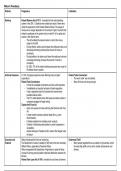
Wilson’s Presidency
Reforms Progressive Limitations
Banking Federal Reserve Act of 1913 - It created the first central banking
system in the USA. 12 districts were created and each of them were
under the supervision of the Federal Reserve Board. The supply of
money was no longer dependent on the amount of gold. Any bank that
wished to participate in the system had to invest 6% of its capital and
surplus in the reserve bank.
- This Act enabled the reserve banks to control the money
supply in the USA.
- During inflation, banks could increase the rediscount rates, and
discourage borrowing (reducing the amount of money in
circulation).
- During deflation, the banks could lower the rediscount rate and
encourage borrowing (increase the amount of money in
circulation).
- By 1923, 70% of the nation's banking resources were a part of
the federal reserve system.
Anti-trust measures In 1914, Congress passed two laws affecting trusts and giant Federal Trade Commission:
corporations. - The word ‘unfair’ was not defined.
Federal Trade Commission - Many felt it was not strong enough.
- Formed to investigate corporations and stop unfair practices.
- It established an important principle of federal regulation.
- It was a regulatory body for business that covered every
possible dubious action.
- The FTC administered almost 400 cease-and-desist orders to
companies engaged in illegal activity.
Clayton Anti-Trust Act
- Gave more powers to those enforcing the Sherman Anti-Trust
Act.
- It made certain business practices illegal (for e.g. price
discrimination).
- It forbade retailers from handling rivals’ products.
- Creation of interlocking directorates to control companies in
competition.
- Samuel Gompers, President of AFL called it the ‘Magna Carta
for labour’.
Economic and Wilson introduced the first ever income tax. Underwood Tariff
financial The Department of Labour (created by Taft) had its first ever secretary, - Many people regarded this as an attack on big business, which
William Wilson, appointed by Woodrow Wilson. favoured high tariffs, and an aid to smaller businessmen and
Wilson reorganised the Department of Agriculture to assist all those farmers.
involved in farming ensuring better credit and distribution networks for
farmers.
Federal Farm Loan Act of 1916 - provided low cost loans to farmers.
Reforms Progressive Limitations
Banking Federal Reserve Act of 1913 - It created the first central banking
system in the USA. 12 districts were created and each of them were
under the supervision of the Federal Reserve Board. The supply of
money was no longer dependent on the amount of gold. Any bank that
wished to participate in the system had to invest 6% of its capital and
surplus in the reserve bank.
- This Act enabled the reserve banks to control the money
supply in the USA.
- During inflation, banks could increase the rediscount rates, and
discourage borrowing (reducing the amount of money in
circulation).
- During deflation, the banks could lower the rediscount rate and
encourage borrowing (increase the amount of money in
circulation).
- By 1923, 70% of the nation's banking resources were a part of
the federal reserve system.
Anti-trust measures In 1914, Congress passed two laws affecting trusts and giant Federal Trade Commission:
corporations. - The word ‘unfair’ was not defined.
Federal Trade Commission - Many felt it was not strong enough.
- Formed to investigate corporations and stop unfair practices.
- It established an important principle of federal regulation.
- It was a regulatory body for business that covered every
possible dubious action.
- The FTC administered almost 400 cease-and-desist orders to
companies engaged in illegal activity.
Clayton Anti-Trust Act
- Gave more powers to those enforcing the Sherman Anti-Trust
Act.
- It made certain business practices illegal (for e.g. price
discrimination).
- It forbade retailers from handling rivals’ products.
- Creation of interlocking directorates to control companies in
competition.
- Samuel Gompers, President of AFL called it the ‘Magna Carta
for labour’.
Economic and Wilson introduced the first ever income tax. Underwood Tariff
financial The Department of Labour (created by Taft) had its first ever secretary, - Many people regarded this as an attack on big business, which
William Wilson, appointed by Woodrow Wilson. favoured high tariffs, and an aid to smaller businessmen and
Wilson reorganised the Department of Agriculture to assist all those farmers.
involved in farming ensuring better credit and distribution networks for
farmers.
Federal Farm Loan Act of 1916 - provided low cost loans to farmers.


