Indirect realism
“Asses indirect realism”
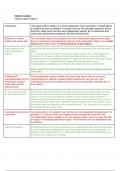
Introduction I will argue indirect realism is a weak explanation of our perception, instead taking
an idealist account as idealism is a better account. My strongest argument will be
that from ‘ideas cannot be like mind-independent objects’ as it undermines that
sense data represents/corresponds with the external world.
Definition of indirect The immediate objects of perception are mind-independent objects (sense data)
realism and sense data that are caused and represented by external mind-independent objects. Is a realist
theory which states there are three elements of perception.
ideas cannot be like Argues that indirect realism’s claim that sense data represents the external world is
mind-independent false:
objects P1. I have an idea of a tree with certain sensible qualities- P2. These depend on
the mind -P3. To say my idea of a tree resembles a tree is to say something
invisible represents something visible- P4. Ideas are fleeting and changing, objects
are permanent-C1. therefore mind-independent objects cannot have
mind-dependent properties-C2. It follows that ideas cannot resemble ideas
Most crucial P is P3 as it shows that sense data cannot accurately represent
the world.
Challenge P3, P3 misrepresents, indirect realists can accept that sense data are not exact
misrepresentation of the copies/replicas of external. Instead indirect realists can say they are mere
relationship between indicators that point to the external world but do not necessarily resemble this in
sense data and the every detail.
external world
No empirical evidence If we accept the indirect realist claim that ‘we only perceive sense data’, on what
for the external world grounds do indirect realists have to claim that the external world exists? Using
Hume’s fork we can show that the existence of an external world is neither a
relation of idea (analytic truth) nor a matter of fact (cannit be empirically proven as
all we perceive is sense data), therefore indirect realists cannot necessarily claim
that sense data corresponds with an external world. This argument is strong as it
is strengthened by Hume’s fork
Involuntary nature of our Our sense data is not subject to our will like our mind-dependent thoughts are. For
experience example, if I close my eyes and imagine an apple tasting like a banana, the
mind-dependent idea is subject to my will, however when I open my eyes and bite
an apple, it will always taste like an apple. Thus showing how our perceptions are
involuntary.
Begs the question Presupposes the truth of the conclusion as it supposes that the ‘apple being bitten’
is mind-independent (distinguishes the mind-dependent idea from the apple), an
idealist would suggest there is no difference as all things are mind-dependent, so
the truth of the conclusion is flawed.
“Asses indirect realism”
Introduction I will argue indirect realism is a weak explanation of our perception, instead taking
an idealist account as idealism is a better account. My strongest argument will be
that from ‘ideas cannot be like mind-independent objects’ as it undermines that
sense data represents/corresponds with the external world.
Definition of indirect The immediate objects of perception are mind-independent objects (sense data)
realism and sense data that are caused and represented by external mind-independent objects. Is a realist
theory which states there are three elements of perception.
ideas cannot be like Argues that indirect realism’s claim that sense data represents the external world is
mind-independent false:
objects P1. I have an idea of a tree with certain sensible qualities- P2. These depend on
the mind -P3. To say my idea of a tree resembles a tree is to say something
invisible represents something visible- P4. Ideas are fleeting and changing, objects
are permanent-C1. therefore mind-independent objects cannot have
mind-dependent properties-C2. It follows that ideas cannot resemble ideas
Most crucial P is P3 as it shows that sense data cannot accurately represent
the world.
Challenge P3, P3 misrepresents, indirect realists can accept that sense data are not exact
misrepresentation of the copies/replicas of external. Instead indirect realists can say they are mere
relationship between indicators that point to the external world but do not necessarily resemble this in
sense data and the every detail.
external world
No empirical evidence If we accept the indirect realist claim that ‘we only perceive sense data’, on what
for the external world grounds do indirect realists have to claim that the external world exists? Using
Hume’s fork we can show that the existence of an external world is neither a
relation of idea (analytic truth) nor a matter of fact (cannit be empirically proven as
all we perceive is sense data), therefore indirect realists cannot necessarily claim
that sense data corresponds with an external world. This argument is strong as it
is strengthened by Hume’s fork
Involuntary nature of our Our sense data is not subject to our will like our mind-dependent thoughts are. For
experience example, if I close my eyes and imagine an apple tasting like a banana, the
mind-dependent idea is subject to my will, however when I open my eyes and bite
an apple, it will always taste like an apple. Thus showing how our perceptions are
involuntary.
Begs the question Presupposes the truth of the conclusion as it supposes that the ‘apple being bitten’
is mind-independent (distinguishes the mind-dependent idea from the apple), an
idealist would suggest there is no difference as all things are mind-dependent, so
the truth of the conclusion is flawed.