Section 2 : Inorganic Chemistry
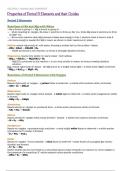
Properties of Period 3 Elements and their Oxides
Period 3 Elements
Reactions of Na and Mg with Water
• Na is found in group 1 + Mg is found in group 2.
• ∴ when reacting w/ oxygen, Na loses 1 electron to form an Na+ ion, while Mg loses 2 electrons to form
an Mg2+ ion.
• ∴ Na is more reactive than Mg because it takes less energy to lose 1 electron than it does to lose 2.
• So more energy is needed for Mg to react, as shown in their reactions w/ water…
Sodium reacts vigorously w/ cold water, forming a molten ball on the surface + zzes.
• 2Na + 2H2O → 2NaOH + H2
- NaOH produced in the reaction, so forms a strongly alkaline solution.
Magnesium reacts very slowly w/ warm water - few bubbles.
• Mg(s) + 2H2O(l) → Mg(OH)2 + H2
- Mg(OH)2 produced in the reaction + is not very soluble in water, so forms a weakly alkaline
solution.
But, reacts vigorously w/ steam - the Mg burns w/ a bright white light + a white solid (MgO) is formed.
• Mg(s) + H2O(g) → MgO + H2
Reactions of Period 3 Elements with Oxygen
Sodium
Reacts vigorously w/ oxygen - a yellow ame is observed + a white solid (sodium oxide) is formed.
• 4Na + O2 → 2Na2O
Magnesium
Reacts vigorously w/ oxygen when heated - a white light is observed + a white solid (magnesium oxide)
is formed.
• 2Mg + O2 → 2MgO
Aluminium
Reacts slowly w/ oxygen in powdered form - a white solid (aluminium oxide) is formed.
• 4Al + 3O2 → 2Al2O3
Silicon
Reacts slowly w/ oxygen when nely divided + heated - a white solid (silicon dioxide) is formed.
• Si + O2 → SiO2
Phosphorus
Reacts w/ oxygen + spontaneously combusts - a very bright white ame is observed + a white smoke
(phosphorus(V) oxide) is formed.
• P4 + 5O2 → P4O10
Sulfur
Reacts w/ oxygen + burns steadily - a blue ame is observed + misty fumes of a pungent gas (sulfur
dioxide) are formed.
• S + O2 → SO2
Sulfur dioxide can be converted to a colourless liquid (sulfur trioxide) on reaction w/ more oxygen in
the presence of a vanadium(V) oxide catalyst under speci c conditions.
• 2SO2 + O2 → 2SO3
fi fl fl fi fl fi
Properties of Period 3 Elements and their Oxides
Period 3 Elements
Reactions of Na and Mg with Water
• Na is found in group 1 + Mg is found in group 2.
• ∴ when reacting w/ oxygen, Na loses 1 electron to form an Na+ ion, while Mg loses 2 electrons to form
an Mg2+ ion.
• ∴ Na is more reactive than Mg because it takes less energy to lose 1 electron than it does to lose 2.
• So more energy is needed for Mg to react, as shown in their reactions w/ water…
Sodium reacts vigorously w/ cold water, forming a molten ball on the surface + zzes.
• 2Na + 2H2O → 2NaOH + H2
- NaOH produced in the reaction, so forms a strongly alkaline solution.
Magnesium reacts very slowly w/ warm water - few bubbles.
• Mg(s) + 2H2O(l) → Mg(OH)2 + H2
- Mg(OH)2 produced in the reaction + is not very soluble in water, so forms a weakly alkaline
solution.
But, reacts vigorously w/ steam - the Mg burns w/ a bright white light + a white solid (MgO) is formed.
• Mg(s) + H2O(g) → MgO + H2
Reactions of Period 3 Elements with Oxygen
Sodium
Reacts vigorously w/ oxygen - a yellow ame is observed + a white solid (sodium oxide) is formed.
• 4Na + O2 → 2Na2O
Magnesium
Reacts vigorously w/ oxygen when heated - a white light is observed + a white solid (magnesium oxide)
is formed.
• 2Mg + O2 → 2MgO
Aluminium
Reacts slowly w/ oxygen in powdered form - a white solid (aluminium oxide) is formed.
• 4Al + 3O2 → 2Al2O3
Silicon
Reacts slowly w/ oxygen when nely divided + heated - a white solid (silicon dioxide) is formed.
• Si + O2 → SiO2
Phosphorus
Reacts w/ oxygen + spontaneously combusts - a very bright white ame is observed + a white smoke
(phosphorus(V) oxide) is formed.
• P4 + 5O2 → P4O10
Sulfur
Reacts w/ oxygen + burns steadily - a blue ame is observed + misty fumes of a pungent gas (sulfur
dioxide) are formed.
• S + O2 → SO2
Sulfur dioxide can be converted to a colourless liquid (sulfur trioxide) on reaction w/ more oxygen in
the presence of a vanadium(V) oxide catalyst under speci c conditions.
• 2SO2 + O2 → 2SO3
fi fl fl fi fl fi