
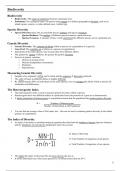
Biodiversity
Biodiversity
• Biodiversity: The range of organisms found in a particular area.
• Endemism: The ecological state of a species being unique to a defined geographical location, such as an
island, nation, country, or other defined zone / habitat type.
Species Diversity
• Species Diversity takes into account both species richness and species evenness:
o Species Richness: The number of different species found in a particular area.
o Species Evenness: A measure of how evenly distributed the different species are in a particular are.
Genetic Diversity
• Genetic Diversity: The variation of alleles within a species (or a population of a species).
• Gene Pool: The complete set of alleles in a species (or population).
• Individuals of the same species vary because they have different alleles.
• The greater the variety of alleles, the greater the genetic diversity.
• Sources of genetic variation:
o Meiosis (Crossing Over)
o Meiosis (Independent Assortment)
o Mutations
o Reproduction
Measuring Genetic Diversity
• Samples of an organism’s DNA can be taken and the sequence of base pairs analysed.
• The order of bases in different alleles is slightly different.
• By sequencing the DNA of individuals of the same species, you can compare the alleles within a species for
similarities and differences.
The Heterozygosity Index
• The heterozygosity index is used to measure genetic diversity within a species.
• Heterozygotes have two different alleles at a particular locus (the position of a gene on a chromosome).
• A higher proportion of heterozygotes in a population means that the population has greater genetic diversity.
H= ______Number of Heterozygotes______
Number of Individuals in the Population
• You can find an average value of H at many loci – this can be used to estimate genetic diversity in the whole
genome of a population.
The Index of Diversity
• An index of diversity is calculated using an equation that takes both the number of species (species richness)
and the abundance of each species (population size) into account.
D: Index of Diversity
N: Total Number of organisms of all species
n: Total Number of organisms of one species
• The higher the index of diversity (D), the more diverse the area is.
• If all the individuals are of the same species (i.e. no biodiversity) then the D=1.
3
Biodiversity
• Biodiversity: The range of organisms found in a particular area.
• Endemism: The ecological state of a species being unique to a defined geographical location, such as an
island, nation, country, or other defined zone / habitat type.
Species Diversity
• Species Diversity takes into account both species richness and species evenness:
o Species Richness: The number of different species found in a particular area.
o Species Evenness: A measure of how evenly distributed the different species are in a particular are.
Genetic Diversity
• Genetic Diversity: The variation of alleles within a species (or a population of a species).
• Gene Pool: The complete set of alleles in a species (or population).
• Individuals of the same species vary because they have different alleles.
• The greater the variety of alleles, the greater the genetic diversity.
• Sources of genetic variation:
o Meiosis (Crossing Over)
o Meiosis (Independent Assortment)
o Mutations
o Reproduction
Measuring Genetic Diversity
• Samples of an organism’s DNA can be taken and the sequence of base pairs analysed.
• The order of bases in different alleles is slightly different.
• By sequencing the DNA of individuals of the same species, you can compare the alleles within a species for
similarities and differences.
The Heterozygosity Index
• The heterozygosity index is used to measure genetic diversity within a species.
• Heterozygotes have two different alleles at a particular locus (the position of a gene on a chromosome).
• A higher proportion of heterozygotes in a population means that the population has greater genetic diversity.
H= ______Number of Heterozygotes______
Number of Individuals in the Population
• You can find an average value of H at many loci – this can be used to estimate genetic diversity in the whole
genome of a population.
The Index of Diversity
• An index of diversity is calculated using an equation that takes both the number of species (species richness)
and the abundance of each species (population size) into account.
D: Index of Diversity
N: Total Number of organisms of all species
n: Total Number of organisms of one species
• The higher the index of diversity (D), the more diverse the area is.
• If all the individuals are of the same species (i.e. no biodiversity) then the D=1.
3


