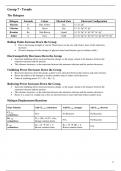
Group 7 - Trends
The Halogens
Halogen Formula Colour Physical State Electronic Configuration
Fluorine F2 Pale Yellow Gas 1s 2s 2p5
2 2
Chlorine Cl2 Green Gas 1s2 2s2 2p6 3s2 3p5
Bromine Br2 Red-Brown Liquid 1s2 2s2 2p6 3s2 3p6 3d10 4s2 4p5
Iodine I2 Grey Solid 1s2 2s2 2p6 3s2 3p6 3d10 4s2 4p6 4d10 5s2 5p5
Boiling Points Increase Down the Group
• Due to increasing strength of van der Waals forces as the size and relative mass of the molecules
increases.
• (Trend is displayed in the changes of physical state from fluorine (gas) to iodine (solid).)
Electronegativity Decreases Down the Group
• Increased shielding offsets increased nuclear charge, so the major variant is the distance between the
outermost electron and the nucleus.
• This distance increases, so the attraction between the outermost electron and the nucleus decreases.
Oxidising Power Decreases Down the Group
• Reactivity decreases down the group, as there is less attraction between the nucleus and outer electron.
• Hence the ability of the halogen to oxidise another atom or reduce itself decreases.
• Order of oxidising power: F2 > Cl2 > Br2 > I2.
Reducing Power Increases Down the Group
• Increased shielding offsets increased nuclear charge, so the major variant is the distance between the
outermost electron and the nucleus.
• This distance increases, so the attraction between the outermost electron and the nucleus decreases.
• Hence it is easier for a halide ion to lose an electron from its outer shell and reduce another atom.
Halogen Displacement Reactions
Start Solution Add Cl2 (aq) (colourless) Add Br2 (aq) (orange) Add I2 (aq) (brown)
Cl- (aq)
N/A No Reaction No Reaction
(colourless)
Br- (aq) Cl2 + 2Br- → 2Cl- + Br2
N/A No Reaction
(colourless) Orange solution forms
I- (aq) Cl2 + 2I- → 2Cl- + I2 Br2 + 2I- → 2Br- + I2
N/A
(colourless) Brown solution forms Brown solution forms
7
The Halogens
Halogen Formula Colour Physical State Electronic Configuration
Fluorine F2 Pale Yellow Gas 1s 2s 2p5
2 2
Chlorine Cl2 Green Gas 1s2 2s2 2p6 3s2 3p5
Bromine Br2 Red-Brown Liquid 1s2 2s2 2p6 3s2 3p6 3d10 4s2 4p5
Iodine I2 Grey Solid 1s2 2s2 2p6 3s2 3p6 3d10 4s2 4p6 4d10 5s2 5p5
Boiling Points Increase Down the Group
• Due to increasing strength of van der Waals forces as the size and relative mass of the molecules
increases.
• (Trend is displayed in the changes of physical state from fluorine (gas) to iodine (solid).)
Electronegativity Decreases Down the Group
• Increased shielding offsets increased nuclear charge, so the major variant is the distance between the
outermost electron and the nucleus.
• This distance increases, so the attraction between the outermost electron and the nucleus decreases.
Oxidising Power Decreases Down the Group
• Reactivity decreases down the group, as there is less attraction between the nucleus and outer electron.
• Hence the ability of the halogen to oxidise another atom or reduce itself decreases.
• Order of oxidising power: F2 > Cl2 > Br2 > I2.
Reducing Power Increases Down the Group
• Increased shielding offsets increased nuclear charge, so the major variant is the distance between the
outermost electron and the nucleus.
• This distance increases, so the attraction between the outermost electron and the nucleus decreases.
• Hence it is easier for a halide ion to lose an electron from its outer shell and reduce another atom.
Halogen Displacement Reactions
Start Solution Add Cl2 (aq) (colourless) Add Br2 (aq) (orange) Add I2 (aq) (brown)
Cl- (aq)
N/A No Reaction No Reaction
(colourless)
Br- (aq) Cl2 + 2Br- → 2Cl- + Br2
N/A No Reaction
(colourless) Orange solution forms
I- (aq) Cl2 + 2I- → 2Cl- + I2 Br2 + 2I- → 2Br- + I2
N/A
(colourless) Brown solution forms Brown solution forms
7