Periodicity
How is the Periodic Table Arranged?
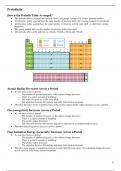
• The periodic table is arranged into periods (rows) and groups (columns) by atomic (proton) number.
• All elements within a period have the same number of electron shells (but varying numbers of sub-shells).
• All elements within a group have the same number of electrons in their outer shell – so they have similar
properties.
• The group number tells you the number of electrons in the outer shell.
• The periodic table can be split into an s-block, d-block, p-block and f-block.
Atomic Radius Decreases Across a Period
• As you move across a period:
o The number of protons increases, so the nuclear charge increases.
o There is a similar amount of shielding.
o The outer electrons are in the same shell.
o The attraction between the nucleus and outer shell electron increases.
• Therefore the outer electro is pulled closer to the nucleus; hence atomic radius decreases across a period.
Electronegativity Increases Across a Period
• As you move across a period:
o The number of protons increases, so the nuclear charge increases.
o There is a similar amount of shielding.
o The atomic radius decreases/
o The attraction between the nucleus and pair of electrons in a covalent bond increases.
• Therefore electronegativity increases across a period.
First Ionisation Energy (Generally) Increases Across a Period
• As you move across a period:
o The number of protons increases, so the nuclear charge increases.
o There is a similar amount of shielding.
o The atomic radius decreases.
o The attraction between the nucleus and outer shell electron increases
• Therefore more energy is required to remove an outer shell electron; hence first ionisation energy increases
across a period, aside from various exceptions.
2
How is the Periodic Table Arranged?
• The periodic table is arranged into periods (rows) and groups (columns) by atomic (proton) number.
• All elements within a period have the same number of electron shells (but varying numbers of sub-shells).
• All elements within a group have the same number of electrons in their outer shell – so they have similar
properties.
• The group number tells you the number of electrons in the outer shell.
• The periodic table can be split into an s-block, d-block, p-block and f-block.
Atomic Radius Decreases Across a Period
• As you move across a period:
o The number of protons increases, so the nuclear charge increases.
o There is a similar amount of shielding.
o The outer electrons are in the same shell.
o The attraction between the nucleus and outer shell electron increases.
• Therefore the outer electro is pulled closer to the nucleus; hence atomic radius decreases across a period.
Electronegativity Increases Across a Period
• As you move across a period:
o The number of protons increases, so the nuclear charge increases.
o There is a similar amount of shielding.
o The atomic radius decreases/
o The attraction between the nucleus and pair of electrons in a covalent bond increases.
• Therefore electronegativity increases across a period.
First Ionisation Energy (Generally) Increases Across a Period
• As you move across a period:
o The number of protons increases, so the nuclear charge increases.
o There is a similar amount of shielding.
o The atomic radius decreases.
o The attraction between the nucleus and outer shell electron increases
• Therefore more energy is required to remove an outer shell electron; hence first ionisation energy increases
across a period, aside from various exceptions.
2