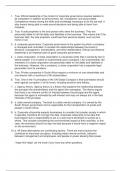
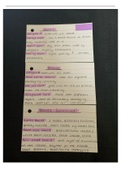
The biological approach assumptions:
1. Psychology should be scientific
2. Behaviour can be explained as a function of biology
3. Genes evolved over millions of years and therefore have evolutionary purpose
The social learning approach assumptions:
1. Learning can occur through direct experience and the observation of role models
2. SLT sees people as active manipulators of their own environment rather than passive
receivers of experiences
3. SLT focuses on human rather than animal behaviour
The behaviourist approach assumptions:
1. All behaviour is learned from the environment
2. Psychology should be scientific
3. It is primarily concerned with observable behaviour as opposed to internal events
like thinking and emotion.
The cognitive approach assumptions:
1. Mediational processes occur between stimulus and response
2. Psychology should be seen as a science
3. Humans are like computers
The humanistic approach assumptions:
1. People have free will
2. People are basically good and have an innate need to make themselves and the
world better
3. People are motivated to self-actualise
4. Rejects scientific methodology
The psychodynamic approach assumptions:
1. Our behaviour and feelings are powerfully attracted by unconscious motives
2. Our behaviour and feelings as adults are rooted in our childhood experiences
3. Personality is made up of 3 parts: id, ego and superego
4. All behaviour is determined
1. Psychology should be scientific
2. Behaviour can be explained as a function of biology
3. Genes evolved over millions of years and therefore have evolutionary purpose
The social learning approach assumptions:
1. Learning can occur through direct experience and the observation of role models
2. SLT sees people as active manipulators of their own environment rather than passive
receivers of experiences
3. SLT focuses on human rather than animal behaviour
The behaviourist approach assumptions:
1. All behaviour is learned from the environment
2. Psychology should be scientific
3. It is primarily concerned with observable behaviour as opposed to internal events
like thinking and emotion.
The cognitive approach assumptions:
1. Mediational processes occur between stimulus and response
2. Psychology should be seen as a science
3. Humans are like computers
The humanistic approach assumptions:
1. People have free will
2. People are basically good and have an innate need to make themselves and the
world better
3. People are motivated to self-actualise
4. Rejects scientific methodology
The psychodynamic approach assumptions:
1. Our behaviour and feelings are powerfully attracted by unconscious motives
2. Our behaviour and feelings as adults are rooted in our childhood experiences
3. Personality is made up of 3 parts: id, ego and superego
4. All behaviour is determined