

Arbitration
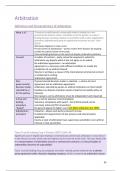
Definition and Characteristics of Arbitration
What is it? “A process by which parties consensually submit a dispute to a non-
governmental decision-maker, selected by or for the parties, to render a
binding decision resolving a dispute in accordance with neutral, adjudicatory
procedures affording each party an opportunity to present its case”. Born
(2012)
Alternative litigation to state courts
Private system of adjudication – parties resolve their disputes by stepping
outside the judicial system of any state
Final and binding decision on the merits of dispute rendered by arbitrator
Consent A matter of contract – party cannot be required to submit to
arbitration any dispute which it has not agree so to submit
No arbitration agreement = no arbitration
Agreement is a necessary and sufficient condition to invoke the
jurisdiction of an arbitral tribunal
May be in writing as a clause of the international commercial contract
or evidenced in writing
Submission agreement
Non- If governmental decision-maker is selected – a choice of court
governmental agreement not an arbitration agreement
decision-maker Arbitrators selected by parties or arbitral institutions on their behalf
selected by or Emphasis on dispute resolution needs of parties (not public policy or
for the parties interest)
Non-lawyers can be arbitrators (must be independent and impartial)
A final and Not a merely advisory recommendation
binding Voluntary compliance with award – but arbitral award can be
procedure coercively enforced (NY Convention)
“Award” No general appeal to higher court (Art 69(1) Arbitration Act 1996)
Adjudicatory Impartial – allows each party to present its case
procedure Fundamental requirements of due procees and natural justice
applicable
Courts at seat of arbitration have supervisory jurisdiction over arbitral
tribunal in that jurisdiction
Fiona Trust & Holding Corp v Privalov [2007] UKHL 40.
Significant case in English law relating to international commercial arbitration. It was heard
in the House of Lords, which was the highest court in the UK at the time. The case dealt with
the interpretation of arbitration clauses in commercial contracts and the principles of
arbitrability (doctrine of separability)
Fiona Trust & Holding Corp (a company) and other related parties entered into a charter
party agreement with a Russian shipping company, which contained an arbitration clause.
50
Definition and Characteristics of Arbitration
What is it? “A process by which parties consensually submit a dispute to a non-
governmental decision-maker, selected by or for the parties, to render a
binding decision resolving a dispute in accordance with neutral, adjudicatory
procedures affording each party an opportunity to present its case”. Born
(2012)
Alternative litigation to state courts
Private system of adjudication – parties resolve their disputes by stepping
outside the judicial system of any state
Final and binding decision on the merits of dispute rendered by arbitrator
Consent A matter of contract – party cannot be required to submit to
arbitration any dispute which it has not agree so to submit
No arbitration agreement = no arbitration
Agreement is a necessary and sufficient condition to invoke the
jurisdiction of an arbitral tribunal
May be in writing as a clause of the international commercial contract
or evidenced in writing
Submission agreement
Non- If governmental decision-maker is selected – a choice of court
governmental agreement not an arbitration agreement
decision-maker Arbitrators selected by parties or arbitral institutions on their behalf
selected by or Emphasis on dispute resolution needs of parties (not public policy or
for the parties interest)
Non-lawyers can be arbitrators (must be independent and impartial)
A final and Not a merely advisory recommendation
binding Voluntary compliance with award – but arbitral award can be
procedure coercively enforced (NY Convention)
“Award” No general appeal to higher court (Art 69(1) Arbitration Act 1996)
Adjudicatory Impartial – allows each party to present its case
procedure Fundamental requirements of due procees and natural justice
applicable
Courts at seat of arbitration have supervisory jurisdiction over arbitral
tribunal in that jurisdiction
Fiona Trust & Holding Corp v Privalov [2007] UKHL 40.
Significant case in English law relating to international commercial arbitration. It was heard
in the House of Lords, which was the highest court in the UK at the time. The case dealt with
the interpretation of arbitration clauses in commercial contracts and the principles of
arbitrability (doctrine of separability)
Fiona Trust & Holding Corp (a company) and other related parties entered into a charter
party agreement with a Russian shipping company, which contained an arbitration clause.
50



