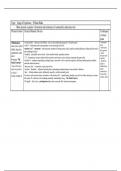
Evaluating Cognitive Explanations of SZ
Empirical Supporting Evidence
Stirling compared 30 patients with a diagnosis of schizophrenia with 18 non-patient controls on a cognitive
test (stroop task).
Patients took twice as long to name the ink colour as the control group.
This shows that people with SZ cannot suppress the impulse to read the words.
Which suggests that information processing is different in the minds of those with SZ.
However, this only explains the proximal origins of symptoms. A proximal explanation is one that
can explain current behaviour, it can’t explain the onset of behaviour. For example, the cognitive
explanation can explain why someone with schizophrenia experiences negative symptoms but it
can’t explain how someone got negative symptoms. It’s likely that genetic and/or family dysfunction
explanations will provide a better explanation of this. It’s also worth noting that the link between
these explanations and cognitive abnormalities is not clear: how do genes or family dysfunction
cause dysfunctional thoughts? This means that the cognitive explanation alone is insufficient and
only provides a partial explanation.
Support from the success of Cognitive Therapies
In CBT for psychosis (CBTp) patients are encouraged to evaluate the content of their delusions and/or
hallucinations by considering how they could test the validity of their faulty beliefs. A NICE review of
treatments for schizophrenia in 2014 found that CBTp was more effective than antipsychotic medication at
reducing symptom severity and improving levels of social functioning.
Due to changing the cognitions of patients with schizophrenia being effective, this suggests that the cause of
schizophrenia must be faulty cognition, which increases the credibility of this psychological explanation for
schizophrenia.
Meta-analysis supports the role of cognition in schizophrenia
Sarin & Wallin (2014) reviewed recent research evidence relating to the cognitive model of schizophrenia.
They found supporting evidence for the claim that the positive symptoms of SZ have their origins in faulty
cognition. E.g. delusional patients were found to show biases in their information processing (e.g. jumping
to conclusions). And those with hallucinations were found to experience their own thoughts as voices. They
also found that SZ patients with negative symptoms had dysfunctional thought processes, such as having
low expectations regarding pleasure and success.
Given that this was a meta-analysis, this provides compelling evidence for the role of cognition in
schizophrenia.
Empirical Supporting Evidence
Stirling compared 30 patients with a diagnosis of schizophrenia with 18 non-patient controls on a cognitive
test (stroop task).
Patients took twice as long to name the ink colour as the control group.
This shows that people with SZ cannot suppress the impulse to read the words.
Which suggests that information processing is different in the minds of those with SZ.
However, this only explains the proximal origins of symptoms. A proximal explanation is one that
can explain current behaviour, it can’t explain the onset of behaviour. For example, the cognitive
explanation can explain why someone with schizophrenia experiences negative symptoms but it
can’t explain how someone got negative symptoms. It’s likely that genetic and/or family dysfunction
explanations will provide a better explanation of this. It’s also worth noting that the link between
these explanations and cognitive abnormalities is not clear: how do genes or family dysfunction
cause dysfunctional thoughts? This means that the cognitive explanation alone is insufficient and
only provides a partial explanation.
Support from the success of Cognitive Therapies
In CBT for psychosis (CBTp) patients are encouraged to evaluate the content of their delusions and/or
hallucinations by considering how they could test the validity of their faulty beliefs. A NICE review of
treatments for schizophrenia in 2014 found that CBTp was more effective than antipsychotic medication at
reducing symptom severity and improving levels of social functioning.
Due to changing the cognitions of patients with schizophrenia being effective, this suggests that the cause of
schizophrenia must be faulty cognition, which increases the credibility of this psychological explanation for
schizophrenia.
Meta-analysis supports the role of cognition in schizophrenia
Sarin & Wallin (2014) reviewed recent research evidence relating to the cognitive model of schizophrenia.
They found supporting evidence for the claim that the positive symptoms of SZ have their origins in faulty
cognition. E.g. delusional patients were found to show biases in their information processing (e.g. jumping
to conclusions). And those with hallucinations were found to experience their own thoughts as voices. They
also found that SZ patients with negative symptoms had dysfunctional thought processes, such as having
low expectations regarding pleasure and success.
Given that this was a meta-analysis, this provides compelling evidence for the role of cognition in
schizophrenia.