Describe and evaluate differential association theory as a psychological explanation of offending behaviour.
(16 marks).
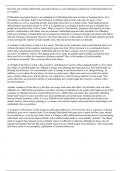
Differential association theory is an explanation of offending behaviour in terms of learning theory, how
interactions with others leads to the formation of attitudes about crime (who may be more or less
favourable), as well as acquiring specific knowledge about how to commit crimes. Sutherland proposed
differentiation association theory in 1939. It is regarded as a sociological theory because it explains how
people are socialised into a life of crime. What is critical is, the duration, frequency and intensity of some
people’s relationships with others who are criminals. Sutherland proposed nine principles for offending
behaviour including: criminal behaviour is learned no inherited, it is learned through association with others
and that learning is directional. However, the most important is if the number of favourable attitudes towards
crime outweigh the number of unfavourable ones, then the person becomes an offender.
A weakness of this theory is that it is too vague. This theory has similarities with social learning theory but
without the detail of the cognitive learning processes involved. This is because it is a sociological theory,
rather than a psychological theory. Sutherland did not feel that a cognitive level of explanation was
necessary. In addition, where is the tipping point? How many favourable:unfavourable associations does
there need to be in order for someone to become criminal? How is the number of (un)favourable
associations measured? This is not specified in the theory.
A strength of the theory is that is has a positive contribution to society. It has changed people’s views about
the origins of criminal behaviour. Marked a change from blaming the individual (e.g. their bad biology) to
blaming social factors. It is considerably easier to change social factors than it is to change biology. In
addition, it can explain the prevalence of crime in certain areas. High crime rates are evident for certain
areas, usually urban areas, and this theory can explain how crime becomes endemic in such areas. This
means that there are practical benefits to understanding how people might have learnt to commit crime,
beyond academia.
Another weakness of this theory is that here are issues with cause and effect. Do offenders seek out other
offenders (i.e. differential association is an effect of being an offender) or do people who happen to be in the
company of offenders become criminal themselves (i.e. differential association has caused the offending
behaviour)? Issues of cause and effect are more problematic given that many studied associations are
between family members; where is it very difficult (if not impossible) to separate the role of nature and
nurture factors. Given that psychology is a science, and science requires cause and effect relationships to be
established; this is a problem.
A weakness of this theory is that it ignores individual differences. Not everyone who is exposed to criminal
influences goes on to commit crime. Even though Sutherland took great care to point out that crime should
be considered on a case-by-case basis, there is a danger within differential association theory of stereotyping
individuals who come from impoverished, crime-ridden backgrounds as ‘unavoidably criminal’. The theory
tends to suggest that exposure to pro-criminal values is sufficient in reducing offending in those who are
exposed and ignores the fact that many people choose not to offend despite such influences. This means that
this theory alone is an incomplete explanation of criminal behaviour.
(16 marks).
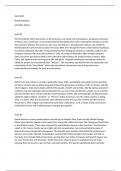
Differential association theory is an explanation of offending behaviour in terms of learning theory, how
interactions with others leads to the formation of attitudes about crime (who may be more or less
favourable), as well as acquiring specific knowledge about how to commit crimes. Sutherland proposed
differentiation association theory in 1939. It is regarded as a sociological theory because it explains how
people are socialised into a life of crime. What is critical is, the duration, frequency and intensity of some
people’s relationships with others who are criminals. Sutherland proposed nine principles for offending
behaviour including: criminal behaviour is learned no inherited, it is learned through association with others
and that learning is directional. However, the most important is if the number of favourable attitudes towards
crime outweigh the number of unfavourable ones, then the person becomes an offender.
A weakness of this theory is that it is too vague. This theory has similarities with social learning theory but
without the detail of the cognitive learning processes involved. This is because it is a sociological theory,
rather than a psychological theory. Sutherland did not feel that a cognitive level of explanation was
necessary. In addition, where is the tipping point? How many favourable:unfavourable associations does
there need to be in order for someone to become criminal? How is the number of (un)favourable
associations measured? This is not specified in the theory.
A strength of the theory is that is has a positive contribution to society. It has changed people’s views about
the origins of criminal behaviour. Marked a change from blaming the individual (e.g. their bad biology) to
blaming social factors. It is considerably easier to change social factors than it is to change biology. In
addition, it can explain the prevalence of crime in certain areas. High crime rates are evident for certain
areas, usually urban areas, and this theory can explain how crime becomes endemic in such areas. This
means that there are practical benefits to understanding how people might have learnt to commit crime,
beyond academia.
Another weakness of this theory is that here are issues with cause and effect. Do offenders seek out other
offenders (i.e. differential association is an effect of being an offender) or do people who happen to be in the
company of offenders become criminal themselves (i.e. differential association has caused the offending
behaviour)? Issues of cause and effect are more problematic given that many studied associations are
between family members; where is it very difficult (if not impossible) to separate the role of nature and
nurture factors. Given that psychology is a science, and science requires cause and effect relationships to be
established; this is a problem.
A weakness of this theory is that it ignores individual differences. Not everyone who is exposed to criminal
influences goes on to commit crime. Even though Sutherland took great care to point out that crime should
be considered on a case-by-case basis, there is a danger within differential association theory of stereotyping
individuals who come from impoverished, crime-ridden backgrounds as ‘unavoidably criminal’. The theory
tends to suggest that exposure to pro-criminal values is sufficient in reducing offending in those who are
exposed and ignores the fact that many people choose not to offend despite such influences. This means that
this theory alone is an incomplete explanation of criminal behaviour.