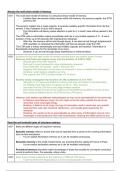
discuss the multi store model of memory.
AO1 The multi store model of memory is a structural linear model of memory.
- It states there are several unitary stores within the memory: the sensory register, the STM
and the LTM.
The sensory register has a huge capacity. It receives modality specific information from the five
senses. It has a duration of up to half a second
- The information will decay unless attention is paid to it, in which case will be passed to the
STM
The STM code is information mainly acoustically and has a very limited capacity of 7+ -2 and a
duration of only up to 30 seconds with maintenance rehearsal.
- After this, the memory will be lost through decay. It can also be lost through displacement.
With repetition or rehearsal the information will then be passed under the LTM.
The LTM code is mainly semantically and has limitless capacity and duration. Information is
theoretically stored here for the remainder of our lives.
- However, it can be lost through decay interference or retrieval failure.
AO3 evidence for the multi store model of memory showing there are multiple types of stores.
Peterson and Petersons trigram study into the duration of STM in 1959
- Showed ppts three letter trigrams
- Ppts had to count backwards to stop maintenance rehearsal
- Found that after 18 seconds - recall = less that 10%
- Suggests that information is lost when no rehearsal is done to maintain this information;
therefore, recall declines steadily over time
- And supports the STM’s duration length (15-30 secs)
Another study investigated the duration of LTM, by Bahrick et al in 1975
- 390 ppts (17-74 years old) tested for memory with pics and names of old classmates
- the findings show that name recognition at 48 yrs - 80% accuracy
- concluded that the LTM has a very large limitless duration
- Both these studies provide strong evidence for the MSM having different stores as they
both evidence different stores, the STM and the LTM stores.
However, both studies had different methodologies so may not be generalisable in the same way.
- In Peterson and Peterson study, the stm might not be the same outside the lab as we
remember more meaningful things.
- Similarly, in Bahrick et als study, the type of information used to recall was very specific
meaning there was high emotional significance, and usually great opportunity for
rehearsal.
- therefore, the results not be as generalisable as other types of information may be more
meaningful to individuals and more well remembered, meaning the MSM cannot be true
Describe and evaluate types of long-term memory.
AO1 there are different types of long-term memory:
Episodic memory refers to events that can be reported from a person's life covering information
such as time and places.
- It is an explicit declarative memory as it can be recalled consciously.
Semantic memory is the recall of learnt facts, eg, knowing that the capital of France is Paris.
- It is an explicit declarative memory as it can be recalled consciously.
Procedural memory describes implicit knowledge of tasks that usually do not require conscious
record to perform them. For example, riding a bike.
AO3 Brain scans provide evidence for the existence of different LTM stores.
- It was found that the hippocampus is active during episodic memories.
, - The temporal lobe is active during semantic memory.
- The cerebellum is active during procedural memory
- Therefore, providing scientific evidence to support that there are different stores for the
different types of long-term memory
Case studies such as HM (Milner 1962) support the case for procedural and declarative
memories stores being distinctively different.
- HM could not form episodic or semantic memories due to the destruction of his
hippocampus and temporal lobes; yet he was able to form procedural memory through
learning how to draw figures by looking at their reflection (mirror drawing).
- However, he could not recollect how he had learnt this skill
- supporting the case for different stores between “knowing how” to do something and
semantic knowledge-based memories or experience-based (episodic).
A weakness with this study is it is based on a single individual
- therefore, making it difficult to generalise the findings to the wider population as deficits in
memory may be unique to this one person.
Discuss the working model of memory.
AO1 The working model of memory (baddeley and hitch) - an alternative to the multi store model of
memory.
- This was developed due to the dual task of effect in which they believe the STM was not a
unitary store.
It consists of the central executive which drives the whole system and allocates data to the slave
systems. It also deals with cognitive tasks such as problem-solving and decision-making
Slave systems include
- visual spatial sketch pad (inner eye) which stores and processes information in a visual
spatial form, deals with navigation
- The other subsystem is the phonological loop which deals with spoken and written
material.
- The phonological loop is subdivided into the phonological store (inner ear),
which rehearses sound information
- and the articulatory process (inner voice) which stores the sound information
Baddeley later added the episodic buffer as he thought the model needed a general store, which
combines information from the other stores and sends it to the LTM
AO3 can be criticised for being too simplistic.
- A study of an individual who had a brain tumour removed showed that he displaced
contradictory symptoms related to central executive.
- The patient was able to perform reasoning tasks indicating an intact central executive, but
took longer on decision-making tasks, indicating the damage to central executive.
- This led them to believe that the current model of the central executive is too simple thus
undermining a key aspect of the model structure.
supporting study of KF.
- Shallice and Warrington studied a man known as KF had an accident and suffered brain
damage
- He had great impaired loss of auditory and verbal information.
- PS suffered but not VSS
- supports the WMM’s claim that separate short-term stores manage short-term
phonological and visual memories
The use of case studies of brain-damaged individuals to support the model is criticised.
AO1 The multi store model of memory is a structural linear model of memory.
- It states there are several unitary stores within the memory: the sensory register, the STM
and the LTM.
The sensory register has a huge capacity. It receives modality specific information from the five
senses. It has a duration of up to half a second
- The information will decay unless attention is paid to it, in which case will be passed to the
STM
The STM code is information mainly acoustically and has a very limited capacity of 7+ -2 and a
duration of only up to 30 seconds with maintenance rehearsal.
- After this, the memory will be lost through decay. It can also be lost through displacement.
With repetition or rehearsal the information will then be passed under the LTM.
The LTM code is mainly semantically and has limitless capacity and duration. Information is
theoretically stored here for the remainder of our lives.
- However, it can be lost through decay interference or retrieval failure.
AO3 evidence for the multi store model of memory showing there are multiple types of stores.
Peterson and Petersons trigram study into the duration of STM in 1959
- Showed ppts three letter trigrams
- Ppts had to count backwards to stop maintenance rehearsal
- Found that after 18 seconds - recall = less that 10%
- Suggests that information is lost when no rehearsal is done to maintain this information;
therefore, recall declines steadily over time
- And supports the STM’s duration length (15-30 secs)
Another study investigated the duration of LTM, by Bahrick et al in 1975
- 390 ppts (17-74 years old) tested for memory with pics and names of old classmates
- the findings show that name recognition at 48 yrs - 80% accuracy
- concluded that the LTM has a very large limitless duration
- Both these studies provide strong evidence for the MSM having different stores as they
both evidence different stores, the STM and the LTM stores.
However, both studies had different methodologies so may not be generalisable in the same way.
- In Peterson and Peterson study, the stm might not be the same outside the lab as we
remember more meaningful things.
- Similarly, in Bahrick et als study, the type of information used to recall was very specific
meaning there was high emotional significance, and usually great opportunity for
rehearsal.
- therefore, the results not be as generalisable as other types of information may be more
meaningful to individuals and more well remembered, meaning the MSM cannot be true
Describe and evaluate types of long-term memory.
AO1 there are different types of long-term memory:
Episodic memory refers to events that can be reported from a person's life covering information
such as time and places.
- It is an explicit declarative memory as it can be recalled consciously.
Semantic memory is the recall of learnt facts, eg, knowing that the capital of France is Paris.
- It is an explicit declarative memory as it can be recalled consciously.
Procedural memory describes implicit knowledge of tasks that usually do not require conscious
record to perform them. For example, riding a bike.
AO3 Brain scans provide evidence for the existence of different LTM stores.
- It was found that the hippocampus is active during episodic memories.
, - The temporal lobe is active during semantic memory.
- The cerebellum is active during procedural memory
- Therefore, providing scientific evidence to support that there are different stores for the
different types of long-term memory
Case studies such as HM (Milner 1962) support the case for procedural and declarative
memories stores being distinctively different.
- HM could not form episodic or semantic memories due to the destruction of his
hippocampus and temporal lobes; yet he was able to form procedural memory through
learning how to draw figures by looking at their reflection (mirror drawing).
- However, he could not recollect how he had learnt this skill
- supporting the case for different stores between “knowing how” to do something and
semantic knowledge-based memories or experience-based (episodic).
A weakness with this study is it is based on a single individual
- therefore, making it difficult to generalise the findings to the wider population as deficits in
memory may be unique to this one person.
Discuss the working model of memory.
AO1 The working model of memory (baddeley and hitch) - an alternative to the multi store model of
memory.
- This was developed due to the dual task of effect in which they believe the STM was not a
unitary store.
It consists of the central executive which drives the whole system and allocates data to the slave
systems. It also deals with cognitive tasks such as problem-solving and decision-making
Slave systems include
- visual spatial sketch pad (inner eye) which stores and processes information in a visual
spatial form, deals with navigation
- The other subsystem is the phonological loop which deals with spoken and written
material.
- The phonological loop is subdivided into the phonological store (inner ear),
which rehearses sound information
- and the articulatory process (inner voice) which stores the sound information
Baddeley later added the episodic buffer as he thought the model needed a general store, which
combines information from the other stores and sends it to the LTM
AO3 can be criticised for being too simplistic.
- A study of an individual who had a brain tumour removed showed that he displaced
contradictory symptoms related to central executive.
- The patient was able to perform reasoning tasks indicating an intact central executive, but
took longer on decision-making tasks, indicating the damage to central executive.
- This led them to believe that the current model of the central executive is too simple thus
undermining a key aspect of the model structure.
supporting study of KF.
- Shallice and Warrington studied a man known as KF had an accident and suffered brain
damage
- He had great impaired loss of auditory and verbal information.
- PS suffered but not VSS
- supports the WMM’s claim that separate short-term stores manage short-term
phonological and visual memories
The use of case studies of brain-damaged individuals to support the model is criticised.