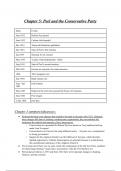
Chapter 5: Peel and the Conservative Party
Dates Events
June 1832 Reform Act passed
June 1832 Carlton club founded
Dec 1834 Tamworth Manifesto published
Dec 1834 Start of Peel’s first ministry
Jan 1839 National ACLL formed
May 1839 ‘Ladies of the Bedchamber’ Affair
Aug 1841 Start of Peel’s second ministry
Mar 1842 Income tax restored, free trade measures
1844 The Companies Act
July 1844 Bank Charter Act
Aug - Sep Irish Famine
1845
May 1846 Repeal of the Corn Laws passed by House of Commons
June 1846 Peel resigns
2 July 1850 Peel dies
Chapter 5 summary/takeaways:
● Realised that there were changes that needed to be made to the party after 1832. Although
these changes fell short of creating a modern party organisation, they nevertheless did
modernise the outlook and structure of the Conservatives
○ Conservatism as expounded Sir Robert Peel was based on Tory traditions built up
under Lord Liverpool
○ Conservatism was Toryism but using different tactics - Toryism was a commitment
to strong government
○ Support for the Anglican Church was the lifeblood of Toryism, which therefore
implied opposition to Catholic Emancipation on principle because it would destroy
the constitutional supremacy of the Anglican Church 4
● The Conservative Party was, to some extent, the continuation of the old Tory Party, members
of which began forming “conservative associations” after the 1832 Reform Act
● Peel proposed reforms in 1835 and from 1841 there were important changes to banking,
finances, and the economy
, ● When famine in Ireland became severe in 1845, Peel decided to end the corn duty
● This had been the object of a major middle-class pressure group since 1939. However, the
ACLL was unpopular with many Conservative MPs and repeal seemed to them to be another
example of Peel surrendering to agitation and sacrificing the interests of landowners. It led to
his fall in 1846.
● The 1832 Reform Act - It took 18 months for the Reform Act to go through parliament - the
legislation came after PUBLIC MEETINGS, DEMONSTRATION, RIOTS AND
POTENTIALLY A REVOLUTION.
○ Duke of Wellington had told the Tory Lords not to oppose the Bill.
THE REFORM ACT CLAUSES
Disenfranchisemen 56 nomination or rotten boroughs returning 111 MPs
t Clauses lost their representation
30 boroughs with less than 4,000 inhabitants lost
one MP each
Weymouth and Melcombe Regis gave up two of
their four MPs
Enfranchisement 65 seats were awarded to the counties
44 seats were distributed to 22 larger towns
including Birmingham, Manchester, Leeds,
Sheffield, and the new London metropolitan districts
21 smaller towns were given one MP each
Scotland was awarded 8 extras
Ireland was given 5 extra seats
Franchise The borough franchise was regularised
Qualification The right of voting was vested in all householders
paying a yearly rental of £10 and, subject to one
year residence qualification £10 logers
Carlton Club
- Set up by Joseph Planta, William Holmes, J.C. Herries, Lord Ellenborough, Charles
Arbuthnot
- Provided a central party organisation and to supervise Conservative electoral arrangements
- The aim of the Committee was to defeat reform proposals, which had been put before
parliament by the Whigs
- Peel had limited interest in the details of party management this was because he was not
fundamentally a party politician: party loyalty did not come first for him but rather the
‘maintenance of our settled institutions in Church and State’
- Helped with Peel’s first Ministry in 1834
The 1835 Municipal Corporations Act
- The Bill had gone through the House of Commons without any difficulties compared to the
House of Lords where they saw it as an attack on privileges and property
- Terms of the Act:
o All closed corporations were abolished
o Borough councils were to be elected by all male ratepayers who had lived in the town
for three years
o Councillors were elected for three years at a time and one third of the council was to
be elected annually
o Councillors would choose the mayor, who would hold office for one year
Dates Events
June 1832 Reform Act passed
June 1832 Carlton club founded
Dec 1834 Tamworth Manifesto published
Dec 1834 Start of Peel’s first ministry
Jan 1839 National ACLL formed
May 1839 ‘Ladies of the Bedchamber’ Affair
Aug 1841 Start of Peel’s second ministry
Mar 1842 Income tax restored, free trade measures
1844 The Companies Act
July 1844 Bank Charter Act
Aug - Sep Irish Famine
1845
May 1846 Repeal of the Corn Laws passed by House of Commons
June 1846 Peel resigns
2 July 1850 Peel dies
Chapter 5 summary/takeaways:
● Realised that there were changes that needed to be made to the party after 1832. Although
these changes fell short of creating a modern party organisation, they nevertheless did
modernise the outlook and structure of the Conservatives
○ Conservatism as expounded Sir Robert Peel was based on Tory traditions built up
under Lord Liverpool
○ Conservatism was Toryism but using different tactics - Toryism was a commitment
to strong government
○ Support for the Anglican Church was the lifeblood of Toryism, which therefore
implied opposition to Catholic Emancipation on principle because it would destroy
the constitutional supremacy of the Anglican Church 4
● The Conservative Party was, to some extent, the continuation of the old Tory Party, members
of which began forming “conservative associations” after the 1832 Reform Act
● Peel proposed reforms in 1835 and from 1841 there were important changes to banking,
finances, and the economy
, ● When famine in Ireland became severe in 1845, Peel decided to end the corn duty
● This had been the object of a major middle-class pressure group since 1939. However, the
ACLL was unpopular with many Conservative MPs and repeal seemed to them to be another
example of Peel surrendering to agitation and sacrificing the interests of landowners. It led to
his fall in 1846.
● The 1832 Reform Act - It took 18 months for the Reform Act to go through parliament - the
legislation came after PUBLIC MEETINGS, DEMONSTRATION, RIOTS AND
POTENTIALLY A REVOLUTION.
○ Duke of Wellington had told the Tory Lords not to oppose the Bill.
THE REFORM ACT CLAUSES
Disenfranchisemen 56 nomination or rotten boroughs returning 111 MPs
t Clauses lost their representation
30 boroughs with less than 4,000 inhabitants lost
one MP each
Weymouth and Melcombe Regis gave up two of
their four MPs
Enfranchisement 65 seats were awarded to the counties
44 seats were distributed to 22 larger towns
including Birmingham, Manchester, Leeds,
Sheffield, and the new London metropolitan districts
21 smaller towns were given one MP each
Scotland was awarded 8 extras
Ireland was given 5 extra seats
Franchise The borough franchise was regularised
Qualification The right of voting was vested in all householders
paying a yearly rental of £10 and, subject to one
year residence qualification £10 logers
Carlton Club
- Set up by Joseph Planta, William Holmes, J.C. Herries, Lord Ellenborough, Charles
Arbuthnot
- Provided a central party organisation and to supervise Conservative electoral arrangements
- The aim of the Committee was to defeat reform proposals, which had been put before
parliament by the Whigs
- Peel had limited interest in the details of party management this was because he was not
fundamentally a party politician: party loyalty did not come first for him but rather the
‘maintenance of our settled institutions in Church and State’
- Helped with Peel’s first Ministry in 1834
The 1835 Municipal Corporations Act
- The Bill had gone through the House of Commons without any difficulties compared to the
House of Lords where they saw it as an attack on privileges and property
- Terms of the Act:
o All closed corporations were abolished
o Borough councils were to be elected by all male ratepayers who had lived in the town
for three years
o Councillors were elected for three years at a time and one third of the council was to
be elected annually
o Councillors would choose the mayor, who would hold office for one year