Holly Connell
Assignment 11b
P2: Explain why science is used in the investigation of
causes of road traffic collisions
Science is extremely reliable when carried out by a professional. The evidence gained
from forensic collision investigation can be used in court to help determine guilt or
innocence. As well as validate or disprove human testimonies.
Some of the more common techniques include assessing vehicle damage for where and
how impacts occurred, assessing road marks for evidence of things such as brake lock
location and documenting any environmental factors that could impact the control of a
vehicle.
P3: Calculate velocity and use the coefficient friction to
determine the speed of vehicles before a collision from
collision scenarios
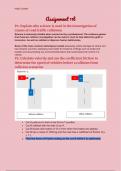
● Car A pulls out in front of car B at a T junction.
● Car B collided with the side of car A.
● Car B leaves skid marks of 15 m from when the brakes are applied.
● Car B has a mass of 1000 kg and the road has a coefficient of friction of µ
= 1.1.
a. Find the force of friction acting on the car B while it is stationary.
, Holly Connell
b. After the collision has occurred, what is the final velocity of car B?
c. Assume car B comes instantly to the velocity you stated in part b. If
the time between car B applying the brakes and colliding with A is 1.5
2
s and the rate of deceleration is 4 m/s , using SUVAT determine the
initial velocity.
d. What was the initial kinetic energy of car B?
2. A driver is travelling along a straight road. At point A, she spots a potential
hazard ahead and applies the brakes in order to slow down, decelerating at a
rate of 1.2 m/s2. She stops applying the brakes at point B, after that time her
velocity is 2 m/s.
Assignment 11b
P2: Explain why science is used in the investigation of
causes of road traffic collisions
Science is extremely reliable when carried out by a professional. The evidence gained
from forensic collision investigation can be used in court to help determine guilt or
innocence. As well as validate or disprove human testimonies.
Some of the more common techniques include assessing vehicle damage for where and
how impacts occurred, assessing road marks for evidence of things such as brake lock
location and documenting any environmental factors that could impact the control of a
vehicle.
P3: Calculate velocity and use the coefficient friction to
determine the speed of vehicles before a collision from
collision scenarios
● Car A pulls out in front of car B at a T junction.
● Car B collided with the side of car A.
● Car B leaves skid marks of 15 m from when the brakes are applied.
● Car B has a mass of 1000 kg and the road has a coefficient of friction of µ
= 1.1.
a. Find the force of friction acting on the car B while it is stationary.
, Holly Connell
b. After the collision has occurred, what is the final velocity of car B?
c. Assume car B comes instantly to the velocity you stated in part b. If
the time between car B applying the brakes and colliding with A is 1.5
2
s and the rate of deceleration is 4 m/s , using SUVAT determine the
initial velocity.
d. What was the initial kinetic energy of car B?
2. A driver is travelling along a straight road. At point A, she spots a potential
hazard ahead and applies the brakes in order to slow down, decelerating at a
rate of 1.2 m/s2. She stops applying the brakes at point B, after that time her
velocity is 2 m/s.