

HFI - 1. Introduction to A&P
Anatomy = body structures and relationships
Physiology = body functions
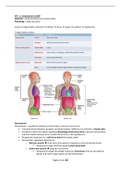
Levels of organisation: chemical → cellular → tissue → organ → systemic → organismal.
3 major body cavities:
Homeostasis
Homeostasis = equilibrium (balance) of the body’s internal environment
• Communication between receptors and body systems (effectors) to maintain a steady state
• Conditions within the tightly regulated physiological tolerance limits represent homeostasis
and thus health. Disease occur outside these limits (= dis-equilibrium)
• Bringing the body back to a reference point (the steady state)
• Homeostatic regulation depends on:
o Nervous system ➔ short-term very specific responses to environmental stimuli
▪ Responses trough electrical signals (action potentials)
o Endrocrine system ➔ long-term processes
▪ Responses through messenger molecules (hormones) that are secreted by
glands and reach target organs via the bloodstream
Pagina 1 van 140
, • Homeostatic regulation is controlled by:
o Mainly negative feedback ➔ i.e. blood glucose regulation, temperature regulation,
body water regulation, heart rate control, Ca control
▪ Homeostasis is maintained by detecting a deviation from a set point and
acting to restore that set point
▪ Three components react on the environmental stimulus to be able to make
a response to correct the change
➢ Receptors: monitor internal environment
➢ Control centre: determine the set point
➢ Effectors: allow control centre to respond
o Positive feedback ➔ i.e. oxytocin control during birth or during post-pregnancy
lactation, (blood clotting? ➔ haemorrhage)
▪ A change keeps increasing in one direction out of the normal ranges away
from the usual reference point
▪ External stimulus required to block the cycle
▪ A series of events initiate a cascade that activates a positive feedback (past a
threshold)
▪ Not common due to the risk of an uncontrollable process
o Feed-forward regulation ➔ i.e. saliva production and HCl production in the stomach
on sight of food, reflex reaction when touching a hot surface, shivering before diving
into cold water
▪ This is a compensatory response in anticipation (expectation) of change of a
variable
▪ Looks like a reflex reaction: body provokes a response prior to signals sent
from the CNS
Negative feedback regulations
Pagina 2 van 140
,Pagina 3 van 140
,Positive feedback regulations
HFI - 2. The human cell
Cell theory ➔ the cell is the fundamental unit of structure and function in living organisms.
• In contrast to vitalism theories proposed before cell discovery (by Robert Hooke)
• Development because of advances in microscopy (by Antoni van Leeuwenhoek)
• Key ideas:
o All cells originate by division
o All cells contain hereditary information which is passed on
o All cells have the same chemical composition and metabolic activity
o Organisms are unicellular or multicellular
o Cell activity depends on sub-cellular structures
• Exceptions:
o Viruses are not cells because they are smaller than prokaryotic cells and cannot
reproduce outside of a cell
o Mitochondria and chloroplasts contain own genetic material and reproduce
independently
o Tissues and organs are not made of typical cells (e.g. skeletal muscles contain large
multi-nucleated cells)
• Origin of the first cell by a chemical evolution:
o Abiotic syntheses of small monomeric organic
molecules
o Multiple monomers form polymers (proteins,
nucleotides, lipids)
o Self-replicating molecules originate that made
inheritance possible (RNA, DNA, polymerisation)
o Packaging of the molecules into a protocell ➔
primitive membrane maintains internal
environment and separates the outside
o Stability of DNA and selection of genetic code
creates a self-replicating system of life
Pagina 4 van 140
,Prokaryotes vs. eukaryotes
Prokaryotic Eukaryotic Both
Small cells (0.1-10 µm) Larger cells (10-100 µm) with Plasma membrane
complex structure
Few internal structures Intracellular organelle system Cytoplasm
without membranes surrounded by membranes
Simple circular DNA Complex linear DNA DNA as genetic material
DNA freely floating in nucleoid DNA in nucleus Chromosomes
region
DNA unprotected DNA protected by a double Ribosomes
membrane
Unicellular organisms and Most living multicellular Vacuoles
bacteria organisms, both plant and
animal cells
Divide by binary fission Divide by mitosis and meiosis Sometimes have cell walls
Anaerobic and aerobic Aerobic
Endosymbiotic theory ➔ possible origin of eukaryotic cells.
Human cells
Two types of human cells:
• Somatic cells = any cell of the body except reproductive cells
o Diploid ➔ contain 2 sets of chromosomes, one inherited from each parent (n=46)
• Gametes = reproductive cells (ova and spermatozoa)
o Haploid ➔ have a single set of chromosomes (n=23)
Pagina 5 van 140
, Basic human cell structure:
1) Cytoplasmic/plasma membranes
2) Cytoplasm/cytosol
3) Nucleus
Cytoplasmic/plasma membranes
• Fluid mosaic structure because of the lipids with free or anchored proteins
• Selectively permeable and flexible barrier
o Lipids allow lipophilic material to pass
o Proteins allow lipophobic and ionic material to pass
• Phospholipid amphipathic bilayer ➔ hydrophilic glycerol heads facing out and hydrophobic
fatty acid tails facing in. Contains:
• Flippase enzyme sweeps the lipids to preserve asymmetry
• A membrane is involved in adhesion, signalling and ion conductance. It is also an attachment
point for the intracellular cytoskeleton
o Membrane lipids maintain cell shape (and cytoskeleton) and ensure correct
association of proteins
▪ Phospholipids ➔ form 75% of inner membrane lipids
▪ Cholesterol ➔ variates sporadically amongst the phospholipids
▪ Glycolipids ➔ on the exterior surface and cause bilayer asymmetry
o Membrane proteins determine function of membranes because they fulfil many
functions themselves: ion-channels, pores, receptors, enzymes, markers, movement,
joints, cytoskeleton anchorage
▪ Glycoproteins
Two groups of glycoproteins:
• Integral proteins ➔ inserted into lipid bilayer
o Some stick out one side from the membrane, but most stick out both side because
they are transmembrane
o Hydrophobic and hydrophilic regions
o Form channels, act as carriers, act as enzymes or receptors to aid in signal
transduction
• Peripheral (extrinsic) proteins ➔ not embedded in lipid bilayer
o Loosely attached to integral proteins
o Cytoplasmic side partially supported by filament network
o Act as cytoskeleton proteins (i.e. spectrin), transmembrane channels and anchor
points to define cell shape, polarity and strength
Pagina 6 van 140
Anatomy = body structures and relationships
Physiology = body functions
Levels of organisation: chemical → cellular → tissue → organ → systemic → organismal.
3 major body cavities:
Homeostasis
Homeostasis = equilibrium (balance) of the body’s internal environment
• Communication between receptors and body systems (effectors) to maintain a steady state
• Conditions within the tightly regulated physiological tolerance limits represent homeostasis
and thus health. Disease occur outside these limits (= dis-equilibrium)
• Bringing the body back to a reference point (the steady state)
• Homeostatic regulation depends on:
o Nervous system ➔ short-term very specific responses to environmental stimuli
▪ Responses trough electrical signals (action potentials)
o Endrocrine system ➔ long-term processes
▪ Responses through messenger molecules (hormones) that are secreted by
glands and reach target organs via the bloodstream
Pagina 1 van 140
, • Homeostatic regulation is controlled by:
o Mainly negative feedback ➔ i.e. blood glucose regulation, temperature regulation,
body water regulation, heart rate control, Ca control
▪ Homeostasis is maintained by detecting a deviation from a set point and
acting to restore that set point
▪ Three components react on the environmental stimulus to be able to make
a response to correct the change
➢ Receptors: monitor internal environment
➢ Control centre: determine the set point
➢ Effectors: allow control centre to respond
o Positive feedback ➔ i.e. oxytocin control during birth or during post-pregnancy
lactation, (blood clotting? ➔ haemorrhage)
▪ A change keeps increasing in one direction out of the normal ranges away
from the usual reference point
▪ External stimulus required to block the cycle
▪ A series of events initiate a cascade that activates a positive feedback (past a
threshold)
▪ Not common due to the risk of an uncontrollable process
o Feed-forward regulation ➔ i.e. saliva production and HCl production in the stomach
on sight of food, reflex reaction when touching a hot surface, shivering before diving
into cold water
▪ This is a compensatory response in anticipation (expectation) of change of a
variable
▪ Looks like a reflex reaction: body provokes a response prior to signals sent
from the CNS
Negative feedback regulations
Pagina 2 van 140
,Pagina 3 van 140
,Positive feedback regulations
HFI - 2. The human cell
Cell theory ➔ the cell is the fundamental unit of structure and function in living organisms.
• In contrast to vitalism theories proposed before cell discovery (by Robert Hooke)
• Development because of advances in microscopy (by Antoni van Leeuwenhoek)
• Key ideas:
o All cells originate by division
o All cells contain hereditary information which is passed on
o All cells have the same chemical composition and metabolic activity
o Organisms are unicellular or multicellular
o Cell activity depends on sub-cellular structures
• Exceptions:
o Viruses are not cells because they are smaller than prokaryotic cells and cannot
reproduce outside of a cell
o Mitochondria and chloroplasts contain own genetic material and reproduce
independently
o Tissues and organs are not made of typical cells (e.g. skeletal muscles contain large
multi-nucleated cells)
• Origin of the first cell by a chemical evolution:
o Abiotic syntheses of small monomeric organic
molecules
o Multiple monomers form polymers (proteins,
nucleotides, lipids)
o Self-replicating molecules originate that made
inheritance possible (RNA, DNA, polymerisation)
o Packaging of the molecules into a protocell ➔
primitive membrane maintains internal
environment and separates the outside
o Stability of DNA and selection of genetic code
creates a self-replicating system of life
Pagina 4 van 140
,Prokaryotes vs. eukaryotes
Prokaryotic Eukaryotic Both
Small cells (0.1-10 µm) Larger cells (10-100 µm) with Plasma membrane
complex structure
Few internal structures Intracellular organelle system Cytoplasm
without membranes surrounded by membranes
Simple circular DNA Complex linear DNA DNA as genetic material
DNA freely floating in nucleoid DNA in nucleus Chromosomes
region
DNA unprotected DNA protected by a double Ribosomes
membrane
Unicellular organisms and Most living multicellular Vacuoles
bacteria organisms, both plant and
animal cells
Divide by binary fission Divide by mitosis and meiosis Sometimes have cell walls
Anaerobic and aerobic Aerobic
Endosymbiotic theory ➔ possible origin of eukaryotic cells.
Human cells
Two types of human cells:
• Somatic cells = any cell of the body except reproductive cells
o Diploid ➔ contain 2 sets of chromosomes, one inherited from each parent (n=46)
• Gametes = reproductive cells (ova and spermatozoa)
o Haploid ➔ have a single set of chromosomes (n=23)
Pagina 5 van 140
, Basic human cell structure:
1) Cytoplasmic/plasma membranes
2) Cytoplasm/cytosol
3) Nucleus
Cytoplasmic/plasma membranes
• Fluid mosaic structure because of the lipids with free or anchored proteins
• Selectively permeable and flexible barrier
o Lipids allow lipophilic material to pass
o Proteins allow lipophobic and ionic material to pass
• Phospholipid amphipathic bilayer ➔ hydrophilic glycerol heads facing out and hydrophobic
fatty acid tails facing in. Contains:
• Flippase enzyme sweeps the lipids to preserve asymmetry
• A membrane is involved in adhesion, signalling and ion conductance. It is also an attachment
point for the intracellular cytoskeleton
o Membrane lipids maintain cell shape (and cytoskeleton) and ensure correct
association of proteins
▪ Phospholipids ➔ form 75% of inner membrane lipids
▪ Cholesterol ➔ variates sporadically amongst the phospholipids
▪ Glycolipids ➔ on the exterior surface and cause bilayer asymmetry
o Membrane proteins determine function of membranes because they fulfil many
functions themselves: ion-channels, pores, receptors, enzymes, markers, movement,
joints, cytoskeleton anchorage
▪ Glycoproteins
Two groups of glycoproteins:
• Integral proteins ➔ inserted into lipid bilayer
o Some stick out one side from the membrane, but most stick out both side because
they are transmembrane
o Hydrophobic and hydrophilic regions
o Form channels, act as carriers, act as enzymes or receptors to aid in signal
transduction
• Peripheral (extrinsic) proteins ➔ not embedded in lipid bilayer
o Loosely attached to integral proteins
o Cytoplasmic side partially supported by filament network
o Act as cytoskeleton proteins (i.e. spectrin), transmembrane channels and anchor
points to define cell shape, polarity and strength
Pagina 6 van 140


