
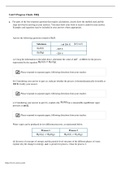
Unit 9 Progress Check: FRQ
1. For parts of the free-response question that require calculations, clearly show the method used and the
steps involved in arriving at your answers. You must show your work to receive credit for your answer.
Examples and equations may be included in your answers where appropriate.
Answer the following questions related to .
Substance at
(a) Using the information in the table above, determine the value of at for the process
represented by the equation .
Please respond on separate paper, following directions from your teacher.
(b) Considering your answer to part (a), indicate whether the process is thermodynamically favorable at
. Justify your answer.
Please respond on separate paper, following directions from your teacher.
(c) Considering your answer to part (b), explain why has a measurable equilibrium vapor
pressure at .
Please respond on separate paper, following directions from your teacher.
Water vapor can be produced in two different processes, as represented below.
Process 1 Process 2
(d) In terms of concepts of entropy and the particle-level structure of the different phases of water,
explain why the change in entropy, , is greater for process 1 than for process 2.
https://www.stuvia.com/
, AP Chemistry Scoring Guide
Unit 9 Progress Check: FRQ
Please respond on separate paper, following directions from your teacher.
Part (a)
Select a point value to view scoring criteria, solutions, and/or examples and to score the response.
0 1
The response includes both the following criteria:
Part (b)
Select a point value to view scoring criteria, solutions, and/or examples and to score the response. The answer to
part (b) must be consistent with part (a). If a student makes an error in a previous part of the question, the student
can still earn credit in a later part if the incorrect answer is used correctly.
0 1
The response indicates that the process is not thermodynamically favorable at because is
positive.(OR, if part (a) indicates a negative value of ,the response indicates that the process is
thermodynamically favorable because is negative.)
Part (c)
Select a point value to view scoring criteria, solutions, and/or examples and to score the response.
https://www.stuvia.com/
1. For parts of the free-response question that require calculations, clearly show the method used and the
steps involved in arriving at your answers. You must show your work to receive credit for your answer.
Examples and equations may be included in your answers where appropriate.
Answer the following questions related to .
Substance at
(a) Using the information in the table above, determine the value of at for the process
represented by the equation .
Please respond on separate paper, following directions from your teacher.
(b) Considering your answer to part (a), indicate whether the process is thermodynamically favorable at
. Justify your answer.
Please respond on separate paper, following directions from your teacher.
(c) Considering your answer to part (b), explain why has a measurable equilibrium vapor
pressure at .
Please respond on separate paper, following directions from your teacher.
Water vapor can be produced in two different processes, as represented below.
Process 1 Process 2
(d) In terms of concepts of entropy and the particle-level structure of the different phases of water,
explain why the change in entropy, , is greater for process 1 than for process 2.
https://www.stuvia.com/
, AP Chemistry Scoring Guide
Unit 9 Progress Check: FRQ
Please respond on separate paper, following directions from your teacher.
Part (a)
Select a point value to view scoring criteria, solutions, and/or examples and to score the response.
0 1
The response includes both the following criteria:
Part (b)
Select a point value to view scoring criteria, solutions, and/or examples and to score the response. The answer to
part (b) must be consistent with part (a). If a student makes an error in a previous part of the question, the student
can still earn credit in a later part if the incorrect answer is used correctly.
0 1
The response indicates that the process is not thermodynamically favorable at because is
positive.(OR, if part (a) indicates a negative value of ,the response indicates that the process is
thermodynamically favorable because is negative.)
Part (c)
Select a point value to view scoring criteria, solutions, and/or examples and to score the response.
https://www.stuvia.com/


