

Discovery of Benzene: Properties of benzene:
1825, Michael Faraday first isolated and Benzene is a colorless, carcinogenic
identified benzene from the oily residue and highly flammable liquid with a
derived from the production of illuminating sweet smell.
gas.
1845, Charles Mansfield isolated benzene
from coal tar; later he used this method to
produce benzene in industrial quantities.
1865, Friedrich August Kekulé suggested that It has a boiling point of 80°C.
the benzene structure contained a six-
membered ring of carbon atoms with Benzene is resistant to addition; it
alternating single and double bonds. undergoes substitution reactions
1929, Dame Kathleen Lonsdale finally proved instead.
benzene`s cyclic nature with X-ray
crystallography.
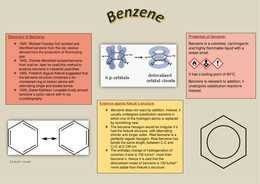
Evidence against Kekulé`s structure:
Benzene does not react by addition. Instead, it
usually undergoes substitution reactions in
which one of the hydrogen atoms is replaced
by something new.
The benzene hexagon would be irregular if it
had the Kekulé structure, with alternating
shorter and longer sides. Real benzene is a
perfectly regular hexagon. Real benzene has
bonds the same length; between C-C and
C=C at 0.139 nm.
The enthalpy change of hydrogenation of
cyclohex-3-ene is 152 kJmol-1 more than
benzene`s. Hence it is said that the
1 Kekulé`s model delocalised model of benzene is 152 kJmol-1
more stable than Kekulé`s structure.
1825, Michael Faraday first isolated and Benzene is a colorless, carcinogenic
identified benzene from the oily residue and highly flammable liquid with a
derived from the production of illuminating sweet smell.
gas.
1845, Charles Mansfield isolated benzene
from coal tar; later he used this method to
produce benzene in industrial quantities.
1865, Friedrich August Kekulé suggested that It has a boiling point of 80°C.
the benzene structure contained a six-
membered ring of carbon atoms with Benzene is resistant to addition; it
alternating single and double bonds. undergoes substitution reactions
1929, Dame Kathleen Lonsdale finally proved instead.
benzene`s cyclic nature with X-ray
crystallography.
Evidence against Kekulé`s structure:
Benzene does not react by addition. Instead, it
usually undergoes substitution reactions in
which one of the hydrogen atoms is replaced
by something new.
The benzene hexagon would be irregular if it
had the Kekulé structure, with alternating
shorter and longer sides. Real benzene is a
perfectly regular hexagon. Real benzene has
bonds the same length; between C-C and
C=C at 0.139 nm.
The enthalpy change of hydrogenation of
cyclohex-3-ene is 152 kJmol-1 more than
benzene`s. Hence it is said that the
1 Kekulé`s model delocalised model of benzene is 152 kJmol-1
more stable than Kekulé`s structure.


