

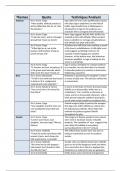
Themes Quote Technique/Analysis
Jealousy Act 1 Scene 1;Iago Iago claims he's far more qualified than Cassio,
“Mere prattle, without practice is who lacks Iago's experience on the field of
all his soldiership. But he, sir, had battle. Iago boastful tone is Shakespeare’s
the election.” introduction of Iago to the audience as a
character who is arrogant and self-assured.
Act 1 Scene 2;Iago Here, Iago suggests that his wife, Emilia, has
“I hate the moor, and it is thought cheated on him with Othello. What we don't
abroad that ‘twixt my sheets” know is whether or not Iago actually believes
that Othello has slept with Emilia.
Act 3 Scene 3;Iago A jealous man will latch onto anything as proof
“Trifles light as air are to the of his lover’s unfaithfulness. A trifle light as air
jealous confirmations strong as could suggest something innocent, for
proofs of holy writ” example, friends hugging one another.
However, to the jealous man, this behaviour
becomes amplified, as Iago is looking for the
worse in everything.
Act 3 Scene 3;Iago Iago is using a metaphor to compare jealousy
“O, beware, my lord, of jealousy! It to a monster. He uses the traits of a monster
is the green-eyed monster which to describe jealousy (a monster is destructive,
doth mock the meat it feeds on” frightening, powerful).
Race Act 1 Scene 3;Brabantio Brabantio is questioning his daughter’s choice
“To fall in love with that she feared to marry a black man. This decision strikes him
to look on! It is a judgement as nonsensical.
maimed and most imperfect.”
Act 1 Scene 3;Duke of Venice It seems to the Duke of Venice that portraying
“Your son-in-law is far more fair Othello as an honourable, white man is a
than black” compliment. ‘Fair’ could be a reference to
colour and to an honourable character, with a
black person being the antithesis during this
era of what would usually be considered ‘fair’.
Act 1 Scene 1;Iago Animal imagery helps to portray the savagery
“Your daughter and the moor are that Iago sees within Othello as a black man.
now making the beast with two He dehumanises Othello, which helps him
backs” maintain his jealousy against Othello
throughout the play.
Gender Act 1 Scene 1;Iago The imagery of thieves speaks to how women
“Look to your house, your were seen in Jacobean society: Valuable
daughter, and your bags! Thieves, property. The repetition of ‘your’ suggests that
thieves! men often felt entitled to everything
surrounding them in the 16th century.
Act 4 Scene 1;Othello This reflects how women were not seen as
“If that the earth could teem with being as trustworthy as men in Jacobean
woman’s tears, each drops she society.
falls would prove a crocodile”
Act 1 Scene 3;Othello Gender roles are defined clearly here: Othello
“She loved me for the dangers I goes out to do the dangerous work and when
had passed, And I loved her that he is successful, she is there to applaud him.
she did pity them” Desdemona is reduced to only an applauder.
Act 4 Scene;Emilia Emilia shows some extremely transgressive
Jealousy Act 1 Scene 1;Iago Iago claims he's far more qualified than Cassio,
“Mere prattle, without practice is who lacks Iago's experience on the field of
all his soldiership. But he, sir, had battle. Iago boastful tone is Shakespeare’s
the election.” introduction of Iago to the audience as a
character who is arrogant and self-assured.
Act 1 Scene 2;Iago Here, Iago suggests that his wife, Emilia, has
“I hate the moor, and it is thought cheated on him with Othello. What we don't
abroad that ‘twixt my sheets” know is whether or not Iago actually believes
that Othello has slept with Emilia.
Act 3 Scene 3;Iago A jealous man will latch onto anything as proof
“Trifles light as air are to the of his lover’s unfaithfulness. A trifle light as air
jealous confirmations strong as could suggest something innocent, for
proofs of holy writ” example, friends hugging one another.
However, to the jealous man, this behaviour
becomes amplified, as Iago is looking for the
worse in everything.
Act 3 Scene 3;Iago Iago is using a metaphor to compare jealousy
“O, beware, my lord, of jealousy! It to a monster. He uses the traits of a monster
is the green-eyed monster which to describe jealousy (a monster is destructive,
doth mock the meat it feeds on” frightening, powerful).
Race Act 1 Scene 3;Brabantio Brabantio is questioning his daughter’s choice
“To fall in love with that she feared to marry a black man. This decision strikes him
to look on! It is a judgement as nonsensical.
maimed and most imperfect.”
Act 1 Scene 3;Duke of Venice It seems to the Duke of Venice that portraying
“Your son-in-law is far more fair Othello as an honourable, white man is a
than black” compliment. ‘Fair’ could be a reference to
colour and to an honourable character, with a
black person being the antithesis during this
era of what would usually be considered ‘fair’.
Act 1 Scene 1;Iago Animal imagery helps to portray the savagery
“Your daughter and the moor are that Iago sees within Othello as a black man.
now making the beast with two He dehumanises Othello, which helps him
backs” maintain his jealousy against Othello
throughout the play.
Gender Act 1 Scene 1;Iago The imagery of thieves speaks to how women
“Look to your house, your were seen in Jacobean society: Valuable
daughter, and your bags! Thieves, property. The repetition of ‘your’ suggests that
thieves! men often felt entitled to everything
surrounding them in the 16th century.
Act 4 Scene 1;Othello This reflects how women were not seen as
“If that the earth could teem with being as trustworthy as men in Jacobean
woman’s tears, each drops she society.
falls would prove a crocodile”
Act 1 Scene 3;Othello Gender roles are defined clearly here: Othello
“She loved me for the dangers I goes out to do the dangerous work and when
had passed, And I loved her that he is successful, she is there to applaud him.
she did pity them” Desdemona is reduced to only an applauder.
Act 4 Scene;Emilia Emilia shows some extremely transgressive



