

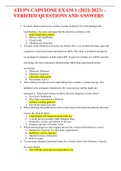
ATI PN CAPSTONE EXAM 1 (2022/2023) VERIFIED Q &A ATI PN CAPSTONE EXAM 1 (2022/2023) – VERIFIED QUESTIONS AND ANSWERS 1. If a male client experienced a cerebrovascular accident (CVA) that damaged the hypothalamus, the nurse anticipate that the client has p
ATI PN CAPSTONE EXAM 1 (2022/2023) VERIFIED Q &A ATI PN CAPSTONE EXAM 1 (2022/2023) – VERIFIED QUESTIONS AND ANSWERS 1. If a male client experienced a cerebrovascular accident (CVA) that damaged the hypothalamus, the nurse anticipate that the client has problems with: a. Body temperature control. b. Balance and equilibrium c. Visual acuity d. Thinking and reasoning 2. A female client admitted to an acute care facility after a car accident develops signs and symptoms of increased intracranial pressure (ICP). The client is intubated and placed on mechanical ventilation to help reduce ICP. To prevent a further rise in ICP caused by suctioning, the nurse anticipates administering which drug endotracheal before suctioning? a. Phenytoin (Dilantin) b. Mannitol (Osmitrol) c. Lidocaine (Xylocaine) d. Furosemide (Lasix) 3. After striking his head on a tree while falling from a ladder, a young man age 18 is admitted to the emergency department. He’s unconscious and his pupils are nonreactive. Which intervention would be the most dangerous for the client? a. Give him a barbiturate b. Place him a mechanical ventilation c. Perform a lumbar puncture d. Elevate the head of his bed 4. When obtaining the health history from a male client with retinal detachment, the nurse expects the client to report: a. Light flashed and floaters in front of the eye b. A recent driving accident while changing lanes c. Headaches, nausea, and redness of the eyes d. Frequent episodes of double vision 5. Which nursing diagnosis takes highest priority for a client with Parkinson’s crisis? a. Imbalanced nutrition: less than body requirements b. Ineffective airway clearance c. Impaired urinary elimination d. Risk for injury 6. To encourage adequate nutritional intake for a female client with Alzheimer’s disease, the nurse should: a. Stay with the client and encourage him to eat b. Help the client fill out his menu c. Give the client privacy during meals d. Fill out the menu for the client
Document information
- Uploaded on
- March 27, 2023
- Number of pages
- 22
- Written in
- 2022/2023
- Type
- Exam (elaborations)
- Contains
- Questions & answers


