A Cook 2016
Chemistry Spec Led Revision
Chapter 6 - Organic Chemistry I
1. Know that a hydrocarbon is a compound of hydrogen and carbon only.
2. Be able to represent organic molecules using empirical formulae, molecular formulae, general
formulae, structural formulae, displayed formulae and skeletal formulae
Using diagrams to refer to organic compounds
The two main ways in which we refer to organic compounds is by:
1) Formula
AND
2) Names
Types of Formula:
1) Displayed formulae
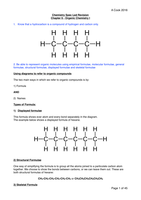
This formula shows ever atom and every bond separately in the diagram.
The example below shows a displayed formula of hexane.
2) Structural Formulae
One way of simplifying the formula is to group all the atoms joined to a particulate carbon atom
together. We choose to show the bonds between carbons, or we can leave them out. These are
both structural formulas of hexane:
CH3-CH2-CH2-CH2-CH2-CH3 or CH3CH2CH2CH2CH2CH3
3) Skeletal Formula
Page 1 of 45
, A Cook 2016
Another way to represent a compound is by a skeletal formula. The word skeletal is connected to
skeleton. This formula shows the carbons atoms. Every change in direction means another carbon
atom (with as many hydrogen atoms as needed). Atoms other than carbon or hydrogen will be
shown.
Skeletal formula of hexane:
4) Molecular Formula
The molecular formula shows the numbers of each atom type in the molecule, but not its structure
or the position of where these atoms are joined on to.
Hexane: C6H14
5) Empirical Formula
The empirical formula shows the smallest whole number ratio of atoms present in the molecule. So
Hexane as empirical is: C2H7
The word empirical means ‘found from experiment’ which means that you will usually work out the
empirical formula for molecules by using maths and data collected from experiments.
3. Know what is meant by the terms ‘homologous series’ and ‘functional group’.
Functional Group
A functional group in a molecule is an atom or group of atoms that gives the compound some
distinctive and predictable properties. For example, the functional group of atoms shown as COOH
give molecules conning this group a sour, acidic taste.
There are many organic compounds continuing this group. Here are some examples:
HCOOH // CH3COOH // CH3CH2COOH // CH3CH2CH2COOH
Homologous Series
If you look at the formula above, you can see that each formula has one more carbon atom and
two more hydrogen atoms than the previous one - they differ by CH2.
These compounds are the first four members of what is called a homologous series.
This is a set of compounds with the same functional group, similar chemical properties and
physical properties that show a gradation (a gradual change from one to the next).
Page 2 of 45
, A Cook 2016
4. Be able to name compounds relevant to this specification using the rules of International Union
of Pure and Applied Chemistry (IUPAC) nomenclature.
Students will be expected to know prefixes for compounds up to C10
The simple rule of nomenclature
The part of the name How to write it Example
This is shown by using a letter
Number of carbon atoms Meth = One carbon
code (usually three of four letters)
The presence of atoms other than
carbon and hydrogen is shown by
Prefixes Bromo = An atom of bromine
adding other letters before or after
Suffixes ol = A hydroxyl group (OH)
the code for the number of carbon
atoms.
The presence of two or more
Multiplying prefixes identical groups is shown by using di = two
the prefixes - di, try -, etc.
Where atoms and groups can
have different positions in a
molecule, numbers and hyphens
2- = the atom or group is attached
are used to show their positions.
Locates to the second carbon atom in the
The number represent the carbon
chain.
atoms in the longest chain that
the atoms and groups are
attached to.
The letter codes for each carbon atoms:
Number Code Prefix
1 meth methyl
2 eth ethyl
3 prop propyl
4 but butyl
5 pent pentyl
6 hex hexyl
7 hept heptyl
8 oct octyl
9 non nonyl
10 doc docyl
Applying these rules to writing names:
Alkanes
The rules work for some of the alkanes. The names of all the alkanes en in -ane.
Page 3 of 45
, A Cook 2016
Structural Formula Name
CH3 - CH2 - CH2 Propane
CH3 - CH(CH3) - CH3 methylpropane
CH3 - CH2 - CH(CH3) - CH2 - CH3 3- methylpentane
CH3 - CH2 - CH2 - CH (CH3) - CH3 2 - methylpentane
CH3 - CH (CH3) - CH(CH3) - CH3 2, 3 - dimethylbutane
CH3 - CH2 - CH (CH2 - CH3) CH(CH3) - CH3 3 - ethyl 2 - methylpentane
Alcohols:
The functional group of alcohol is referred to by the suffix of -ol at the end.
Structural Formula Name
CH3 - CH2 - OH Ethanol
CH3 - CH2 - CH2 - OH Propan-1-ol
CH3 - CH2 (OH) - CH - (CH3) - CH3 3 - metylbutan-2-ol
CH3 - C (CH3)(CH3) - CH2 - CH2 - OH 3, 3 - dimethylbutan-1-ol
6. understand the term ‘structural isomerism’ and determine the possible structural, displayed and
skeletal formulae of an organic molecule, given its molecular formula.
Structural Isomerism
Consider the two following structures:
CH3 - CH2 - CH2 - CH3 = Butane
and
CH3 - CH (CH3) - CH3 = Methylpropane
You can see that these are different compounds because their names are different and structures
are different too.
However their molecular formulae are the same - they both can be represented by C4H10.
These two compounds are what we call Structural Isomers.
Structural Isomers = Same Molecular Formula Different Structural Formula
The molecular formula C4H10 represents only two possible structures, but more complicated
molecular formula can be represented by several possible structures. As the number of carbon
atoms increases, the number of possible structures can be hundreds or thousands.
Page 4 of 45
, A Cook 2016
Types of structural isomerism:
1) Chain Isomerism
Chain isomerism refers to molecules with different carbon chains. Butane and methylpropane are
examples of chain isomers because their carbon chains are different.
2) Position Isomerism
Refers to molecules with the same functional group attached in different positions on the same
carbon chain. Propan-1-ol and propan-2-ol are similar examples of position isomerism.
CH2(OH) - CH2 - CH3 = Propan-1-ol
CH3 - CH (OH) - CH3 = Propan-2-ol
Both chain isomerism and position isomerism can be seen at once
CH2 (OH) - CH2 - CH (CH3) - CH3
CH3 - CH2 - CH (OH) - CH2 - CH3
Page 5 of 45
Chemistry Spec Led Revision
Chapter 6 - Organic Chemistry I
1. Know that a hydrocarbon is a compound of hydrogen and carbon only.
2. Be able to represent organic molecules using empirical formulae, molecular formulae, general
formulae, structural formulae, displayed formulae and skeletal formulae
Using diagrams to refer to organic compounds
The two main ways in which we refer to organic compounds is by:
1) Formula
AND
2) Names
Types of Formula:
1) Displayed formulae
This formula shows ever atom and every bond separately in the diagram.
The example below shows a displayed formula of hexane.
2) Structural Formulae
One way of simplifying the formula is to group all the atoms joined to a particulate carbon atom
together. We choose to show the bonds between carbons, or we can leave them out. These are
both structural formulas of hexane:
CH3-CH2-CH2-CH2-CH2-CH3 or CH3CH2CH2CH2CH2CH3
3) Skeletal Formula
Page 1 of 45
, A Cook 2016
Another way to represent a compound is by a skeletal formula. The word skeletal is connected to
skeleton. This formula shows the carbons atoms. Every change in direction means another carbon
atom (with as many hydrogen atoms as needed). Atoms other than carbon or hydrogen will be
shown.
Skeletal formula of hexane:
4) Molecular Formula
The molecular formula shows the numbers of each atom type in the molecule, but not its structure
or the position of where these atoms are joined on to.
Hexane: C6H14
5) Empirical Formula
The empirical formula shows the smallest whole number ratio of atoms present in the molecule. So
Hexane as empirical is: C2H7
The word empirical means ‘found from experiment’ which means that you will usually work out the
empirical formula for molecules by using maths and data collected from experiments.
3. Know what is meant by the terms ‘homologous series’ and ‘functional group’.
Functional Group
A functional group in a molecule is an atom or group of atoms that gives the compound some
distinctive and predictable properties. For example, the functional group of atoms shown as COOH
give molecules conning this group a sour, acidic taste.
There are many organic compounds continuing this group. Here are some examples:
HCOOH // CH3COOH // CH3CH2COOH // CH3CH2CH2COOH
Homologous Series
If you look at the formula above, you can see that each formula has one more carbon atom and
two more hydrogen atoms than the previous one - they differ by CH2.
These compounds are the first four members of what is called a homologous series.
This is a set of compounds with the same functional group, similar chemical properties and
physical properties that show a gradation (a gradual change from one to the next).
Page 2 of 45
, A Cook 2016
4. Be able to name compounds relevant to this specification using the rules of International Union
of Pure and Applied Chemistry (IUPAC) nomenclature.
Students will be expected to know prefixes for compounds up to C10
The simple rule of nomenclature
The part of the name How to write it Example
This is shown by using a letter
Number of carbon atoms Meth = One carbon
code (usually three of four letters)
The presence of atoms other than
carbon and hydrogen is shown by
Prefixes Bromo = An atom of bromine
adding other letters before or after
Suffixes ol = A hydroxyl group (OH)
the code for the number of carbon
atoms.
The presence of two or more
Multiplying prefixes identical groups is shown by using di = two
the prefixes - di, try -, etc.
Where atoms and groups can
have different positions in a
molecule, numbers and hyphens
2- = the atom or group is attached
are used to show their positions.
Locates to the second carbon atom in the
The number represent the carbon
chain.
atoms in the longest chain that
the atoms and groups are
attached to.
The letter codes for each carbon atoms:
Number Code Prefix
1 meth methyl
2 eth ethyl
3 prop propyl
4 but butyl
5 pent pentyl
6 hex hexyl
7 hept heptyl
8 oct octyl
9 non nonyl
10 doc docyl
Applying these rules to writing names:
Alkanes
The rules work for some of the alkanes. The names of all the alkanes en in -ane.
Page 3 of 45
, A Cook 2016
Structural Formula Name
CH3 - CH2 - CH2 Propane
CH3 - CH(CH3) - CH3 methylpropane
CH3 - CH2 - CH(CH3) - CH2 - CH3 3- methylpentane
CH3 - CH2 - CH2 - CH (CH3) - CH3 2 - methylpentane
CH3 - CH (CH3) - CH(CH3) - CH3 2, 3 - dimethylbutane
CH3 - CH2 - CH (CH2 - CH3) CH(CH3) - CH3 3 - ethyl 2 - methylpentane
Alcohols:
The functional group of alcohol is referred to by the suffix of -ol at the end.
Structural Formula Name
CH3 - CH2 - OH Ethanol
CH3 - CH2 - CH2 - OH Propan-1-ol
CH3 - CH2 (OH) - CH - (CH3) - CH3 3 - metylbutan-2-ol
CH3 - C (CH3)(CH3) - CH2 - CH2 - OH 3, 3 - dimethylbutan-1-ol
6. understand the term ‘structural isomerism’ and determine the possible structural, displayed and
skeletal formulae of an organic molecule, given its molecular formula.
Structural Isomerism
Consider the two following structures:
CH3 - CH2 - CH2 - CH3 = Butane
and
CH3 - CH (CH3) - CH3 = Methylpropane
You can see that these are different compounds because their names are different and structures
are different too.
However their molecular formulae are the same - they both can be represented by C4H10.
These two compounds are what we call Structural Isomers.
Structural Isomers = Same Molecular Formula Different Structural Formula
The molecular formula C4H10 represents only two possible structures, but more complicated
molecular formula can be represented by several possible structures. As the number of carbon
atoms increases, the number of possible structures can be hundreds or thousands.
Page 4 of 45
, A Cook 2016
Types of structural isomerism:
1) Chain Isomerism
Chain isomerism refers to molecules with different carbon chains. Butane and methylpropane are
examples of chain isomers because their carbon chains are different.
2) Position Isomerism
Refers to molecules with the same functional group attached in different positions on the same
carbon chain. Propan-1-ol and propan-2-ol are similar examples of position isomerism.
CH2(OH) - CH2 - CH3 = Propan-1-ol
CH3 - CH (OH) - CH3 = Propan-2-ol
Both chain isomerism and position isomerism can be seen at once
CH2 (OH) - CH2 - CH (CH3) - CH3
CH3 - CH2 - CH (OH) - CH2 - CH3
Page 5 of 45