Memory
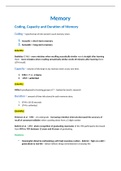
Coding, Capacity and Duration of Memory
Coding = type/format of info stored in each memory store.
1. Acoustic = short-term memory
2. Semantic = long-term memory
EXAMPLE
Baddeley (1966) - more mistakes when recalling acoustically-similar words straight after learning
them - more mistakes when recalling semantically-similar words 20 minutes after learning them
(LTM recall).
Capacity = volume of info kept in any memory store at any one time.
1. STM = 7 +/- 2 items
2. LTM = unlimited
EXAMPLE
Miller’s predisposed to learning groups of 7 – backed by Jacob’s research
Duration = amount of time info stored in each memory store.
1. STM is 18-30 seconds
2. LTM is unlimited,
EXAMPLE
Petersen et al – STM – 24 undergrads - increasing retention intervals decreased the accuracy of
recall of consonant syllables when counting down from a 3-digit number
Bahrick et al – LTM - photo recognition of graduating classmates of the 396 participants decreased
from 90% to 70% between 15 years and 46 years of graduating.
Positives
Meaningful stimuli & methodology with high mundane realism - Bahrick = high eco valid =
generalised to real-life - stimuli reflects things remembered in everyday life
, Negatives
Low mundane realism - Petersen et al and Miller et al = less eco valid - of artificial stimuli –
not every day learning experiences - limits generalisability
Modern research support against - Miller - over-exaggerated the capacity of STM – similar
to 4 - outdated methodologies adopted by Miller + lack of control over confounding
variables
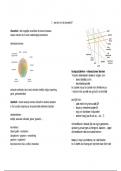
The Multi-Store Memory Model (MSM) - represents how
memory is stored, transferred, retrieved and forgotten.
There are 3 stores:
1. sensory register – contains sub-store for each of the senses (echoic) – huge capacity but
duration >1 sec
2. short- term memory – acoustically encoded – capacity 7+/-2 – duration 18-30 secs
3. long-term memory – semantically encoded – unlimited capacity – unlimited duration
Repeat new info to ourselves
– prolonged repetition
passes to LTM
Maintenance
loop
Positives
Acknowledges qualitative differences between STM and LTM by representing them as
separate stores - STM is encoded acoustically, whilst LTM is encoded semantically an –
accurate view of STM/LTM supported by Baddeley and Miller
Coding, Capacity and Duration of Memory
Coding = type/format of info stored in each memory store.
1. Acoustic = short-term memory
2. Semantic = long-term memory
EXAMPLE
Baddeley (1966) - more mistakes when recalling acoustically-similar words straight after learning
them - more mistakes when recalling semantically-similar words 20 minutes after learning them
(LTM recall).
Capacity = volume of info kept in any memory store at any one time.
1. STM = 7 +/- 2 items
2. LTM = unlimited
EXAMPLE
Miller’s predisposed to learning groups of 7 – backed by Jacob’s research
Duration = amount of time info stored in each memory store.
1. STM is 18-30 seconds
2. LTM is unlimited,
EXAMPLE
Petersen et al – STM – 24 undergrads - increasing retention intervals decreased the accuracy of
recall of consonant syllables when counting down from a 3-digit number
Bahrick et al – LTM - photo recognition of graduating classmates of the 396 participants decreased
from 90% to 70% between 15 years and 46 years of graduating.
Positives
Meaningful stimuli & methodology with high mundane realism - Bahrick = high eco valid =
generalised to real-life - stimuli reflects things remembered in everyday life
, Negatives
Low mundane realism - Petersen et al and Miller et al = less eco valid - of artificial stimuli –
not every day learning experiences - limits generalisability
Modern research support against - Miller - over-exaggerated the capacity of STM – similar
to 4 - outdated methodologies adopted by Miller + lack of control over confounding
variables
The Multi-Store Memory Model (MSM) - represents how
memory is stored, transferred, retrieved and forgotten.
There are 3 stores:
1. sensory register – contains sub-store for each of the senses (echoic) – huge capacity but
duration >1 sec
2. short- term memory – acoustically encoded – capacity 7+/-2 – duration 18-30 secs
3. long-term memory – semantically encoded – unlimited capacity – unlimited duration
Repeat new info to ourselves
– prolonged repetition
passes to LTM
Maintenance
loop
Positives
Acknowledges qualitative differences between STM and LTM by representing them as
separate stores - STM is encoded acoustically, whilst LTM is encoded semantically an –
accurate view of STM/LTM supported by Baddeley and Miller