100% satisfaction guarantee Immediately available after payment Both online and in PDF No strings attached 4.2 TrustPilot
logo-home
Exam (elaborations)

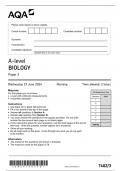
A-level BUSINESS 7132/2 Paper 2 Business 2 Mark scheme June 2022 Version: 1.0 Final

Rating
-
Sold
-
Pages
27
Grade
A
Uploaded on
23-03-2023
Written in
2022/2023

AQA A-level BUSINESS 7132/2 Paper 2 Business 2 Mark scheme June 2022 Version: 1.0 Final Mark schemes are prepared by the Lead Assessment Writer and considered, together with the relevant questions, by a panel of subject teachers. This mark scheme includes any amendments made at the standardisation events which all associates participate in and is the scheme which was used by them in this examination. The standardisation process ensures that the mark scheme covers the students’ responses to questions and that every associate understands and applies it in the same correct way. As preparation for standardisation each associate analyses a number of students’ scripts. Alternative answers not already covered by the mark scheme are discussed and legislated for. If, after the standardisation process, associates encounter unusual answers which have not been raised they are required to refer these to the Lead Examiner. It must be stressed that a mark scheme is a working document, in many cases further developed and expanded on the basis of students’ reactions to a particular paper. Assumptions about future mark schemes on the basis of one year’s document should be avoided; whilst the guiding principles of assessment remain constant, details will change, depending on the content of a particular examination paper. Further copies of this mark scheme are available from Level of response marking instructions Level of response mark schemes are broken down into levels, each of which has a descriptor. The descriptor for the level shows the average performance for the level. There are marks in each level. Before you apply the mark scheme to a student’s answer read through the answer and annotate it (as instructed) to show the qualities that are being looked for. You can then apply the mark scheme. Step 1 Determine a level Start at the lowest level of the mark scheme and use it as a ladder to see whether the answer meets the descriptor for that level. The descriptor for the level indicates the different qualities that might be seen in the student’s answer for that level. If it meets the lowest level then go to the next one and decide if it meets this level, and so on, until you have a match between the level descriptor and the answer. With practice and familiarity you will find that for better answers you will be able to quickly skip through the lower levels of the mark scheme. When assigning a level you should look at the overall quality of the answer and not look to pick holes in small and specific parts of the answer where the student has not performed quite as well as the rest. If the answer covers different aspects of different levels of the mark scheme you should use a best fit approach for defining the level and then use the variability of the response to help decide the mark within the level, ie if the response is predominantly level 3 with a small amount of level 4 material it would be placed in level 3 but be awarded a mark near the top of the level because of the level 4 content. Step 2 Determine a mark Once you have assigned a level you need to decide on the mark. The descriptors on how to allocate marks can help with this. The exemplar materials used during standardisation will help. There will be an answer in the standardising materials which will correspond with each level of the mark scheme. This answer will have been awarded a mark by the Lead Examiner. You can compare the student’s answer with the example to determine if it is the same standard, better or worse than the example. You can then use this to allocate a mark for the answer based on the Lead Examiner’s mark on the example. You may well need to read back through the answer as you apply the mark scheme to clarify points and assure yourself that the level and the mark are appropriate. Indicative content in the mark scheme is provided as a guide for examiners. It is not intended to be exhaustive and you must credit other valid points. Students do not have to cover all of the points mentioned in the Indicative content to reach the highest level of the mark scheme. An answer which contains nothing of relevance to the question must be awarded no marks. Marking guidance • Be clear on the focus of the question. • Read the response as a whole; follow the flow of the argument as a whole. • Remember that the indicative content provides possible lines of argument but there may be others that are equally valid. Be willing to credit other lines of argument. • Annotate the script as you read in accordance with the instructions given at standardisation. • Consider what it all adds up to, eg is this a good response? A reasonable one? A limited one? Refer back to the standardisation scripts and guidance to help you benchmark. You are marking to the standard agreed at standardisation. • Summarise your findings briefly at the end of the response. This will help you decide on the overall level and is helpful for others to understand the mark given, eg for an extended response ‘well-argued’ but does not focus fully on the issue of ‘long-term’ feels as if it might be good rather than excellent. Make sure the comments fit with the level awarded: ‘unbalanced and not comparing with alternative solutions’ does not sound as if it is ‘good’. • Next to your comment put the level awarded, eg L4. • If in doubt about an approach contact your Team Leader, do not make up your own rules because we must have a standardised approach across all marking. Be positive in your marking. Look to reward what is there. Annotations Key Annotation Definition T Free text box – use this for making comments at end of sections/answers Bal Balance BD Benefit of Doubt Cross Incorrect J Judgement/Evaluation KU Knowledge/Understanding NFF Losing Focus/Not Fully Focused An Analysis without context Arg Argument with analysis and context Dev Developed DP Developed point CON Context ? Question mark - uncertain V Vague NAQ Not answered question OFR Own figure rule Rng Range SEEN Indicates that the point has been noted, but no credit has been given Tick Correct point/Calculation Levels used at the end of the response L1 Level 1 L2 Level 2 L3 Level 3 L4 Level 4 0 1 . 1 What is meant by the term extrapolation? [2 marks] Marks for this question: AO1 = 2 Extrapolation is the action of estimating or concluding something by assuming that existing trends will continue. Or the extension of a graph, curve, or range of values by inferring unknown values from trends in the known data. 2 marks for good understanding 1 mark some/partial understanding of the term 0 1 . 2 Using Appendix B, calculate the combined market share of the top four tea brands in 2019. [3 marks] Marks for this question: AO1 = 1, AO2 = 2 Total market = £562m (108 + 99 + 98 + 90 + 23 + 144) Top four brands = £395m (108 + 99 + 98 + 90) 395m Market share of 'top four' = 562m × 100 = 70.28% 3 marks for correct answer 70.28% or 70.3% 2 marks for partial calculation eg with one error or % sign missing 1 mark for calculation of both elements e.g. total market = £562m and Top four brands = £395m 1 mark for correct definition of market share with no valid calculation or correct formula 0 1 . 3 Using the data in Appendix D, explain one benefit of the use of market segmentation to a business selling tea. [4 marks] Marks for this question: AO1 = 2, AO2 = 2. Level The student will typically demonstrate: Marks 3 A good response that focuses on many of the demands of the question. • Benefit explained clearly in context. 4 2 A reasonable response overall that focuses on some of the demands of the question. • Good understanding. Or some understanding with some use of case. 3–2 1 A limited response overall that focuses on a few demands of the question. • Some understanding of market segmentation. 1 The demands of the question are: • to demonstrate an understanding of market segmentation • explain a benefit of market segmentation • to contextualise to the tea market by using the data. Indicative content: • market segmentation is splitting the consumers into groups depending on certain characteristics • benefits of this incudes better understanding customer needs; better targeting of promotional messages; designing products more in line with segments’ needs • targeted promotion may be a way to save money as well as being more effective • relevant data provided includes: • Age – • over 65s drink black tea more frequently • younger people are more likely to never drink tea • Gender – males less likely to drink health tea • Lifestyle – • ethical sourcing seen as important • growing niche parts of market are associated with health benefits. Allow other relevant arguments. 0 1 . 4 A business sells two types of tea: black tea and health tea. Analyse how the data in Appendix C will affect how this business might change the price it charges for each type of tea to increase its sales revenue. [9 marks] Marks for this question: AO1 = 2, AO2 = 3, AO3 = 4 Level The student will typically demonstrate: Marks 3 A good response overall that focuses on many of the demands of the question. Provides an answer to the question set that: • demonstrates a depth and range of knowledge and understanding of issues in the question • demonstrates analysis which is well-developed and is applied effectively to the context. 7–9 2 A reasonable response overall that focuses on some of the demands of the question. Provides an answer to the question set that: • demonstrates a limited knowledge and understanding of a range of issues in the question or a good knowledge and understanding of relatively few issues in the question • demonstrates analysis which is developed and is applied to the context. 4–6 1 A limited response overall with little focus on the demands of the question. Provides an answer to the question set that: • demonstrates a limited range and depth of knowledge and understanding of issues in the question • demonstrates analysis with little development and with mainly descriptive application to the context. 1–3 The demands of the question are: • show understanding of price elasticity of demand • interpret the figures of –0.5 as price inelastic and –1.2 as price elastic • analyse a link between price elasticity of demand, a related pricing strategy and increasing sales revenue. Indicative content: • a clear chain of argument interpreting the meaning of the –0.5 figure; health tea being price inelastic demand • price inelastic demand will allow the business to increase price of health tea and as percentage increase in price will be half the fall in percentage demanded then revenue would rise if price increased • a clear chain of argument interpreting the meaning of the –1.2 figure; black tea being price elastic demand • price elastic demand will allow the business to decrease the price of black tea then revenue would rise if price decreased.

Show more Read less


Whoops! We can’t load your doc right now. Try again or contact support.

Document information

Uploaded on
March 23, 2023
Number of pages
27
Written in
2022/2023
Type
Exam (elaborations)
Contains
Questions & answers

Subjects

Content preview

[Type text]
BS2MS


AQA


A-level
BUSINESS
7132/2
Paper 2 Business 2
Mark scheme
June 2022
Version: 1.0 Final


1

,
, MARK SCHEME – A-LEVEL BUSINESS – 7132/2 –
JUNE 2022


Mark schemes are prepared by the Lead Assessment Writer and considered,
together with the relevant questions, by a panel of subject teachers. This mark
scheme includes any amendments made at the standardisation events which all
associates participate in and is the scheme which was used by them in this
examination. The standardisation process ensures that the mark scheme covers
the students’ responses to questions and that every associate understands and
applies it in the same correct way.
As preparation for standardisation each associate analyses a number of students’
scripts. Alternative answers not already covered by the mark scheme are discussed
and legislated for. If, after the standardisation process, associates encounter unusual
answers which have not been raised they are required to refer these to the Lead
Examiner.

It must be stressed that a mark scheme is a working document, in many cases
further developed and expanded on the basis of students’ reactions to a particular
paper. Assumptions about future mark schemes on the basis of one year’s
document should be avoided; whilst the guiding principles of assessment remain
constant, details will change, depending on the content of a particular
examination paper.


Further copies of this mark scheme are available from aqa.org.uk


3

Get to know the seller

Seller avatar
Reputation scores are based on the amount of documents a seller has sold for a fee and the reviews they have received for those documents. There are three levels: Bronze, Silver and Gold. The better the reputation, the more your can rely on the quality of the sellers work.
Intelligentexceller17 Chamberlain College Of Nursing
View profile
Follow You need to be logged in order to follow users or courses
Sold
90
Member since
2 year
Number of followers
64
Documents
277
Last sold
1 month ago

3.8

17 reviews

5
9
4
3
3
1
2
0
1
4

Recently viewed by you

Why students choose Stuvia

Created by fellow students, verified by reviews

Quality you can trust: written by students who passed their exams and reviewed by others who've used these revision notes.

Didn't get what you expected? Choose another document

No problem! You can straightaway pick a different document that better suits what you're after.

Pay as you like, start learning straight away

No subscription, no commitments. Pay the way you're used to via credit card and download your PDF document instantly.

Student with book image

“Bought, downloaded, and smashed it. It really can be that simple.”

Alisha Student

Frequently asked questions