

Company Accounts
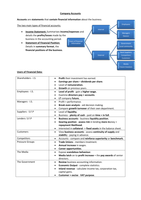
Accounts are statements that contain financial information about the business.
Employees
The two main types of financial accounts:
Internal
Income Statement: Summarises income/expenses and Managers
details the profits/losses made by the Owners
business in the accounting period.
Users of financial
Statement of Financial Position: Information Government
Details in summary format, the Local community
financial positions of the business.
Bank Suppliers
External Competitors
Customers
Media
Future Investors
Users of Financial Data:
Shareholders - I.S. Profit their investment has earned.
Earnings per share + dividends per share.
Level of remuneration.
Growth on previous years.
Employees - I.S. Level of profit - gain a higher wage.
Examine directors pay + accounts.
LT company future.
Managers - I.S. Profit + performance.
Break even analysis - aid decision making.
Compare growth turnover of their own department.
Suppliers - S.F.P Level of liquidity.
Business - plenty of cash - paid on time + in full.
Lenders: S.F.P Business accounts - business liquidity position.
Gearing position - assess risk in lending more money +
repayment likelihood.
Interested in collateral -> fixed assets in the balance sheet.
Customers View business accounts - assess continuity of supply and
stability - paying in advance.
Competitors Accounts - compare and reinforce superiority or benchmark.
Pressure Groups Trade Unions - members treatment.
Annual increase in wages.
Career opportunities.
The Media Expose scandalous behaviour.
Media latch on to profit increase + the pay awards of senior
directors.
The Government Review business accounting information.
Economic Output - complete statistics.
Inland revenue - calculate income tax, corporation tax,
capital gains.
Customer + excise - VAT purpose.
Accounts are statements that contain financial information about the business.
Employees
The two main types of financial accounts:
Internal
Income Statement: Summarises income/expenses and Managers
details the profits/losses made by the Owners
business in the accounting period.
Users of financial
Statement of Financial Position: Information Government
Details in summary format, the Local community
financial positions of the business.
Bank Suppliers
External Competitors
Customers
Media
Future Investors
Users of Financial Data:
Shareholders - I.S. Profit their investment has earned.
Earnings per share + dividends per share.
Level of remuneration.
Growth on previous years.
Employees - I.S. Level of profit - gain a higher wage.
Examine directors pay + accounts.
LT company future.
Managers - I.S. Profit + performance.
Break even analysis - aid decision making.
Compare growth turnover of their own department.
Suppliers - S.F.P Level of liquidity.
Business - plenty of cash - paid on time + in full.
Lenders: S.F.P Business accounts - business liquidity position.
Gearing position - assess risk in lending more money +
repayment likelihood.
Interested in collateral -> fixed assets in the balance sheet.
Customers View business accounts - assess continuity of supply and
stability - paying in advance.
Competitors Accounts - compare and reinforce superiority or benchmark.
Pressure Groups Trade Unions - members treatment.
Annual increase in wages.
Career opportunities.
The Media Expose scandalous behaviour.
Media latch on to profit increase + the pay awards of senior
directors.
The Government Review business accounting information.
Economic Output - complete statistics.
Inland revenue - calculate income tax, corporation tax,
capital gains.
Customer + excise - VAT purpose.


