Unit 9 : Human Regulation And Reproduction
Learning Aim C : Understand The Role of Hormones In The
Regulation and Control of the Reproductive System
Reproductive System:
Reproductive system is the human organ system in which organs, tissues and
glands work together to produce offspring (children). The reproductive system is in charge of gamete
(sperm or eggs) production and fertilisation, as well as the bearing of a foetus. The main function of the
reproductive system in both male and female is to produce gametes. Gametes are the sex cells which in
males are the sperm cells and in females are the egg cells.
Male Reproductive System:
Right Kidney
Seminal Vesicle
Prostate Gland
Ureter
Cowper’s Gland
Bladder Vas
Deferens
Epididymis
Urethra Testis
Scrotum
Penis
Foreskin
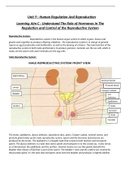
The testes, epididymis, ductus deferens, ejaculatory duct, penis, Cowper's gland, seminal vesicle, and
prostate gland make up the male reproductive system. Sperm and the hormone testosterone are
produced by the testes. The epididymis is a lengthy tube that connects both testicles and transports
sperm. The ductus deferens is a tube that stores sperm and transports it to the scrotal sac. It also serves
as a link between the epididymis and the urethra. Seminal vesicles are sac-like glands beneath the
bladder that release a fluid that is part of the sperm. The bladder's neck and the urethra are covered by
the prostate gland. It's the tube that transports urine from the bladder and produces a slightly alkaline
, fluid that's part of the seminal fluid that carries sperm. Urethra is the tube through which urine is
released from the body and semen is released during ejaculation. Penis is the external male reproductive
organ and consists of two parts(shaft and glans). Glans is the tip of the penis whereas shafts is the main
part of the penis which contains urethra that drains the bladder.
Female Reproductive System:
Oviduct
Right Kidney
Ureter
Ovary
Ligament
Funnel
Fimbriae
Myometrium
Bladder
Endometrium
Urethra
Vagina Uterus
Cervix
The female reproductive system consists of the ovaries, uterine tubes (fallopian tubes), uterus, vagina,
mons pubis, labia majora, labia minora, Bartholin glands, and clitoris. The Labia majora encases and
protects the exterior female reproductive organs. The vaginal and urethral openings are enclosed by the
labia minora, which are positioned inside the labia majora. Bartholin glands surround the vaginal
opening. They produce a mucus-like fluid that helps to keep the vaginal region moist. Clitoris is
comparable to a man's penis. The two minor labia meet at the clitoris. The vaginal canal is another
name for the birth canal. It is a tube that links the cervix to the outside world. The uterus, often known
as the womb, is where the embryo develops. It consists of two parts: the cervix and the uterus. The
lower section of the cervix exits into the vaginal canal and has a pathway for sperm to enter and
menstrual blood to depart. The corpus is the primary component of the vaginal opening that extends to
accommodate the growing foetus. Ovaries are found on both sides of the uterus and generate eggs and
hormones. The ova (egg cells) go from the ovaries to the uterus via the uterine tubes, which are small
tubes connected to the uterus' upper part. The uterine tubes are where an egg is fertilised by a sperm.
The fertilised egg subsequently goes to the uterus and implants in the lining of the uterine wall. Females
have a big mound of tissue called the mons pubis that is normally covered in pubic hair. During sexual
intercourse, the mons pubis serves as a source of cushioning. Sebaceous glands in the mons pubis
release pheromones that induce sexual desire.
Learning Aim C : Understand The Role of Hormones In The
Regulation and Control of the Reproductive System
Reproductive System:
Reproductive system is the human organ system in which organs, tissues and
glands work together to produce offspring (children). The reproductive system is in charge of gamete
(sperm or eggs) production and fertilisation, as well as the bearing of a foetus. The main function of the
reproductive system in both male and female is to produce gametes. Gametes are the sex cells which in
males are the sperm cells and in females are the egg cells.
Male Reproductive System:
Right Kidney
Seminal Vesicle
Prostate Gland
Ureter
Cowper’s Gland
Bladder Vas
Deferens
Epididymis
Urethra Testis
Scrotum
Penis
Foreskin
The testes, epididymis, ductus deferens, ejaculatory duct, penis, Cowper's gland, seminal vesicle, and
prostate gland make up the male reproductive system. Sperm and the hormone testosterone are
produced by the testes. The epididymis is a lengthy tube that connects both testicles and transports
sperm. The ductus deferens is a tube that stores sperm and transports it to the scrotal sac. It also serves
as a link between the epididymis and the urethra. Seminal vesicles are sac-like glands beneath the
bladder that release a fluid that is part of the sperm. The bladder's neck and the urethra are covered by
the prostate gland. It's the tube that transports urine from the bladder and produces a slightly alkaline
, fluid that's part of the seminal fluid that carries sperm. Urethra is the tube through which urine is
released from the body and semen is released during ejaculation. Penis is the external male reproductive
organ and consists of two parts(shaft and glans). Glans is the tip of the penis whereas shafts is the main
part of the penis which contains urethra that drains the bladder.
Female Reproductive System:
Oviduct
Right Kidney
Ureter
Ovary
Ligament
Funnel
Fimbriae
Myometrium
Bladder
Endometrium
Urethra
Vagina Uterus
Cervix
The female reproductive system consists of the ovaries, uterine tubes (fallopian tubes), uterus, vagina,
mons pubis, labia majora, labia minora, Bartholin glands, and clitoris. The Labia majora encases and
protects the exterior female reproductive organs. The vaginal and urethral openings are enclosed by the
labia minora, which are positioned inside the labia majora. Bartholin glands surround the vaginal
opening. They produce a mucus-like fluid that helps to keep the vaginal region moist. Clitoris is
comparable to a man's penis. The two minor labia meet at the clitoris. The vaginal canal is another
name for the birth canal. It is a tube that links the cervix to the outside world. The uterus, often known
as the womb, is where the embryo develops. It consists of two parts: the cervix and the uterus. The
lower section of the cervix exits into the vaginal canal and has a pathway for sperm to enter and
menstrual blood to depart. The corpus is the primary component of the vaginal opening that extends to
accommodate the growing foetus. Ovaries are found on both sides of the uterus and generate eggs and
hormones. The ova (egg cells) go from the ovaries to the uterus via the uterine tubes, which are small
tubes connected to the uterus' upper part. The uterine tubes are where an egg is fertilised by a sperm.
The fertilised egg subsequently goes to the uterus and implants in the lining of the uterine wall. Females
have a big mound of tissue called the mons pubis that is normally covered in pubic hair. During sexual
intercourse, the mons pubis serves as a source of cushioning. Sebaceous glands in the mons pubis
release pheromones that induce sexual desire.