

Discuss psychological explanations for anorexia nervosa
Introduction
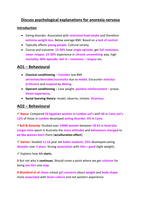
Eating disorder. Associated with restricted food intake and therefore
extreme weight loss. Below average BMI. Based on a lack of control.
Typically affects young people. Cultural variety.
Course and outcome: 15-20% have single episode, get full remission,
never relapse. 15-20% experience in chronic unremitting way, high
mortality. 60% episodic. Get it – remission – relapse etc.
AO1 – Behavioural
Classical conditioning – Consider low BMI
attractive/desirable/successful due to media. Encounter stimulus
(criticism) and respond by dieting.
Operant conditioning – Lose weight, positive reinforcement – praise.
Direct experience.
Social learning theory: model, observe, imitate. Vicarious.
AO2 – Behavioural
Nassa: Compared 50 Egyptian women in London uni’s with 60 in Cairo uni’s.
12% of those in London developed eating disorder. 0% in Cairo.
Ball & Kenardy: Studied over 14000 women between 18-23 in Australia.
Longer time spent in Australia the more attitudes and behaviours changed to
be like women born there (acculturation effect).
Garner: Studied 11-14 year old ballet students. 25% developed eating
disorder over 2 years. Strong association with thin = good (light weight).
Explains how AN starts.
X But not why it continues. Should come a point where we get criticism for
being too thin and stop.
X Mumford et al: Asian school girl concerns about weight and body shape
more associated with Asian culture and not western experience.
Introduction
Eating disorder. Associated with restricted food intake and therefore
extreme weight loss. Below average BMI. Based on a lack of control.
Typically affects young people. Cultural variety.
Course and outcome: 15-20% have single episode, get full remission,
never relapse. 15-20% experience in chronic unremitting way, high
mortality. 60% episodic. Get it – remission – relapse etc.
AO1 – Behavioural
Classical conditioning – Consider low BMI
attractive/desirable/successful due to media. Encounter stimulus
(criticism) and respond by dieting.
Operant conditioning – Lose weight, positive reinforcement – praise.
Direct experience.
Social learning theory: model, observe, imitate. Vicarious.
AO2 – Behavioural
Nassa: Compared 50 Egyptian women in London uni’s with 60 in Cairo uni’s.
12% of those in London developed eating disorder. 0% in Cairo.
Ball & Kenardy: Studied over 14000 women between 18-23 in Australia.
Longer time spent in Australia the more attitudes and behaviours changed to
be like women born there (acculturation effect).
Garner: Studied 11-14 year old ballet students. 25% developed eating
disorder over 2 years. Strong association with thin = good (light weight).
Explains how AN starts.
X But not why it continues. Should come a point where we get criticism for
being too thin and stop.
X Mumford et al: Asian school girl concerns about weight and body shape
more associated with Asian culture and not western experience.


