

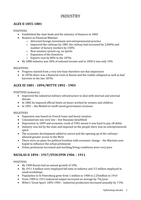
INDUSTRY
ALEX II 1855-1881
POSITIVES:
Established the state bank and the ministry of finances in 1860
Reutern as Financial Minister:
o Attracted foreign investment and entrepreneurial practice
o Improved the railways by 1881 the railway had increased by 2,000% and
number of factory workers by 150%
o New taxation system e.g. on spirits
o Expansion of the Zemstvos
o Exports rose by 80% in the 1870s
By 1880 industry was 30% of national income and in 1850 it was only 10%
NEGATIVES:
Progress started from a very low base therefore not that impressive
In 1870s there was a financial crisis in Russia and the rouble collapsed as well as bad
harvests in the late 1870s
ALEX III 1881 - 1894/WITTE 1892 - 1903
POSITIVES (industry)
Improved the industrial military infrastructure to deal with internal and external
threats
In 1882 he imposed official limits on hours worked by women and children
In 1891 – the Medele’ev tariff raised government revenues
NEGATIVES
Expansion was based on French loans and heavy taxation
Consumerism was very low – few Russians benefitted
Depression in 1899 and economic crash of 1901 meant it was hard to pay off debts
Industry was led by the state and imposed on the people there was no entrepreneurial
spirit
The economic development added to unrest and the opening up of the railways
allowed greater access to the West
There were no plans for political freedom with economic change – the Marxists now
hoped to influence the urban proletariat
Urban proletariat increased and working/living conditions were very poor
NICOLAS II 1894 - 1917/STOLYPIN 1906 – 1911
POSITIVES
By 1900 Russia had an annual growth of 10%
By 1911 4 million were employed full time in industry and 3.5 million employed in
small workshops
Population in St Petersburg grew from 1 million in 1900 to 2.25million in 1914
From 1909 to 1913 industrial output increased on average by 7%/year
Witte’s ‘Great Spurt’ 1893-1903 – industrial production increased annually by 7.5%
hyhaomqz.zla.doc 1
ALEX II 1855-1881
POSITIVES:
Established the state bank and the ministry of finances in 1860
Reutern as Financial Minister:
o Attracted foreign investment and entrepreneurial practice
o Improved the railways by 1881 the railway had increased by 2,000% and
number of factory workers by 150%
o New taxation system e.g. on spirits
o Expansion of the Zemstvos
o Exports rose by 80% in the 1870s
By 1880 industry was 30% of national income and in 1850 it was only 10%
NEGATIVES:
Progress started from a very low base therefore not that impressive
In 1870s there was a financial crisis in Russia and the rouble collapsed as well as bad
harvests in the late 1870s
ALEX III 1881 - 1894/WITTE 1892 - 1903
POSITIVES (industry)
Improved the industrial military infrastructure to deal with internal and external
threats
In 1882 he imposed official limits on hours worked by women and children
In 1891 – the Medele’ev tariff raised government revenues
NEGATIVES
Expansion was based on French loans and heavy taxation
Consumerism was very low – few Russians benefitted
Depression in 1899 and economic crash of 1901 meant it was hard to pay off debts
Industry was led by the state and imposed on the people there was no entrepreneurial
spirit
The economic development added to unrest and the opening up of the railways
allowed greater access to the West
There were no plans for political freedom with economic change – the Marxists now
hoped to influence the urban proletariat
Urban proletariat increased and working/living conditions were very poor
NICOLAS II 1894 - 1917/STOLYPIN 1906 – 1911
POSITIVES
By 1900 Russia had an annual growth of 10%
By 1911 4 million were employed full time in industry and 3.5 million employed in
small workshops
Population in St Petersburg grew from 1 million in 1900 to 2.25million in 1914
From 1909 to 1913 industrial output increased on average by 7%/year
Witte’s ‘Great Spurt’ 1893-1903 – industrial production increased annually by 7.5%
hyhaomqz.zla.doc 1


