

Cognitive Psychology
What is it?
• The study of how we take in information from the outside world, process and then
use it to help us function successfully.
• It is concerned with the internal operation of the mind and seeks to understand the
role of mental processes that lead to human behaviour.
How to study cognitive processes?
Cognitive neuropsychology- to study brain damaged people and to assess the impact that
the damage had on capacity and functioning.
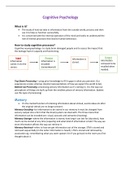
Input Process Output
Information is
Information Information is Information
stored.
comes in via the encoded retrieved to be
senses. (remembered) recalled when
needed.
Top-Down Processing – using prior knowledge to fill in gaps in what you perceive. Our
experiences create schemas (mental representations of how we expect the world to be).
Bottom-Up Processing- processing sensory information as it’s coming in. It is the way our
perceptions of things are built up from the smallest pieces of sensory information. (babies
use this type of processing)
Memory
• It’s the mental function of retaining information about stimuli, events ideas etc after
the original stimuli are no longer present.
Memory Encoding- for information to be stored in our memory it must be changed from
sensory output into a form that the brain/system can deal with. The three mains that
information can be encoded are: visual, acoustic and semantic (meaning).
Memory Storage- where the information is stored, how long it can last for (duration), how
much can be stored at any time (capacity) and what kind of information is held. The way we
store information affects the way we retrieve it.
Memory Retrieval- refers to how we get information out of the storage. STM is stored and
retrieved sequentially (in the order information is heard). LTM is stored and retrieved by
association eg. remembering what you went upstairs for if you go back to the room you first
thought about it.
What is it?
• The study of how we take in information from the outside world, process and then
use it to help us function successfully.
• It is concerned with the internal operation of the mind and seeks to understand the
role of mental processes that lead to human behaviour.
How to study cognitive processes?
Cognitive neuropsychology- to study brain damaged people and to assess the impact that
the damage had on capacity and functioning.
Input Process Output
Information is
Information Information is Information
stored.
comes in via the encoded retrieved to be
senses. (remembered) recalled when
needed.
Top-Down Processing – using prior knowledge to fill in gaps in what you perceive. Our
experiences create schemas (mental representations of how we expect the world to be).
Bottom-Up Processing- processing sensory information as it’s coming in. It is the way our
perceptions of things are built up from the smallest pieces of sensory information. (babies
use this type of processing)
Memory
• It’s the mental function of retaining information about stimuli, events ideas etc after
the original stimuli are no longer present.
Memory Encoding- for information to be stored in our memory it must be changed from
sensory output into a form that the brain/system can deal with. The three mains that
information can be encoded are: visual, acoustic and semantic (meaning).
Memory Storage- where the information is stored, how long it can last for (duration), how
much can be stored at any time (capacity) and what kind of information is held. The way we
store information affects the way we retrieve it.
Memory Retrieval- refers to how we get information out of the storage. STM is stored and
retrieved sequentially (in the order information is heard). LTM is stored and retrieved by
association eg. remembering what you went upstairs for if you go back to the room you first
thought about it.


