Biology 9C
The reproductive system
The reproductive system in both males and females are a collection of internal and external organs
that work together in order to reproduce. It plays a massive role in survival of the species. There are
two reproductive systems, The male and the female reproductive system. Within reproduction,
there are four main functions: production of egg and sperm cells, transportation and sustainability of
cells, nurturing offspring development and the production of hormones.
Function of the Female Reproductive System
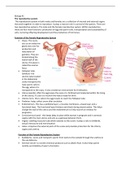
• Ovary- The ovary
acts as an endocrine
gland and a site for
production and
maturation of
gametes. They are
located along the
lateral wall of the
uterus, this place is
called the ovarian
fossa.
• Fallopian tube
(oviduct)- the
uterine tube located
in the abdominal
cavity transports the
male sperm cells to
the egg, where it is
transported to the ovary. It also created an environment for fertilisation.
• Uterus (womb)- After the egg leaves the ovary it is fertilised and implanted within the lining
of the uterus, it’s job is to nourish the foetus ready for birth.
• Uterine horn- this is where the egg travels to reach the Fallopian tube.
• Fimbriae- helps collect ovum after ovulation.
• Endometrium- This has a epithelial layer, a muscles membrane, a basal layer and a
functional layer. The functional layer thickens and sheds during menstruation. This helps
change the wall of the uterus and the endometrium to help nourish an embryo for
pregnancy.
• Cervix/cervical canal- this keeps baby in place while woman is pregnant and it connects
vagina with the main uterus and acts as a gateway between them.
• Vagina- swelling muscular tube which extends to the cervix. It plays a role in childbirth,
sexual intercourse and menstruation.
• Labia- comprises the external parts of the vulva and provides protection for the clitoris,
vagina and urethra.
Function of the Female Reproductive System
• Epididymis- stores and transports sperm from testis to the outside through the urethra to
the vas deferens.
• Seminal vesicle- to secrete chemical products such as alkalin fluid. It also helps sperm
motility and stability of sperm chromatin.
, • Cowper’s gland (bulbourethral gland)- they
take part in the production of volume of semen
by producing lubricating mucus secretion.
• Prostate gland- they secrete the gland,
prostate fluid which is part of the seminal fluid
that is ejected while ejaculating
• Testes- they produce sperm and androgens
(testosterone).
• Penis- this is the external genitalia that passes
seven into the vagina and excrete urine
• Scrotum- pouch like / bag of skin that protects
the testicles.
• Vas deferens- transports sperm during
emission from the epididymis to the
ejaculatory duct.
• Erectile tissue- to fill the penis with blood to
eventually erect the penis.
The hormonal Regulation of Reproductive System
This is a process that consists of the action hormones from the pituitary gland, the adrenal cortex,
and the gonads. Throughout puberty, the hypothalamus in both genders creates and secretes
gonadotropin hormone (GnRH),
which encourages the production of
follicle-stimulating hormone (FSH)
and luteinising hormone (LH) from
the anterior pituitary gland; these
help control the gonads (testes in
both genders). FSH stimulates
gamete production and LH stimulates
production of hormones by the
gonads, if these hormones increases
then GnRH production will undergo a
negative feedback loop.
Female reproductive system
The FSH in females stimulates the
development of egg cells (ova), these
develop follicles which are structures
that produce the hormone inhibin.
LH is also involved in increasing
ovulation, producing Estradiol and
progesterone production in the
ovaries and evolving the ova.
The steroid hormones estradiol and
progesterone help the body prepare
for pregnancy. In females, estradiol
causes secondary sex characteristics,
and both estradiol and progesterone
control the menstrual cycle.
The reproductive system
The reproductive system in both males and females are a collection of internal and external organs
that work together in order to reproduce. It plays a massive role in survival of the species. There are
two reproductive systems, The male and the female reproductive system. Within reproduction,
there are four main functions: production of egg and sperm cells, transportation and sustainability of
cells, nurturing offspring development and the production of hormones.
Function of the Female Reproductive System
• Ovary- The ovary
acts as an endocrine
gland and a site for
production and
maturation of
gametes. They are
located along the
lateral wall of the
uterus, this place is
called the ovarian
fossa.
• Fallopian tube
(oviduct)- the
uterine tube located
in the abdominal
cavity transports the
male sperm cells to
the egg, where it is
transported to the ovary. It also created an environment for fertilisation.
• Uterus (womb)- After the egg leaves the ovary it is fertilised and implanted within the lining
of the uterus, it’s job is to nourish the foetus ready for birth.
• Uterine horn- this is where the egg travels to reach the Fallopian tube.
• Fimbriae- helps collect ovum after ovulation.
• Endometrium- This has a epithelial layer, a muscles membrane, a basal layer and a
functional layer. The functional layer thickens and sheds during menstruation. This helps
change the wall of the uterus and the endometrium to help nourish an embryo for
pregnancy.
• Cervix/cervical canal- this keeps baby in place while woman is pregnant and it connects
vagina with the main uterus and acts as a gateway between them.
• Vagina- swelling muscular tube which extends to the cervix. It plays a role in childbirth,
sexual intercourse and menstruation.
• Labia- comprises the external parts of the vulva and provides protection for the clitoris,
vagina and urethra.
Function of the Female Reproductive System
• Epididymis- stores and transports sperm from testis to the outside through the urethra to
the vas deferens.
• Seminal vesicle- to secrete chemical products such as alkalin fluid. It also helps sperm
motility and stability of sperm chromatin.
, • Cowper’s gland (bulbourethral gland)- they
take part in the production of volume of semen
by producing lubricating mucus secretion.
• Prostate gland- they secrete the gland,
prostate fluid which is part of the seminal fluid
that is ejected while ejaculating
• Testes- they produce sperm and androgens
(testosterone).
• Penis- this is the external genitalia that passes
seven into the vagina and excrete urine
• Scrotum- pouch like / bag of skin that protects
the testicles.
• Vas deferens- transports sperm during
emission from the epididymis to the
ejaculatory duct.
• Erectile tissue- to fill the penis with blood to
eventually erect the penis.
The hormonal Regulation of Reproductive System
This is a process that consists of the action hormones from the pituitary gland, the adrenal cortex,
and the gonads. Throughout puberty, the hypothalamus in both genders creates and secretes
gonadotropin hormone (GnRH),
which encourages the production of
follicle-stimulating hormone (FSH)
and luteinising hormone (LH) from
the anterior pituitary gland; these
help control the gonads (testes in
both genders). FSH stimulates
gamete production and LH stimulates
production of hormones by the
gonads, if these hormones increases
then GnRH production will undergo a
negative feedback loop.
Female reproductive system
The FSH in females stimulates the
development of egg cells (ova), these
develop follicles which are structures
that produce the hormone inhibin.
LH is also involved in increasing
ovulation, producing Estradiol and
progesterone production in the
ovaries and evolving the ova.
The steroid hormones estradiol and
progesterone help the body prepare
for pregnancy. In females, estradiol
causes secondary sex characteristics,
and both estradiol and progesterone
control the menstrual cycle.