Level 2 Diploma in Care Learner Name
Unit Title: 209 – Equality and Inclusion in care settings
Assessor
Use Only-
Learner statement Assessment
Criteria Met
Learner must answer each question in your own words and write in the first person meaning “I do this”. A
tip is always to keep in mind the “who, why, how, where and when” in each answer.
Learning Outcome 1: Understand the importance of equality and inclusion
1.1 Explain what is meant by:-
1.1 a diversity
1.1 b equality
1.1 c inclusion
1.1 d discrimination
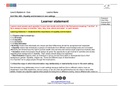
Diversity means that individuals are unique and their differences should be recognised and respected.
Equality means that individuals or groups of individuals from different social backgrounds are not treated
differently and should have the right to access health care services and receive equal support as anybody else.
Inclusion means that people should always be given the opportunity to get involved in activities and society
regarding their background or disability. Their values should always be respected.
Discrimination happens when an individual or group are less favourable or disrespected due to their
background, gender, disability, religion etc. There are different ways of discrimination
It is important not to judge people through first impressions.
1.2 Describe ways in which discrimination may deliberately or inadvertently occur in the work setting
Discrimination may deliberately occur in work settings because staff are from a different culture, have an
impairment, have little experience, are too young, or too old, their job performance are too slow or have other
beliefs. People can prejudice against other people for being from a different country, have a different skin colour or
www.vocationaltraining.org.uk
C688 L2 LS 209 Issue 2 August 2019 KR
, be from a different sexual orientation. This can happen for example if a service user refuses to receive personal care
from a staff member that is from Africa and has a darker skin colour. Another example is when staff don’t involve
younger colleagues in their conversations or don’t let them take part in a task because they think due to their age,
they do not have experience or knowledge.
Inadvertently discrimination is not always noticeable as most times is accidental or unintentional. An act may have
been created with a legitimate objective to generate greater work efficiency, but incidentally ends up generating an
indirect discriminatory act towards some people. For example, in health care settings, women feel more comfortable
receiving personal care from female care assistants, therefore it has been established that only female staff are to
be allocated to assist the ladies with personal care, however this can be an indirect discriminatory practice towards
male staff. Another example would be an individual on a wheel chair not having access to a lift in order to get to the
floor above to attend an appointment or to do shopping.
1.3 Explain how practices that support equality and inclusion reduce the likelihood of
discrimination
I can reduce the likelihood of discrimination by promoting inclusion and equality in our practices. For example, I must
work in a non-judgemental way principally by not judging people through first impressions, work as a team providing
person-centred care by working with the service user’s beliefs and values.
Work in an inclusive way by empowering people to be more sociable active by taking part in various group activities
to achieve their full potential.
It is important to promote anti-discrimination practice when providing care to people.
Range
(1.2) Work setting: Work setting may include one specific location or a range of locations, depending on the context
of a particular work role.
Learning Outcome 2: Be able to work in an inclusive way
www.vocationaltraining.org.uk
C688 L2 LS 209 Issue 2 August 2019 KR
Unit Title: 209 – Equality and Inclusion in care settings
Assessor
Use Only-
Learner statement Assessment
Criteria Met
Learner must answer each question in your own words and write in the first person meaning “I do this”. A
tip is always to keep in mind the “who, why, how, where and when” in each answer.
Learning Outcome 1: Understand the importance of equality and inclusion
1.1 Explain what is meant by:-
1.1 a diversity
1.1 b equality
1.1 c inclusion
1.1 d discrimination
Diversity means that individuals are unique and their differences should be recognised and respected.
Equality means that individuals or groups of individuals from different social backgrounds are not treated
differently and should have the right to access health care services and receive equal support as anybody else.
Inclusion means that people should always be given the opportunity to get involved in activities and society
regarding their background or disability. Their values should always be respected.
Discrimination happens when an individual or group are less favourable or disrespected due to their
background, gender, disability, religion etc. There are different ways of discrimination
It is important not to judge people through first impressions.
1.2 Describe ways in which discrimination may deliberately or inadvertently occur in the work setting
Discrimination may deliberately occur in work settings because staff are from a different culture, have an
impairment, have little experience, are too young, or too old, their job performance are too slow or have other
beliefs. People can prejudice against other people for being from a different country, have a different skin colour or
www.vocationaltraining.org.uk
C688 L2 LS 209 Issue 2 August 2019 KR
, be from a different sexual orientation. This can happen for example if a service user refuses to receive personal care
from a staff member that is from Africa and has a darker skin colour. Another example is when staff don’t involve
younger colleagues in their conversations or don’t let them take part in a task because they think due to their age,
they do not have experience or knowledge.
Inadvertently discrimination is not always noticeable as most times is accidental or unintentional. An act may have
been created with a legitimate objective to generate greater work efficiency, but incidentally ends up generating an
indirect discriminatory act towards some people. For example, in health care settings, women feel more comfortable
receiving personal care from female care assistants, therefore it has been established that only female staff are to
be allocated to assist the ladies with personal care, however this can be an indirect discriminatory practice towards
male staff. Another example would be an individual on a wheel chair not having access to a lift in order to get to the
floor above to attend an appointment or to do shopping.
1.3 Explain how practices that support equality and inclusion reduce the likelihood of
discrimination
I can reduce the likelihood of discrimination by promoting inclusion and equality in our practices. For example, I must
work in a non-judgemental way principally by not judging people through first impressions, work as a team providing
person-centred care by working with the service user’s beliefs and values.
Work in an inclusive way by empowering people to be more sociable active by taking part in various group activities
to achieve their full potential.
It is important to promote anti-discrimination practice when providing care to people.
Range
(1.2) Work setting: Work setting may include one specific location or a range of locations, depending on the context
of a particular work role.
Learning Outcome 2: Be able to work in an inclusive way
www.vocationaltraining.org.uk
C688 L2 LS 209 Issue 2 August 2019 KR