Liberalism
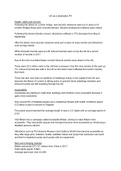
- John Locke - believed that before the establishment of the state, there was a natural state
with natural laws and rights which represented liberty and freedom with no state constraints.
Locke believe a state of law would only be legitimate through the acceptance of the social
contract theory, and it would need to be limited in order to emphasis such liberties. Locke
heavily believed in a government by consent and that “the government should always be the
government, not the master of the people.” Locke believed in tolerance showing support for
Roman Catholics during the glorious revolution despite not agreeing with their religion.
- Thomas Hobbes - (Leviathan) human nature is so brutally selfish that without authorised
constraint, society would not survive.
- Adam Smith (wealth of nations) if the barriers of the economy were “swept away”, the
invisible hand of market force would guide traders towards financial success enabling wealth
to “trickle down” throughout society.
- John Stuart Mills - (on liberty) every individual should be tolerated in society unless they
provoke the harm principle, if so, there Liberty should be restricted due to the harming
effects it has on the freedom of others. He believed that although everybody possessed
rationalism, the uneducated were poor-equipped and that their vote should be instead given
to somebody with universal education. As society evolved, this education would be available
to all enabling a democracy to evolve. He did not believe liberty as a natural right but instead
a sign of ongoing human development. He was concerned that a government by consent
may result in a tyranny of the majority.
- Mary Wollstonecraft - (a vindication on the rights of women) stated that the potential of
women were being limited by women due to societies belief that they were not rational. If
they were entitled to education, such potential could be discovered.
- Samuel Smiles - (self help) although self-reliance is accessible to all, it is restricted by
those in the working class who were seen as “faceless employees”
- Hubert Spencer - (man versus state) believed state intervention would encourage the
liberalism of the working class, however challenged whether this would be possible in
industrial Victorian cities. He believed in a social survival of the fittest.
- John Rawls - (a theory of justice) through an expansion of state, liberty could be
established through legislation and state spending by creating public services etc which
could provide equal opportunities and outcomes. He argued this as being an enabling state.
Foundational equality requires not just formal equality but also social and economic.
- John Locke - believed that before the establishment of the state, there was a natural state
with natural laws and rights which represented liberty and freedom with no state constraints.
Locke believe a state of law would only be legitimate through the acceptance of the social
contract theory, and it would need to be limited in order to emphasis such liberties. Locke
heavily believed in a government by consent and that “the government should always be the
government, not the master of the people.” Locke believed in tolerance showing support for
Roman Catholics during the glorious revolution despite not agreeing with their religion.
- Thomas Hobbes - (Leviathan) human nature is so brutally selfish that without authorised
constraint, society would not survive.
- Adam Smith (wealth of nations) if the barriers of the economy were “swept away”, the
invisible hand of market force would guide traders towards financial success enabling wealth
to “trickle down” throughout society.
- John Stuart Mills - (on liberty) every individual should be tolerated in society unless they
provoke the harm principle, if so, there Liberty should be restricted due to the harming
effects it has on the freedom of others. He believed that although everybody possessed
rationalism, the uneducated were poor-equipped and that their vote should be instead given
to somebody with universal education. As society evolved, this education would be available
to all enabling a democracy to evolve. He did not believe liberty as a natural right but instead
a sign of ongoing human development. He was concerned that a government by consent
may result in a tyranny of the majority.
- Mary Wollstonecraft - (a vindication on the rights of women) stated that the potential of
women were being limited by women due to societies belief that they were not rational. If
they were entitled to education, such potential could be discovered.
- Samuel Smiles - (self help) although self-reliance is accessible to all, it is restricted by
those in the working class who were seen as “faceless employees”
- Hubert Spencer - (man versus state) believed state intervention would encourage the
liberalism of the working class, however challenged whether this would be possible in
industrial Victorian cities. He believed in a social survival of the fittest.
- John Rawls - (a theory of justice) through an expansion of state, liberty could be
established through legislation and state spending by creating public services etc which
could provide equal opportunities and outcomes. He argued this as being an enabling state.
Foundational equality requires not just formal equality but also social and economic.