

COMPUTER APPLICATIONS PACKAGES.
UNITS:
Introduction To Computers & Keyboarding.
Operating Systems-Windows for file management
Word Processor-Ms Word.
Presentation-PowerPoint.
Spreadsheets-Excel.
Database Management Systems-ACCESS.
INTERNET & E-MAIL
http://www.royalnet.ac.ke e-mail : <> 1
, Introduction to Computers.
Def: A computer is an electronic device that works under control of instructions (programs) which is
stored in its own memory. It can accept and store data, perform arithmetic & logic operations on the data
and give out the processed data through the output devices.
A computer is an integral part of information system. An information System is a system that accepts
Input (data), perform operations on these input (processes) and produce the output (information).
An information system may also be termed as a computer system and is a combination of the
following five elements:
Hardware. Procedures.
Software. People.
Data/Information.
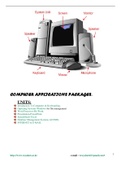
A computer is made of several units to form a system. These parts are as follows;-
i) The System Unit which house the CPU.
ii) Monitor/screen/VDU.
iii) Keyboard and mouse.
Peripheral devices are those hardware devices that are connected to the computer, but your computer can
function without them, since they are not part of the computer. These devices are:-
a) Printer.
b) Scanner.
c) CD/DVD ROMs
d) Floppy drive etc.
COMPUTER TERMINOLOGIES.
1. HARDWARE;
Is a term used to describe all the physical components that make up a computer system.
2. INSTRUCTIONS:
These are commands issued to computer to perform certain operation and the computer will accept
these instructions and perform them. These instructions are also referred to as programs (software)
3. SOFTWARE;
It refers to various programs that are run by the computer. These are set of instruction written in the
language of the computer and used to make the computer perform a specific task.
http://www.royalnet.ac.ke e-mail : <> 2
, TYPES OF SOFTWARE.
There are two types of software namely;-
i) System software.
ii) Application software
System Software.
These are programs designed to provide an interface between the computer and the user to run other
programs known as application software. They were designed to:-
i) Manage and control the computer iv) Report the status of the computer.
hardware operations. v) Shows the memory capacity and
ii) To load in application software in a usage.
computer. vi) Shows various files in the storage etc
iii) To manage the computer data files.
Example of system software include, operating systems {Windows, Linux, Mac MS-DOS etc}, and the
Utility software like Anti-virus programs.
Application Software:
This is a collection of related programs that are used to perform various jobs/tasks. They are programs written to
solve specific problems like:-
i) Word processing. v) Graphic software
ii) Spreadsheets. vi) Statistical software.
iii) Database management systems vii) Accounting software etc.
iv) Desktop publishing software.
SOFTWARE
SYSTEM SOFTWARE APPLICATION SOFTWARE
Language Operating Utility S/W Application User System
Translators System (Anti-Virus) Packages
Interpreters’ Single User Spreadsheets. Programming
compilers & Multi Word Processors. Languages
Assemblers user O/S Accounting Packages.
Graphics Packages.
Database Management Packages.
Computer Aided Design.
Computer Aided Manufacture.
http://www.royalnet.ac.ke e-mail : <> 3
, 4. DATA;
The term “data” refers to qualitative or quantitative attributes of a variable or set of variable. Data are
raw, unevaluated or unprocessed facts and figures, concept or instructions. This raw material is
processed into meaningful information.
Information is therefore the product of data processing. Data Processing cycle includes: - refining,
summarizing, categorizing & manipulating this data into a useful form for decision making. The
purpose of a computer system is to convert data into information.
5. MEDIA;
Is a term used to describe any fixed or removable objects that store computer data. Examples
include hard disks, floppy disks, tapes, and compact discs even a piece of paper.
6. OPERATING SYSTEM
This is the most important program that runs on a computer. Every general-purpose computer must
have an operating system to run other programs. OS as commonly known performs basic tasks, such
as recognizing input from the keyboard, sending output to the display screen, keeping tracks of files
and directories on the disk, and controlling peripheral devices such as disk drives and printers. It is
also responsible for security, ensuring that unauthorized users do not access the system (user account)
WHAT HAPPENS WHEN YOU SWITCH ON THE COMPUTER?
The process of starting a computer is called booting. The computer first checks its memory (ROM)
and some other components. After that, the drive begins to spin and the boot process will commence.
The system then reads drive C for the operating system. If it does not find it, in drive C, it checks
others drives. On finding the OS, it reads COMMAND.COM. This is the command processor file. It
contains all internal commands e.g. CLS, DATE, TIME etc.
After reading the command.com, it checks if autoexec.bat exists. If it does, it carries on the commands
in that file. If it does not exist, it prompts for date, time after which the prompt appears.
QUALITIES OF A COMPUTER.
1. A data processor: process raw facts and figures to produce information.
2. It is storage: stores information for later reference
3. It is automatic- can work with minimum human intervention once supplied with instruction
and data.
4. It is electrical: it requires some sort of power to drive.
http://www.royalnet.ac.ke e-mail : <> 4
UNITS:
Introduction To Computers & Keyboarding.
Operating Systems-Windows for file management
Word Processor-Ms Word.
Presentation-PowerPoint.
Spreadsheets-Excel.
Database Management Systems-ACCESS.
INTERNET & E-MAIL
http://www.royalnet.ac.ke e-mail : <> 1
, Introduction to Computers.
Def: A computer is an electronic device that works under control of instructions (programs) which is
stored in its own memory. It can accept and store data, perform arithmetic & logic operations on the data
and give out the processed data through the output devices.
A computer is an integral part of information system. An information System is a system that accepts
Input (data), perform operations on these input (processes) and produce the output (information).
An information system may also be termed as a computer system and is a combination of the
following five elements:
Hardware. Procedures.
Software. People.
Data/Information.
A computer is made of several units to form a system. These parts are as follows;-
i) The System Unit which house the CPU.
ii) Monitor/screen/VDU.
iii) Keyboard and mouse.
Peripheral devices are those hardware devices that are connected to the computer, but your computer can
function without them, since they are not part of the computer. These devices are:-
a) Printer.
b) Scanner.
c) CD/DVD ROMs
d) Floppy drive etc.
COMPUTER TERMINOLOGIES.
1. HARDWARE;
Is a term used to describe all the physical components that make up a computer system.
2. INSTRUCTIONS:
These are commands issued to computer to perform certain operation and the computer will accept
these instructions and perform them. These instructions are also referred to as programs (software)
3. SOFTWARE;
It refers to various programs that are run by the computer. These are set of instruction written in the
language of the computer and used to make the computer perform a specific task.
http://www.royalnet.ac.ke e-mail : <> 2
, TYPES OF SOFTWARE.
There are two types of software namely;-
i) System software.
ii) Application software
System Software.
These are programs designed to provide an interface between the computer and the user to run other
programs known as application software. They were designed to:-
i) Manage and control the computer iv) Report the status of the computer.
hardware operations. v) Shows the memory capacity and
ii) To load in application software in a usage.
computer. vi) Shows various files in the storage etc
iii) To manage the computer data files.
Example of system software include, operating systems {Windows, Linux, Mac MS-DOS etc}, and the
Utility software like Anti-virus programs.
Application Software:
This is a collection of related programs that are used to perform various jobs/tasks. They are programs written to
solve specific problems like:-
i) Word processing. v) Graphic software
ii) Spreadsheets. vi) Statistical software.
iii) Database management systems vii) Accounting software etc.
iv) Desktop publishing software.
SOFTWARE
SYSTEM SOFTWARE APPLICATION SOFTWARE
Language Operating Utility S/W Application User System
Translators System (Anti-Virus) Packages
Interpreters’ Single User Spreadsheets. Programming
compilers & Multi Word Processors. Languages
Assemblers user O/S Accounting Packages.
Graphics Packages.
Database Management Packages.
Computer Aided Design.
Computer Aided Manufacture.
http://www.royalnet.ac.ke e-mail : <> 3
, 4. DATA;
The term “data” refers to qualitative or quantitative attributes of a variable or set of variable. Data are
raw, unevaluated or unprocessed facts and figures, concept or instructions. This raw material is
processed into meaningful information.
Information is therefore the product of data processing. Data Processing cycle includes: - refining,
summarizing, categorizing & manipulating this data into a useful form for decision making. The
purpose of a computer system is to convert data into information.
5. MEDIA;
Is a term used to describe any fixed or removable objects that store computer data. Examples
include hard disks, floppy disks, tapes, and compact discs even a piece of paper.
6. OPERATING SYSTEM
This is the most important program that runs on a computer. Every general-purpose computer must
have an operating system to run other programs. OS as commonly known performs basic tasks, such
as recognizing input from the keyboard, sending output to the display screen, keeping tracks of files
and directories on the disk, and controlling peripheral devices such as disk drives and printers. It is
also responsible for security, ensuring that unauthorized users do not access the system (user account)
WHAT HAPPENS WHEN YOU SWITCH ON THE COMPUTER?
The process of starting a computer is called booting. The computer first checks its memory (ROM)
and some other components. After that, the drive begins to spin and the boot process will commence.
The system then reads drive C for the operating system. If it does not find it, in drive C, it checks
others drives. On finding the OS, it reads COMMAND.COM. This is the command processor file. It
contains all internal commands e.g. CLS, DATE, TIME etc.
After reading the command.com, it checks if autoexec.bat exists. If it does, it carries on the commands
in that file. If it does not exist, it prompts for date, time after which the prompt appears.
QUALITIES OF A COMPUTER.
1. A data processor: process raw facts and figures to produce information.
2. It is storage: stores information for later reference
3. It is automatic- can work with minimum human intervention once supplied with instruction
and data.
4. It is electrical: it requires some sort of power to drive.
http://www.royalnet.ac.ke e-mail : <> 4


