Gene Regulation and Transgenesis in Zebrafish and Mice
Transgenics can be used to produce overexpression/misexpression mutants (reverse
genetics – know DNA sequence but gene function is unknown)
Need to know how genes are regulated
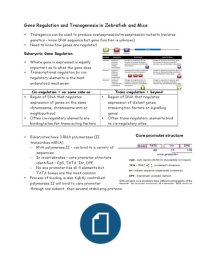
Eukaryotic Gene Regulation
Where gene is expressed is equally
important as to what the gene does
Transcriptional regulation by cis-
regulatory elements is the best
understood mechanism
Cis-regulation = on same side as Trans-regulation = beyond
Region of DNA that regulates Region of DNA that regulates
expression of genes on the same expression of distant genes:
chromosome, chromosome arm or transcription factors or signalling
neighbourhood genes
Often cis-regulatory elements are Often trans-regulatory elements bind
binding/sites for trans-acting factors to cis-regulatory sites
Eukaryotes have 3 RNA polymerases (II
transcribes mRNA)
- RNA polymerase II – can bind to a variety of
sequences
- In invertebrates – core promoter structure
identified – CpG, TATA, Inr, DPE
- No one promoter has all 4 elements but
TATA boxes are the most common
Process of binding is also tightly controlled:
polymerase II will bind to core promoter
through one subunit, then several stabilising proteins
, - Initiating with TFII gives low levels of
transcription – for many genes, it is not
enough to make an impact (though some
genes like ricin – one molecule per cell enough
to kill cell)
Stage and tissue specific TFs bind/interact to
the RNA transcription machinery – do not bind
directly to promoter but to regulatory elements (different distances from
promoter itself – they are specific DNA sequences that proteins can recognise) –
sequences can be almost 1 Mb away – involves bending of DNA – though difficult to
analyse if we want to find all the regulatory elements
- Stage and tissue-specific transcription factors that stimulate or repress RNA
polII activity bind to gene-specific enhancer elements to form the enhancesome
- DNA bending proteins facilitate co-operative binding of transcription factors as
well as bending of the enhancer sequence to bring it into contact with the basal
transcriptional machinery (Vo and Goodman, 2001)
TFs binding to core promoter waiting for binding of other regulatory elements on
DNA (opposite can also happen – suppressors)
Can have enhancers and suppressors binding
simultaneously – the effects of enhancer
effects are additive
Transgenic Animal: possesses a foreign piece of
DNA (either from another organism or from another species)/ an animal that contains
novel heritable genetic material derived from a different species using molecular
cloning techniques
- Need a transfer method – get DNA into cell (specifically nucleus), want all cells
to carry transgenes – ideally get the gene into the egg (in x. laevis – sperm) – so
all cells will inherit the gene
- Mouse – physical microinjection – pronuclear injection (first sign of fertilisation)
– relies on recombination of microinjected DNA (inefficient as duplicated or
scrambled upon insertion), nuclear transfer cloning (remove DNA from oocyte
and transfer new material to egg)
- Fish has yolk in egg as well: technical problems when injecting
Transgenes
, - Inject 100 mice or 1000 fish – 10%
survive procedure and produce
offspring – small percentage will
carry copy of transgene – integrated
into endogenous chromosome
- -Will have founders and each is
unique – site of integration and copy
number (differing strength signal)
- Founder is a mosaic – mixture of
transgenic and normal cells – if
unlucky no transgenes in germ line
cells – so no egg or sperm made with
the transgene
Applications of transgenics
Analysing Gene Regulation
Use transgenics to identify regulatory
elements
- Insert candidate regulatory
sequences in front of a reporter gene
cassette
- Enhancer sequences bend to interact,
so the elements can very far
downstream
- Exons in green, introns in blue – gene
has enhancer sequences which TFs bind to (enhancers can be downstream and
upstream – short or long distances)
Take a sequence, chop up and take a small block clone it in front of a reporter gene,
consists of general promoter (which can interact with putative regulatory element
we just put in)
- Reporters: GFP, lac-Z galactosidase
- Reporter gene can be affected by enhancers
Interpretation – random integration of transgenes in vertebrates can complicate
interpretation – you can get expression that is due to local enhancers and not due to
the transgene itself – depending on where the transgene is integrated (look at
multiple strains to see if there is consensus)
a) a-actin regulation
- skeletal muscle specific
Transgenics can be used to produce overexpression/misexpression mutants (reverse
genetics – know DNA sequence but gene function is unknown)
Need to know how genes are regulated
Eukaryotic Gene Regulation
Where gene is expressed is equally
important as to what the gene does
Transcriptional regulation by cis-
regulatory elements is the best
understood mechanism
Cis-regulation = on same side as Trans-regulation = beyond
Region of DNA that regulates Region of DNA that regulates
expression of genes on the same expression of distant genes:
chromosome, chromosome arm or transcription factors or signalling
neighbourhood genes
Often cis-regulatory elements are Often trans-regulatory elements bind
binding/sites for trans-acting factors to cis-regulatory sites
Eukaryotes have 3 RNA polymerases (II
transcribes mRNA)
- RNA polymerase II – can bind to a variety of
sequences
- In invertebrates – core promoter structure
identified – CpG, TATA, Inr, DPE
- No one promoter has all 4 elements but
TATA boxes are the most common
Process of binding is also tightly controlled:
polymerase II will bind to core promoter
through one subunit, then several stabilising proteins
, - Initiating with TFII gives low levels of
transcription – for many genes, it is not
enough to make an impact (though some
genes like ricin – one molecule per cell enough
to kill cell)
Stage and tissue specific TFs bind/interact to
the RNA transcription machinery – do not bind
directly to promoter but to regulatory elements (different distances from
promoter itself – they are specific DNA sequences that proteins can recognise) –
sequences can be almost 1 Mb away – involves bending of DNA – though difficult to
analyse if we want to find all the regulatory elements
- Stage and tissue-specific transcription factors that stimulate or repress RNA
polII activity bind to gene-specific enhancer elements to form the enhancesome
- DNA bending proteins facilitate co-operative binding of transcription factors as
well as bending of the enhancer sequence to bring it into contact with the basal
transcriptional machinery (Vo and Goodman, 2001)
TFs binding to core promoter waiting for binding of other regulatory elements on
DNA (opposite can also happen – suppressors)
Can have enhancers and suppressors binding
simultaneously – the effects of enhancer
effects are additive
Transgenic Animal: possesses a foreign piece of
DNA (either from another organism or from another species)/ an animal that contains
novel heritable genetic material derived from a different species using molecular
cloning techniques
- Need a transfer method – get DNA into cell (specifically nucleus), want all cells
to carry transgenes – ideally get the gene into the egg (in x. laevis – sperm) – so
all cells will inherit the gene
- Mouse – physical microinjection – pronuclear injection (first sign of fertilisation)
– relies on recombination of microinjected DNA (inefficient as duplicated or
scrambled upon insertion), nuclear transfer cloning (remove DNA from oocyte
and transfer new material to egg)
- Fish has yolk in egg as well: technical problems when injecting
Transgenes
, - Inject 100 mice or 1000 fish – 10%
survive procedure and produce
offspring – small percentage will
carry copy of transgene – integrated
into endogenous chromosome
- -Will have founders and each is
unique – site of integration and copy
number (differing strength signal)
- Founder is a mosaic – mixture of
transgenic and normal cells – if
unlucky no transgenes in germ line
cells – so no egg or sperm made with
the transgene
Applications of transgenics
Analysing Gene Regulation
Use transgenics to identify regulatory
elements
- Insert candidate regulatory
sequences in front of a reporter gene
cassette
- Enhancer sequences bend to interact,
so the elements can very far
downstream
- Exons in green, introns in blue – gene
has enhancer sequences which TFs bind to (enhancers can be downstream and
upstream – short or long distances)
Take a sequence, chop up and take a small block clone it in front of a reporter gene,
consists of general promoter (which can interact with putative regulatory element
we just put in)
- Reporters: GFP, lac-Z galactosidase
- Reporter gene can be affected by enhancers
Interpretation – random integration of transgenes in vertebrates can complicate
interpretation – you can get expression that is due to local enhancers and not due to
the transgene itself – depending on where the transgene is integrated (look at
multiple strains to see if there is consensus)
a) a-actin regulation
- skeletal muscle specific