

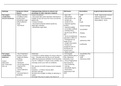
Pathology Symptoms/ clinical Pathophysiology (relevant to anatomy and Risk Factors Interventions Surgical/medical Intervention
features physiology of cardio respiratory symptom)
Post-surgery -Sputum retention General Anesthesia: - Age (≥ 60) - ACBT: - Small / laparoscopic incisions;
complications -Unwilling to deep - Decreased ciliary action (paralyses cilia) leads to - Malnutrition BR - Fluid management;
General Anesthesia breathe (pain) inability to beat and move the mucus secreted by - Obesity (BMI ≥ 27) LTEE - Epidural / local anaesthesia;
-Diminished cough goblet cells - Incision site FET - Keep patients warm.
reflex/ineffective - Drying of airways - Gender (F>M) Cough
cough - Decreased functional residual capacity by - Impaired cognitive
- Sore throat diaphragm relaxation function - Sputum drainage
- Diminished cough reflex - Impaired mobility
- Co-morbid conditions - Auscultation
- Smoking history
- Recent acute URTI or - Shaking
LRTI
- No pre-op pulmonary - Vibrations
education re DBE & IS
- Prolonged pre-op
- pulmonary rehab
length of stay
- Length of procedure
- Presence of -mobilisation
nasogastric tube on
leaving post-op
recovery ward
- History of cancer
Post-surgery - Use of respiratory Atelectasis: - Post-surgical - Auscultation (fine
complications: accessory muscles A complete or partial collapse of a lung or lobe of a Hypoventilation (due to crackles)
Atelectasis - Rapid and shallow lung — develops when the tiny air sacs (alveoli) Pain, Abdominal - ACBT
breathing within the lung become deflated. Part of bronchial Distention, Fear) - Pulmonary rehab
3 types: - cyanosis tree has “collapsed” so alveoli cannot ventilate. Gas - Mucus Plugging/Poor
Obstructive - hypoxemia exchange cannot occur with no ventilation. Chest Clearance
Non- obstructive - Loss of lung volume - Poor Positioning
Post- op - Impaired V/Q FRC: Amount of air left in lungs at end of standard - Scarring
matching breath - Anaesthetic Agents
- Acute respiratory Typically 2 – 2.5 litres in human adult - Poorly-Sited
failure decreases with age Endotracheal Tube
- Increased Work of decreases from upright, to sitting, to side lying, to (ETT)
Breathing supine
the longer they stay in surgery, the chances of
features physiology of cardio respiratory symptom)
Post-surgery -Sputum retention General Anesthesia: - Age (≥ 60) - ACBT: - Small / laparoscopic incisions;
complications -Unwilling to deep - Decreased ciliary action (paralyses cilia) leads to - Malnutrition BR - Fluid management;
General Anesthesia breathe (pain) inability to beat and move the mucus secreted by - Obesity (BMI ≥ 27) LTEE - Epidural / local anaesthesia;
-Diminished cough goblet cells - Incision site FET - Keep patients warm.
reflex/ineffective - Drying of airways - Gender (F>M) Cough
cough - Decreased functional residual capacity by - Impaired cognitive
- Sore throat diaphragm relaxation function - Sputum drainage
- Diminished cough reflex - Impaired mobility
- Co-morbid conditions - Auscultation
- Smoking history
- Recent acute URTI or - Shaking
LRTI
- No pre-op pulmonary - Vibrations
education re DBE & IS
- Prolonged pre-op
- pulmonary rehab
length of stay
- Length of procedure
- Presence of -mobilisation
nasogastric tube on
leaving post-op
recovery ward
- History of cancer
Post-surgery - Use of respiratory Atelectasis: - Post-surgical - Auscultation (fine
complications: accessory muscles A complete or partial collapse of a lung or lobe of a Hypoventilation (due to crackles)
Atelectasis - Rapid and shallow lung — develops when the tiny air sacs (alveoli) Pain, Abdominal - ACBT
breathing within the lung become deflated. Part of bronchial Distention, Fear) - Pulmonary rehab
3 types: - cyanosis tree has “collapsed” so alveoli cannot ventilate. Gas - Mucus Plugging/Poor
Obstructive - hypoxemia exchange cannot occur with no ventilation. Chest Clearance
Non- obstructive - Loss of lung volume - Poor Positioning
Post- op - Impaired V/Q FRC: Amount of air left in lungs at end of standard - Scarring
matching breath - Anaesthetic Agents
- Acute respiratory Typically 2 – 2.5 litres in human adult - Poorly-Sited
failure decreases with age Endotracheal Tube
- Increased Work of decreases from upright, to sitting, to side lying, to (ETT)
Breathing supine
the longer they stay in surgery, the chances of


