Written by students who passed Immediately available after payment Read online or as PDF Wrong document? Swap it for free 4.6 TrustPilot
logo-home
Lecture notes

ENG15o1

Rating
-
Sold
-
Pages
4
Uploaded on
27-12-2022
Written in
2022/2023

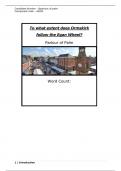
The scene on Mandela Bridge points to the incommensurable: the contrast between the bridge, with its concrete presence, its abundance of symbolic meaning, and its surroundings, conspicuously evacuated of any clear historical meaning. Thinks the narrator, “To my mind, no man should hold the power of life and death over others. But to his mind, there are perhaps compelling reasons to murder strangers in cold blood” (Mohall 2013, 27). This sardonic moral relativism registers the receding of the overarching allegory of freedom fighter redemption and its replacement by an entrepreneurial dog-eat-dog order in which right is purely an expression of force. the narrator’s mugging, on this very icon of aspirational post-apartheid meaning, thus crystallizes the post-revolutionary loss of political focus. Indeed, Mandela Bridge merely foregrounds the loss of the very emancipatory meta-narrative it was intended to embody. It thus marks the end of a post-apartheid form of social cohesion anchored by the shared horror of the TRC and the emergence of an entropic social order. But this is not the last we see of Mandela Bridge. With its symbolic baggage of unity and the notion of a rainbow nation, it becomes a motif of the protagonist’s wanderings through the city, a place from which his disappointed philosophizing finds an anchor. Against the backdrop of Mandela Bridge, a time bearing the imprints of thwarted revolutionary desire. In its juxtaposition with the remnants of futures past, time becomes ruined rather than merely empty. Mandela Bridge, as it is figured in this text, could be considered a concrete, geographically embedded structure of disappointment. In its reverential, melancholic handling of so prominent a piece of urban furniture as Mandela Bridge, Small Things marks its distance from the dominant wave of post-apartheid Johannesburg fiction. It is a text far less invested in imagining forms of the new that might emerge from the debris of the post-apartheid city, less willing to detach itself from the promises of the past. Rather, it is filled with lingering desires and attachments that cannot be severed. This holds, too, at the level of the novel’s central romantic plot. Small Things is a story of disappointment both personal and political: the pallid reality of a democratic South Africa is mirrored by the pallid reality of the narrator’s unrequited passion for Desiree, first ignited in his Sophia town youth, finally consummated two decades later upon the narrator’s release from prison. “Chee” and “Desiree”: the names are signifiers, respectively, of revolutionary desire and the object of that desire. Like the democratic nation that was yearned for, the narrator does eventually attain Desiree. But the anticipated bliss of the narrator’s reunion with his object of desire, after 18 years of imprisonment, is marred by the discovery that he is “courting a stone” (Mohall 2013, 37).

Show more Read less
Institution
Module

Content preview

Section A


Question 1


1.1
That the narrator’s relationship with God is close and has been continuously
over a period of time.


1.2
1.2.1. This phrase alludes to the cross carried by Jesus to his crucifixion. In
the context of the poem it alludes to the pain, suffering that one in the
narrator’s circumstances has to bear, the pain, the sores and isolation of a
Leper. 1.2.2. The general external appearance, the stigma that a Leper
carries.
1.2.3


1.3
1.3.1. With its own sea and its own sadness
1.3.2. The "s" sound often suggests a snake-like quality, implying slyness and
danger. This goes to show the unpleasant, sorrowful circumstances of the
disease.


2.1
The poet refers to his use of the simile “for men like termites will gnaw and tear
at your soul”, the comparison of men to termites is trivial in that men do much
more harm than termites.


2.2
The simile “men like termites” compares men to termites, in that as termites
gnaw and tear at each bite, so do humans to one’s soul through their words
and actions. The simile is effective as it helps the poet clearly illustrates his
message.


3.

This study source was downloaded by 100000836267798 from CourseHero.com on 04-08-2022 15:51:27 GMT -05:00


https://www.coursehero.com/file/84498803/ENG1501-2021-EXAM-SUPPpdf/

Written for

Institution
Module

Document information

Uploaded on
December 27, 2022
Number of pages
4
Written in
2022/2023
Type
Lecture notes
Professor(s)
Prof rogers
Contains
All classes

Subjects

£5.84
Get access to the full document:

Wrong document? Swap it for free Within 14 days of purchase and before downloading, you can choose a different document. You can simply spend the amount again.
Written by students who passed
Immediately available after payment
Read online or as PDF

Get to know the seller
Seller avatar
ProfRogers

Get to know the seller

Seller avatar
ProfRogers Chamberlain College Of Nursing
Follow You need to be logged in order to follow users or courses
Sold
-
Member since
3 year
Number of followers
0
Documents
0
Last sold
-

0.0

0 reviews

5
0
4
0
3
0
2
0
1
0

Trending documents

Recently viewed by you

Why students choose Stuvia

Created by fellow students, verified by reviews

Quality you can trust: written by students who passed their exams and reviewed by others who've used these revision notes.

Didn't get what you expected? Choose another document

No problem! You can straightaway pick a different document that better suits what you're after.

Pay as you like, start learning straight away

No subscription, no commitments. Pay the way you're used to via credit card and download your PDF document instantly.

Student with book image

“Bought, downloaded, and smashed it. It really can be that simple.”

Alisha Student

Frequently asked questions