

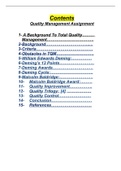
Contents
Quality Management Assignment
1- A Background To Total Quality………
Management……………………………..
2-Background…………………………......
3-Criteria……………………………………
4-Obstacles in TQM……………………….
5-William Edwards Deming:……………
6-Deming’s 13 Points……………………..
7-Deming Awards…………………………
8-Deming Cycle:…………………………..
9-Malcolm Baldridge:…………………….
10- Malcolm Baldridge Award:………
11- Quality Improvement……………..
12- Quality Trilogy: [4] ………………
13- Quality Control……………………
14- Conclusion…………………………
15- References…………………………
, A Background To Total Quality Management
Many businesses nowadays work extremely hard to not just meet but, whenever
possible, surpass their customers' expectations and achieve a high standard of quality.
This can only be accomplished through enhancing product performance, cutting costs,
increasing customer pleasure, and partnering with world-class enterprises. From the
standpoint of the organisation, the quality perspective is extremely important. It is seen
as a vital feature that goes above and beyond what customers anticipate. Total Quality
Management is seen as a zero-error technique for improving the quality of processes
and systems in a business, as are many other approaches to quality maintenance. The
study compares and contrasts the Deming, Juran, and Baldridge TQM models to see
how they approach the pursuit of quality and determines which model is most commonly
applied in real-world settings. Additionally, I talked about how Awards provide thorough
input for additional actions the firm may do to guarantee that it complies with current
quality requirements. My final thoughts on these three models and the lesson I learned.
Background
Total quality management has a conceptual foundation that is based on management
principles. Rite has been widely implemented by many of the top firms in the world ever
since it was first proposed by giants like Deming and Juran. These businesses include
Toyota in Japan and Maruti in India. Many organisations today utilise it as a tool for
creating their goals, which in turn direct their management. This idea seeks to address
several different aspects. It began with monitoring and control and has since expanded
to encompass management commitment, customer satisfaction, process management,
and personnel management, all of which aim to manage the organisation as a whole.
The idea heavily emphasises employee involvement, quick action, fact-based decision-
making, and continual development. Under this idea, product creation occurs in a
conflictual environment where each department is permitted to operate autonomously.
Japan presents the Deming Prize for outstanding quality planning and implementation.
So, it is clear that governments and organisations where these organisations are run
are involved in overall quality management. 2010's "A Few Words About TQM" Due to
changes in organisational structures, many firms now also have a designation for
complete quality management.
Criteria
There are basically seven criteria that are significant in this context. They have been
mentioned as follows:
, Leadership is the first. The success of an organisation is heavily influenced by its
leadership, making this the most crucial factor. Today, most situations require a
situational approach. Also, leadership can be assessed based on the level of
motivation.
Strategic planning is the second component. A company's operations are determined by
the future strategies it expects to employ. This idea serves as the foundation for all
organisational operations, whether short-term and long-term.
Thirdly, the bottom line for the majority of businesses today is now customer and market
focus rather than profit.
In order to move in this direction, information and data analysis are also necessary to
understand the market circumstances. This criterion serves as the foundation for the
company's upcoming product and service advancements.
The next step is human resource management and growth, which is necessary to end
current internal conflicts inside the business and enhance external circumstances as
well.
Process management is the next on the list. Every company engages in highly complex
daily operations. Adequate process management is required. The company's leaders
deal with each of these. To make sure that there are no excuses to go over the time
limit for service delivery, every little prerequisite must be taken care of.
The last factor is business outcomes. One must consider the business response before
judging the calibre of a specific organisation, market, team, or product. The increase in
word-of-mouth advertising for that activity or the increase in gross income are indirectly
related to it.
Obstacles in TQM
The following are the main barriers to overall quality management that have been
mentioned:
The strategic plans, as has been stated numerous times, do not genuinely achieve the
objectives for product quality. Many of a company's best practises are benchmarked in
order to maintain quality, which leads to an insignificant result. Quality considers a lot of
management levels that are difficult to work with within the organisation. Quality
measurement is ineffective and frequently reliant on customers, making it challenging
for a business to define. Additionally, it gets challenging to adopt planning with the
suppliers, making it challenging to establish finest quality. Many times, there are a lot of
teams that do not use cross-functional teams, which limits a high level of quality.
Additionally, it is challenging to hire people with the best attributes because of the
employees' resistance to change. The companies do not have suitable training
programmes due to a lack of resources, which prevents them from providing the clients
with the quality they want. Additionally, the management only rewards employees once
they reach certain milestones, which leads to unhealthy rivalry inside the company and
a decline in quality.
William Edwards Deming:
William Edwards Deming was born in October 14, 1900, his an American statistician,
author, professor, lecturer and consultant, he is well known as the father of the
Japanese post-war industrial revival. In the US Deming was considered by many as the
leading quality guru . His expertise was used during World War II to support the United
Quality Management Assignment
1- A Background To Total Quality………
Management……………………………..
2-Background…………………………......
3-Criteria……………………………………
4-Obstacles in TQM……………………….
5-William Edwards Deming:……………
6-Deming’s 13 Points……………………..
7-Deming Awards…………………………
8-Deming Cycle:…………………………..
9-Malcolm Baldridge:…………………….
10- Malcolm Baldridge Award:………
11- Quality Improvement……………..
12- Quality Trilogy: [4] ………………
13- Quality Control……………………
14- Conclusion…………………………
15- References…………………………
, A Background To Total Quality Management
Many businesses nowadays work extremely hard to not just meet but, whenever
possible, surpass their customers' expectations and achieve a high standard of quality.
This can only be accomplished through enhancing product performance, cutting costs,
increasing customer pleasure, and partnering with world-class enterprises. From the
standpoint of the organisation, the quality perspective is extremely important. It is seen
as a vital feature that goes above and beyond what customers anticipate. Total Quality
Management is seen as a zero-error technique for improving the quality of processes
and systems in a business, as are many other approaches to quality maintenance. The
study compares and contrasts the Deming, Juran, and Baldridge TQM models to see
how they approach the pursuit of quality and determines which model is most commonly
applied in real-world settings. Additionally, I talked about how Awards provide thorough
input for additional actions the firm may do to guarantee that it complies with current
quality requirements. My final thoughts on these three models and the lesson I learned.
Background
Total quality management has a conceptual foundation that is based on management
principles. Rite has been widely implemented by many of the top firms in the world ever
since it was first proposed by giants like Deming and Juran. These businesses include
Toyota in Japan and Maruti in India. Many organisations today utilise it as a tool for
creating their goals, which in turn direct their management. This idea seeks to address
several different aspects. It began with monitoring and control and has since expanded
to encompass management commitment, customer satisfaction, process management,
and personnel management, all of which aim to manage the organisation as a whole.
The idea heavily emphasises employee involvement, quick action, fact-based decision-
making, and continual development. Under this idea, product creation occurs in a
conflictual environment where each department is permitted to operate autonomously.
Japan presents the Deming Prize for outstanding quality planning and implementation.
So, it is clear that governments and organisations where these organisations are run
are involved in overall quality management. 2010's "A Few Words About TQM" Due to
changes in organisational structures, many firms now also have a designation for
complete quality management.
Criteria
There are basically seven criteria that are significant in this context. They have been
mentioned as follows:
, Leadership is the first. The success of an organisation is heavily influenced by its
leadership, making this the most crucial factor. Today, most situations require a
situational approach. Also, leadership can be assessed based on the level of
motivation.
Strategic planning is the second component. A company's operations are determined by
the future strategies it expects to employ. This idea serves as the foundation for all
organisational operations, whether short-term and long-term.
Thirdly, the bottom line for the majority of businesses today is now customer and market
focus rather than profit.
In order to move in this direction, information and data analysis are also necessary to
understand the market circumstances. This criterion serves as the foundation for the
company's upcoming product and service advancements.
The next step is human resource management and growth, which is necessary to end
current internal conflicts inside the business and enhance external circumstances as
well.
Process management is the next on the list. Every company engages in highly complex
daily operations. Adequate process management is required. The company's leaders
deal with each of these. To make sure that there are no excuses to go over the time
limit for service delivery, every little prerequisite must be taken care of.
The last factor is business outcomes. One must consider the business response before
judging the calibre of a specific organisation, market, team, or product. The increase in
word-of-mouth advertising for that activity or the increase in gross income are indirectly
related to it.
Obstacles in TQM
The following are the main barriers to overall quality management that have been
mentioned:
The strategic plans, as has been stated numerous times, do not genuinely achieve the
objectives for product quality. Many of a company's best practises are benchmarked in
order to maintain quality, which leads to an insignificant result. Quality considers a lot of
management levels that are difficult to work with within the organisation. Quality
measurement is ineffective and frequently reliant on customers, making it challenging
for a business to define. Additionally, it gets challenging to adopt planning with the
suppliers, making it challenging to establish finest quality. Many times, there are a lot of
teams that do not use cross-functional teams, which limits a high level of quality.
Additionally, it is challenging to hire people with the best attributes because of the
employees' resistance to change. The companies do not have suitable training
programmes due to a lack of resources, which prevents them from providing the clients
with the quality they want. Additionally, the management only rewards employees once
they reach certain milestones, which leads to unhealthy rivalry inside the company and
a decline in quality.
William Edwards Deming:
William Edwards Deming was born in October 14, 1900, his an American statistician,
author, professor, lecturer and consultant, he is well known as the father of the
Japanese post-war industrial revival. In the US Deming was considered by many as the
leading quality guru . His expertise was used during World War II to support the United


