
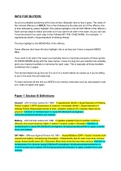
INFO FOR BUYERS:
So you’re probably wondering wtf to look at here. Basically here is how it goes. The name of
the criminal offence is in BOLD, this is then followed by the date and act of the offence, this
is then followed by yellow highlight (The yellow highlight is the ACTUS REUS of the offence.)
Each act has steps to follow and write out if you want to do well in the exam. As you can see
I have structured it so each step is then followed BY THE CASE NAME. For example - V
Apprehends (Smith v Superintendent of Woking Police).
The blue highlight is the MENS REA of the offence.
Some offences dont have the blue highlight, this is as they don’t have a required MENS
REA.
If you want to do well in the exam you basically have to memorise everyone of these quotes
IN THEIR ORDER along with the case names. I know it’s long but your teacher has probably
given you massive booklets to memorise for each case. This is basically all those booklets
condensed into 2 pages.
This format helped me go from an E to an A in a month before my exams so if you’re willing
to put in the work this will really help
To help memorise all this shit you NEED to do memory exercises such as; ask people to test
you, write out again and again.
Paper 1 Section B Definitions
Assault - s39 Criminal Justice Act 1988 - V apprehends (Smith v SuperIntendent of Woking
Police/ Logdon v DPP) Awareness of violence, Immediate (Smith v SuperIntendent of
Woking Police) Reasonable period of time, Unlawful violence (R v Ireland) Need not be
physical, Intention or recklessness to cause AR (Mohan/Cunningham)
Aim/purpose/desire/intention and realises
Battery - s39 Criminal Justice Act 1988 - D applies unlawful force to another (Collins v
Wilcock) Any touch however slight, V doesn’t consent (Latter v Braddell), Intention or
recklessness to cause AR (Mohan/Cunningham) Aim/purpose/desire/Risk to apply unlawful
force and realises
S47 ABH - Offences Against Person Act 1861 - Assault/Battery (DPP v Taylor) Includes both
assault and battery, Occasioning (Causation - White/Smith) But for test/ more than minimal
cause, Actual bodily harm (R v Donavan) More than trivial but less than serious, Intention or
recklessness for common assault (Mohan/Cunningham) Aim/purpose/desire/intention to
commit assault and realises OR Aim/purpose/desire/intention to apply unlawful force and
realises


