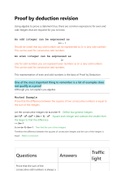
Proof by deduction revision
Using algebra to prove a statement true, there are common expressions for even and
odd integers that are required for you to know.
An odd integer can be expressed as
2m + 1
Should be noted that any odd number can be represented as 2n ± (any odd number)
This can be used for consecutive odd numbers
An even integer can be expressed as
2n
Like for odd numbers you can represent even numbers as 2n ± (any odd number)
This can be used for consecutive odd numbers
This representation of even and odd numbers is the basis of Proof by Deduction
One of the most important thing to remember is a list of examples does
not qualify as a proof
Although you can explain you algebra
Worked Example
Prove that the difference between the squares of two consecutive numbers is equal to
the sum of the integers
Let the consecutive integers be n and n+1 Define two general integers
(n+1)2 - n2 =(n2 + 2m + 1) - n2 Square each integer and subtract the smaller form
the larger to find the difference
=> 2m+1
But n+(n+1)=2m+1 Then find the sum of two integers
Therefore the difference between the squares of consecutive integers and the sum of the integers is
equal Make a conclusion
Traffic
Questions Answers
light
Prove that the sum of the
consecutive odd numbers is always a
Using algebra to prove a statement true, there are common expressions for even and
odd integers that are required for you to know.
An odd integer can be expressed as
2m + 1
Should be noted that any odd number can be represented as 2n ± (any odd number)
This can be used for consecutive odd numbers
An even integer can be expressed as
2n
Like for odd numbers you can represent even numbers as 2n ± (any odd number)
This can be used for consecutive odd numbers
This representation of even and odd numbers is the basis of Proof by Deduction
One of the most important thing to remember is a list of examples does
not qualify as a proof
Although you can explain you algebra
Worked Example
Prove that the difference between the squares of two consecutive numbers is equal to
the sum of the integers
Let the consecutive integers be n and n+1 Define two general integers
(n+1)2 - n2 =(n2 + 2m + 1) - n2 Square each integer and subtract the smaller form
the larger to find the difference
=> 2m+1
But n+(n+1)=2m+1 Then find the sum of two integers
Therefore the difference between the squares of consecutive integers and the sum of the integers is
equal Make a conclusion
Traffic
Questions Answers
light
Prove that the sum of the
consecutive odd numbers is always a